The path to shared prosperity begins with Oregon workers
Sep 07, 2026 | 9:26 am ET
Description
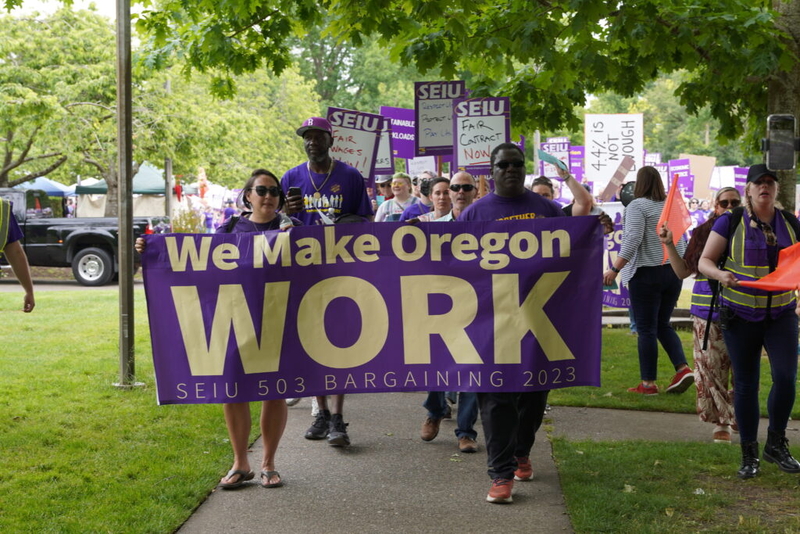
State workers march at a rally at the state Capitol on Thursday, June 8, 2023, in support of better wages. More than 1,000 state workers showed up at a rally, organized by Service Employees International Union 503. (Ben Botkin/Oregon Capital Chronicle)
“I love these patients, but it’s really hard to go home and not be able to provide for your family,” said Dwanna Tarpio, a worker at Serenity Hospice in Eugene. Fed up with wages that didn’t pay enough for the physically and emotionally hard work they perform, Dwanna and her colleagues decided to form a union.
After winning their first union contract this year, their pay and benefits suddenly got a lot better. One Serenity employee saw her pay jump from $29 to $43 an hour, with many workers getting a 33% increase.
The story of Dwanna and her co-workers shows that increasing the economic well-being of Oregonians requires workers having more power in the workplace, through their unions. This rebalance of power would help reduce widespread economic insecurity, build household wealth, and strengthen the communities where workers live.
Research shows that economic insecurity isn’t about individual choices or skills. Rather, it’s the result of efforts by employers and policymakers to undermine the power of workers to demand better wages and working conditions. This weakened leverage has prevented workers from getting their fair share of the gains from rising productivity and profits.
Whether the fruits of the economy are shared broadly depends on who has power. When working people have power in the workplace, the rising tide truly lifts all boats.
This balance of power between workers and employers can have generational consequences. When looking at the typical wealth of unionized workers vs non-unionized workers, workers in unions gain more wealth over their lifetime. One study found that workers covered by a union for most of their careers had a net worth of about $224,000, compared with about $162,000 for workers with no union coverage.
And when retirement and Social Security was included, the difference got even bigger. Workers with long union careers had about $748,000 in total wealth, compared with about $290,000 for workers who were never in a union. Unionized workers also earned more in their careers and were more likely to have other kinds of benefits such as health and retirement.
But power in one’s own workplace isn’t the only thing that matters; the strength of unions in the broader economy mattered as well. Workers who spent their careers in union workplaces gained more wealth when they also worked in industries and regions where unionization was also higher. In essence, workers benefited the most when union power extended beyond their own workplace.
And when workers have more power, all workers benefit, whether or not they belong to a union.
When workers have more power, the minimum wage floor is higher, better protecting the lowest-paid workers. Unions have historically played a role in setting higher minimum wage standards. And indeed, in states with high union density, the minimum wage is more than $4 per hour higher, on average, than in states with low union density.
Unionization also has benefits to household incomes. Researchers have found that high-union density states have median household incomes around $12,300 higher than low-union density states. This means that economic security is not just the product of workforce development, education, or right career choices. Household stability is also shaped by how much collective power workers have in the economy.
That’s why increasing union membership is so vital for improving the well-being of all workers. A recent study considered what would happen if union membership tripled, that is, if union membership climbed to 30 percent of the workforce, a peak not seen since the 1950s. The study concludes that $1.2 trillion more in income would flow annually to workers’ pockets.
To put that in perspective, the typical worker would gain more than $7,700 in annual pay — $270,000 over the course of a career. That could make homeownership possible, or cover the college costs for two children, or help families meet the growing costs of raising children.
Worker power also influences how we fund public services like schools, health care, and public safety. It helps determine whether our tax system treats working families fairly or not. According to one study, in states with higher levels of worker power, the rich contribute more in taxes compared to states with lower levels of union density. Oregon fits this pattern. As a high union density state, it has one of the least regressive tax systems. In other words, the less power workers have, the more that working families foot the bill for public services, while wealthy households avoid paying their fair share.
The evidence is crystal clear. Broadly shared prosperity — an economy where everyone enjoys economic security and a real opportunity to thrive — requires greater worker power. And it requires lawmakers in Washington, D.C., and in Salem removing the obstacles that stand in the way of workers gaining more power.
Salem, OR