‘This is our year’: Will a blue wave swing Pueblo back to Colorado Democrats?
Nov 02, 2026 | 4:40 pm ET
Description
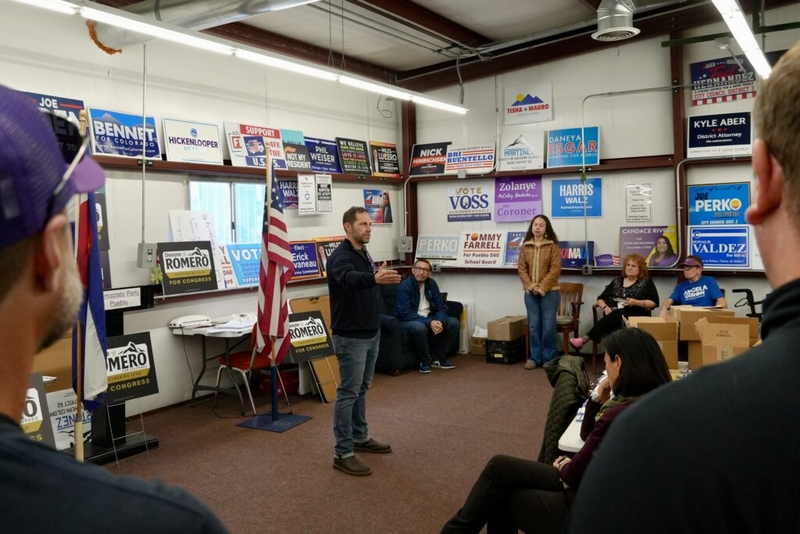
U.S. Rep. Jason Crow, a Democrat from Aurora, speaks at a canvass launch event at the Pueblo County Democratic Party's headquarters on Sunday. (Photo by Chase Woodruff/Colorado Newsline)
The last time Pueblo, Colorado, was represented in Congress by a Democrat — Rep. John Salazar, who served three terms before losing reelection in 2010 — Aaron Gutierrez was a young staffer in Salazar’s Washington, D.C., office.
Now an attorney, father and cancer survivor, Gutierrez is his party’s nominee for a crucial state Senate district centered on Pueblo, and his hometown could be a linchpin in Democrats’ efforts to set a new high-water mark for their recent electoral dominance in the Centennial State.
“This is our year. I think we can do it,” Gutierrez, who faces Republican Dana Charles in the Senate District 3 race, told a small crowd of volunteers inside the Pueblo County Democratic Party’s headquarters on Sunday. “A lot of people have counted out Pueblo because Trump has won here twice … But we know if people actually turn up and vote, we’re going to win.”
Even as Democrats have succeeded over the last decade in painting the former swing state of Colorado a solid shade of blue, Pueblo County has moved in the opposite direction: Once a Democratic stronghold, it’s become one of the state’s top battlegrounds and a national bellwether. In 2016, Donald Trump became the first Republican presidential candidate to carry the county since Richard Nixon in 1972. Joe Biden narrowly swung it back to Democrats four years later, only for Trump to win it again in 2024, by a wider margin than before.
Without Trump’s name on the ballot, the marquee race in Pueblo in the 2026 midterms is the 3rd Congressional District contest between incumbent U.S. Rep. Jeff Hurd, a first-term Republican from Grand Junction, and Democratic challenger Dwayne Romero, an Army veteran and business owner from Aspen.
As polls show voters turning against Republicans over the cost of living, the war in Iran and other issues, Hurd has billed himself as a “voice of independence,” highlighting disagreements with Trump over his denial of disaster aid and a February vote against some of the president’s tariffs. That vote led Trump to briefly pull his endorsement from Hurd and back a primary challenger, before he reversed himself a month later and endorsed Hurd again.
“Doing the right thing in Washington isn’t easy,” Hurd tells voters in an ad airing in the final days of the campaign. “But that’s the job.”
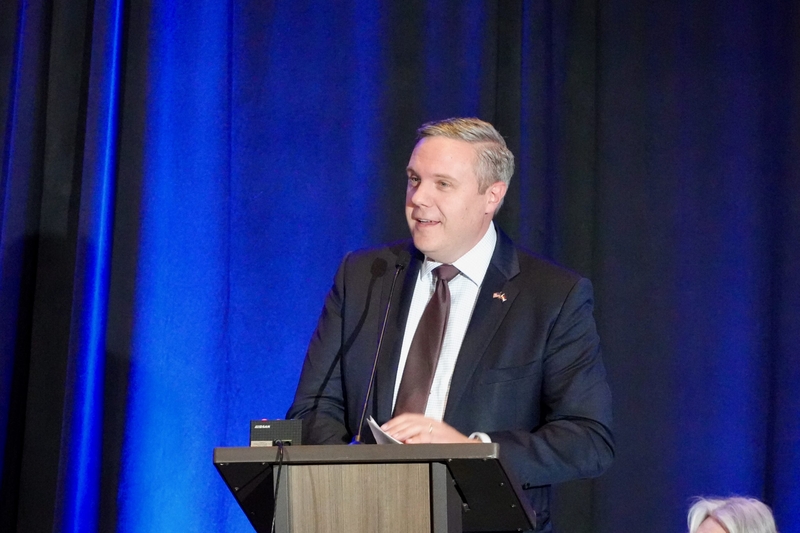
To Democrats, Hurd’s occasional breaks with Trump mean little compared to his votes in favor of Republicans’ 2025 tax and spending law, which included steep cuts to Medicaid, food assistance and other social programs, along with the Iran war and most of the rest of Trump’s domestic and foreign policy agenda.
“Jeff Hurd ran on a campaign of expanding rural access to healthcare, and all of his votes in Congress have done the exact opposite,” Nick Voss, chair of the Pueblo County Democrats, said in an interview. “People aren’t dumb.”
3rd District showdown
“It’s important that we get out there and talk to people, because every vote’s going to count, especially for Dwayne’s race,” Gutierrez told the small crowd of canvassers at party headquarters.
Any Democratic candidate’s hopes of winning the 3rd District hinge on Pueblo, where its largest concentration of Democratic voters is found. Even when he was soundly defeated in the midst of a Republican wave in the 2010 midterms, Salazar carried Pueblo County by more than 14 percentage points. No Democrat has come close to that margin in the last decade.
Pueblo County Republican Chair Michelle Gray said she was busy training volunteers of her own at the party’s headquarters on Monday.
“We’re feeling pretty good as the Republican Party. People want change,” Gray said, but declined an interview until after the election. “We’re in the thick of it.”
Until recently, Hurd and his supporters, including several deep-pocketed Republican super PACs, had massively outspent Romero and Democratic campaign groups in the 3rd District race. Romero — a late recruit for Democrats who only launched his campaign in March — raised and spent $1.1 million and had languished without support from Democratic super PACs.
The lack of investment in the 3rd District race has surprised some Colorado political observers — especially when contrasted with the resources and attention Democratic groups have lavished since last year on the 5th District, where Democratic challenger Jessica Killin, a well-connected D.C. insider, is challenging Rep. Jeff Crank.
In that race, in a district centered on Colorado Springs, Democrats are hoping El Paso County’s palpable leftward shift in recent elections has primed Killin for an upset victory in a district that has never before elected a Democrat to Congress.
Pueblo and Colorado Springs have been on opposite political trajectories — at least in part because of the migration, Voss said, of older and more conservative voters from El Paso County to exurban communities in Pueblo County, like the sprawling Pueblo West development near Lake Pueblo north of town.
While Hurd and Republicans still enjoy a nearly 2-to-1 financial advantage in the race, Romero has benefited from a late infusion of $2.5 million in outside spending on his behalf by the House Majority Project, the main Democratic House super PAC, beginning in the final week of October.
The sprawling 3rd District, which extends from Pueblo across the San Luis Valley and much of Colorado’s Western Slope, can be a difficult place for campaigns to spend money efficiently. It’s split between three different Colorado media markets, complicating TV ad-buying efforts, and field organizing is even more of a challenge.
“As an organizer, you go where population density is,” Voss said. “CD5 is a population-dense area. CD3 is one of if not the largest geographical congressional district in the United States, which makes it very, very hard to put in the miles, to go out there and have the conversations that need to be had.”
A ‘level playing field’
More than any other place in Colorado, Pueblo — a steel town once dubbed “the Pittsburgh of the West,” which has struggled economically since a major contraction in the industry in the 1980s — resembles the Rust Belt communities where Democrats’ electoral fortunes have collapsed in the Trump era.
With a population that’s over 40% Latino, it’s also the kind of community where Trump and Republicans made substantial gains in the 2024 election, raising GOP hopes of a durable new coalition of younger, more diverse and more working-class voters. With polls showing many of those voters having turned sharply against Trump, Democrats are confident they’ll win many of them back on Tuesday.
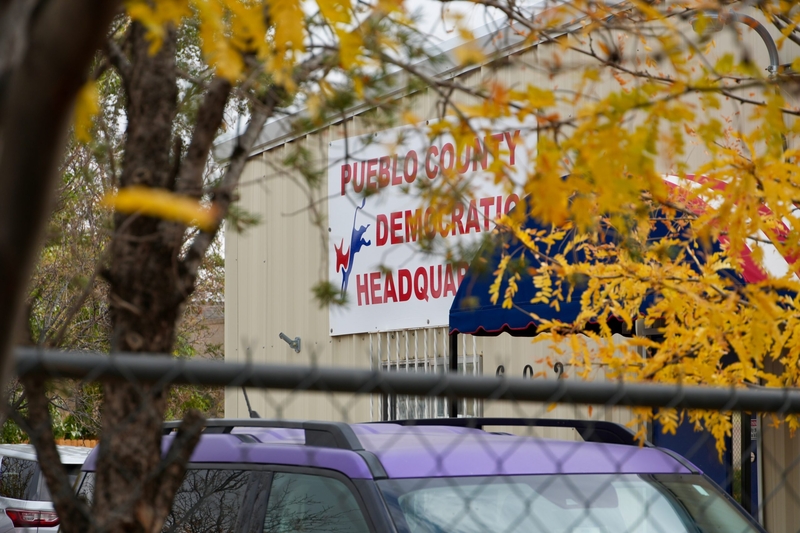
As they prepared to fan out into Pueblo neighborhoods to canvass voters, Democrats joked about the chilly reception they might receive at some doors. One speaker advised volunteers that if they hurried, they could finish before the Broncos game started. As motivation, a field organizer alluded to a statistical model, based on early ballot return data, that showed Romero could be on track to lose the race by as few as 68 votes.
“We are gaining back ground,” said state Rep. Tisha Mauro, who is running for a third term in Pueblo’s House District 46. “We had a couple slips during those Trump years, but we’re bringing it back where it needs to be, as a team.”
U.S. Rep. Jason Crow addressed the group and likened Pueblo to the working-class part of rural Wisconsin where he grew up. An Army veteran like Romero, he said Democrats should appeal to voters who want a “level playing field,” rather than “a handout” or for “anyone to solve our problems for us.”
“That’s why I’m supporting Dwayne Romero, and (county commissioner candidate) Angela (Giron), and Aaron, and Tisha, and the whole group,” Crow said. “Those are the types of Democrats we are. We’re the level-playing-field folks. We want to unrig the system.”
Romero said in an interview that he hopes the 2026 election can “galvanize” the work that Democrats have done to reassert themselves in Pueblo, and “tap into the potential that has always been here.”
“Pueblo has such a great, diverse set of economies and cultures,” Romero said. “It makes a great community, but it’s also a community that needs to tend to staying together. And I believe that’s what I’m seeing.”
Denver, CO