Should Oklahoma lower school class sizes? Educators, experts weigh in.
Nov 02, 2026 | 4:59 pm ET
Description
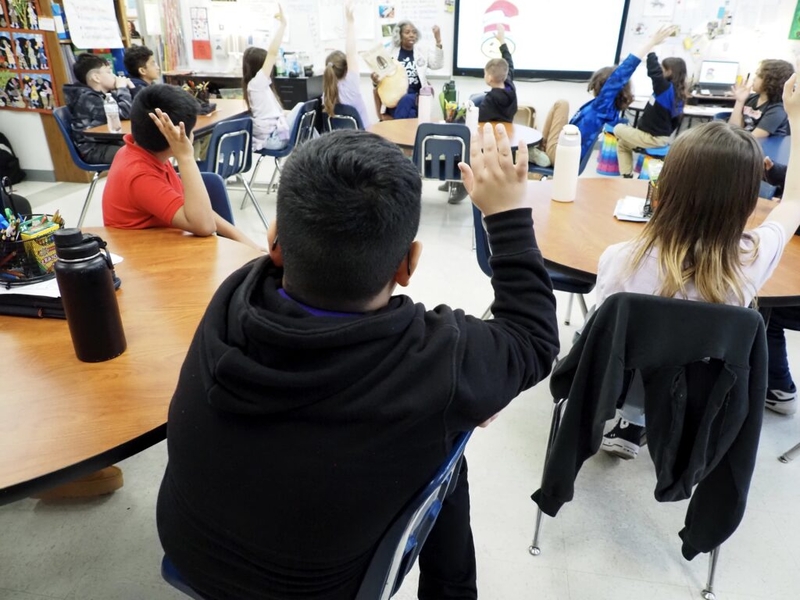
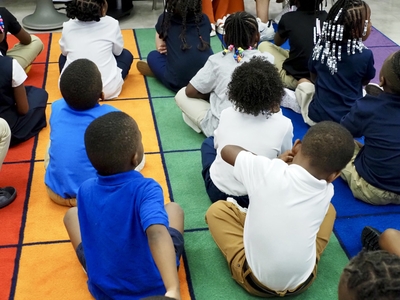
Students raise their hands in a fourth-grade classroom at Cleveland Elementary in Oklahoma City on March 6. (Photo by Nuria Martinez-Keel/Oklahoma Voice)
OKLAHOMA CITY — Having only 18 students last year was “a dream” for Choctaw Elementary teacher Monica Short.
This school year, her roster swelled to 26 fourth graders as a result of redistricting in Choctaw-Nicoma Park Public Schools. Short said she still loves her job, but “it’s hard,” even as an experienced teacher.
“Two weeks ago, I got my 26th student,” Short told state lawmakers last week. “I have always said I felt called to this profession, so I’m like, ‘If the good Lord is going to give me a kid, I’ll take the 27th, and I’m not going to complain about it.’ But I want you to know it is tough. It is tough.”
House legislators heard from experts and educators speak about the impact of class sizes during an interim study last week at the state Capitol.
Last year, Short finished each school day feeling great about what she and her students had accomplished, she said. Now, dedicating one-on-one time to each student, managing classroom behaviors, giving individual feedback on classwork and organizing small-group instruction is more challenging.
The larger the class, “the more difficult it is to have that student success across the board,” she said.
Oklahoma law permits no more than 20 students per classroom at the elementary level, but it allows broad exemptions, said Brent Rowland, executive director of the Oklahoma Appleseed Center for Law and Justice.
For example, districts that have borrowed 85% or more of their bonding capacity are exempt from class size limits, he said. That rule alone would apply to 185 districts, including many of the state’s largest, which educate just under half of all students enrolled in Oklahoma public schools, Oklahoma Appleseed found.
Research is not conclusive on whether lower class sizes lead to better academic results, Rowland said. However, Oklahoma teachers have reported in statewide surveys that large class sizes are one of the top challenges they face, along with disruptive student behavior.
Rowland encouraged state lawmakers to seek out more data, particularly on which districts are using class size exemptions, before making policy decisions.
“Class size, one of the biggest factors in a teacher’s capacity, is regulated here but largely not measured and consistently enforced,” he said during the interim study. “These are not separate problems. Literacy, behavior, teacher capacity all come together in the classroom.”
Choctaw Elementary teacher Susan Johnson said she has 21 third graders in a high-need and high-trauma classroom this year.
One student is reading at an eighth-grade level and another at a kindergarten level, she said. Four of her students have active cases with the Department of Human Services, and two are involved in court proceedings.
“It’s a lot,” Johnson said. “You’re trying to create an environment and have student engagement — meaningful, deep student engagement — with kids that are coming with a lot, and you’re expected to teach them eight subjects every day. Having a complex classroom does impact learning, and you have to really rise to that.”
Rep. Ronny Johns, R-Ada, said he requested the interim study after hearing complaints from teachers in his House district about classroom disruptions and a need for more support.
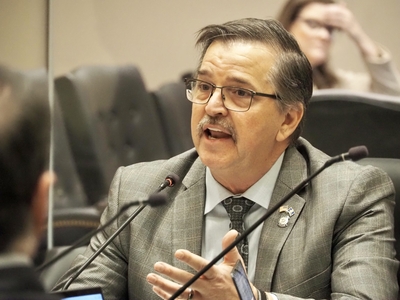
Johns, a former teacher and principal, said class sizes are even more relevant with the state implementing new laws focused on child literacy.
Oklahoma’s Strong Readers Act will require students to repeat third grade if they score below a basic reading level on statewide tests, starting in the 2027-28 academic year. This past spring, 44% of Oklahoma third graders, or 21,100 students, would have been at risk of repeating the grade had the law already been in effect, based on 2025-26 test scores.
Johns said “we’ll see” whether it’s feasible for the Legislature to add more funding to lower class sizes. Providing a strong early education is worth the money, he said.
“It’s about investment,” Johns said after the study. “I get a little aggravated when I hear, ‘Well, we’re just throwing money at education.’ Really, to me, it’s an investment.
“A good third-grade reader is not going to end up in prison. And so we’re either going to invest now, or we’re going to be throwing money in other ways.”
Policymakers should focus more on improving the system of support that surrounds each teacher rather than on the size of that teacher’s class, said Tim Lewis, a professor from the University of Missouri College of Education & Human Development.
Although Lewis acknowledged there’s a class-size “sweet spot” of about 20 students, he said the resources that help teachers provide individualized instruction to students who most need it are even more crucial.
“Spend 99.9% of your time and energy focused on what happens in that classroom and how do we as a state or as a district support that individual teacher,” he told lawmakers during the interim study. “You heard the importance of retaining those highly qualified teachers. They’re going to leave if they’re not successful. They can be successful, but we cannot expect a single teacher to meet and solve this issue.”
Oklahoma City, OK