Oregon DMV won’t reinstate undercover plates for feds, citing potential sanctuary lawsuit
May 26, 2026 | 2:57 pm ET
Description
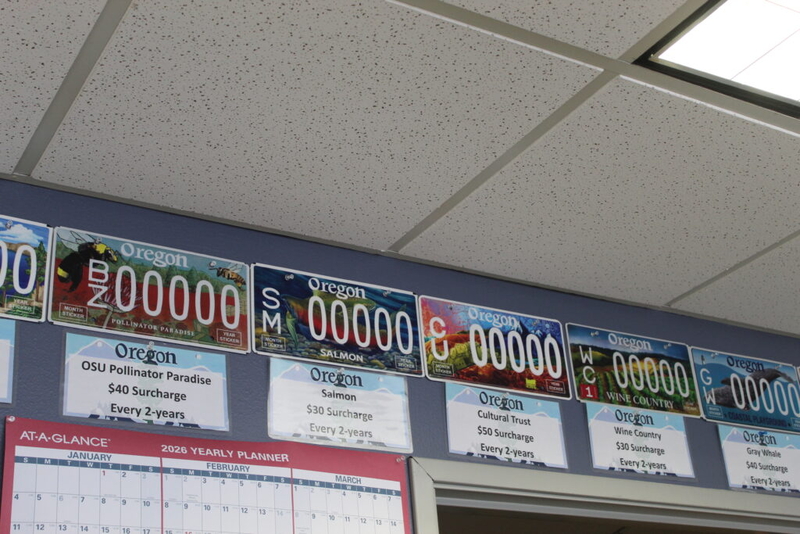
Oregon license plate options are pictured. (Photo by Mia Maldonado/Oregon Capital Chronicle)
Oregon won’t resume issuing undercover state license plates to federal law enforcement agencies, a top Oregon transportation official told the Trump administration late last week.
The Oregon Department of Transportation on April 15 temporarily suspended issuing new undercover license plates to “all federal agencies” in order to ensure its program run by Driver and Motor Vehicle Services complies with state law, agency spokesperson Chris Crabb told the Capital Chronicle last week.
She said the agency was undergoing a review of the program and expected to offer more public findings in the coming weeks following a mid-May legal threat from the Trump administration’s attorneys arguing Oregon’s policy violates the U.S constitution’s supremacy clause. Crabb did not immediately respond to follow-up questions last week about which state laws were in question or whether changes applied to new standard license plates registered by federal officials. But Oregon law has long barred local and state governments and law enforcement from assisting with immigration enforcement without a judicial warrant.
While state law also allows Oregon’s transportation department to issue plates or other evidence of registration for undercover vehicles used by federal, state, local and tribal law enforcement undertaking criminal investigations, the statute does not mention immigration enforcement, which falls under civil law.
But in a Friday letter to the U.S. Department of Justice, DMV Administrator Amy Joyce asserted that Oregon law “permits, but does not require, DMV to issue undercover plates.” State vehicle code explicitly exempts federal vehicles and they are not prohibited from legally driving on Oregon roads, she said.
She added that her agency’s pause on issuing undercover plates was not an intentional move to place federal agents at risk or undermine ongoing criminal investigations, but rather to make sure “issuance of vehicle registrations and license plates to federal agencies fully complies with Oregon law.”
“DMV is committed to ensuring that its exercise of that discretionary authority fully complies with Oregon law. The prospect of litigation in this area is real,” Joyce wrote, pointing to an early May lawsuit against Oregon State Police arguing that the state agency is violating state sanctuary laws through data-sharing agreements with federal law enforcement.
Joyce added: “If the DMV process for issuing undercover plates could be questioned under Oregon law, the state is at risk for additional litigation. And litigation, even if meritless, could result in serious disruption to the process because of judicial intervention.”
Officials with the U.S. Department of Justice did not immediately respond to a request for comment on Tuesday from the Capital Chronicle.
In his earlier letter to Oregon, U.S. Assistant Attorney General Brett Shumate urged Gov. Tina Kotek to order Oregon’s DMV to resume issuing the plates or face a lawsuit, giving her until last week to provide written assurances that the plates would be issued and calling the move “discriminatory” and “unlawful.”
“By refusing to issue standard and undercover license plates to federal agencies, including federal law enforcement agencies, while continuing to issue them to similarly situated state and local agencies without restriction, Oregon’s DMV has directly run afoul of the supremacy clause by discriminating against the federal government,” Shumate wrote.
The dispute between Oregon officials and the federal government comes as federal immigration agents have increasingly used unmarked vehicles during instances of aggressive enforcement in cities across the country, including in Oregon where an influx of more than 100 federal officers made more than 1,100 arrests from September of last year to March, according to estimates from federal immigration authorities. It also comes as Democratic-led states have sparred with the Trump administration over how best to respond to the actions of those agents when they act outside the scope of their authority, with some district attorneys in Colorado and Minnesota pursuing criminal prosecutions.
In her letter, Joyce left the door open to further policy changes from the transportation department.
“The DMV may have to engage in rule making to ensure the undercover vehicle registration program complies with all statutory authority,” she wrote. “The DMV is willing to provide an update or status report to you as it works to ensure it is acting in full compliance with Oregon law.”
Salem, OR