Feds agree to decide on endangered species protections for Crater Lake newt by October
May 26, 2026 | 3:31 pm ET
Description
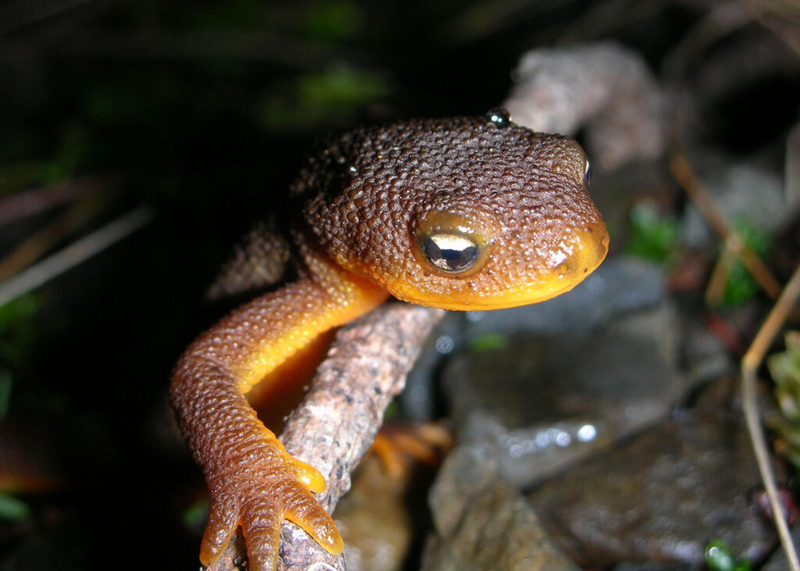
The Crater Lake newt, or Mazama newt, pictured here is endemic to Crater Lake in southern Oregon. The population has plummeted in recent decades due to predation from crayfish that were first introduced in the late 1800s, and whose numbers have exploded as the lake's temperature rises due to climate change. (Photo courtesy of the Oregon Department of Fish and Wildlife)
An imperiled newt only found in and around southern Oregon’s Crater Lake may soon be protected under the Endangered Species Act following a three-year legal battle.
The U.S. Fish and Wildlife Service agreed in a recent settlement with the nonprofit conservation group Center for Biological Diversity to decide by October whether to list the Crater Lake newt, also known as the Mazama newt, on the federal endangered list and to invest in its survival.
The Center first petitioned the agency to list the species in 2023, and agency officials in response agreed the newts might qualify for protections. But the agency missed the legal deadline to undertake research and make a decision by November 2024, leading the Center to sue.
“It’s extremely frustrating that in the midst of a global extinction crisis it still takes a lawsuit to get animals like the Crater Lake newt the help they need,” said Chelsea Stewart-Fusek, an endangered species attorney at the Center.
The small yellow and dark orange newts are a subspecies of rough-skinned newt that, up until about 150 years ago, lacked any predators and did not adapt to defend themselves from predation. But in the late 1800s, fish were introduced to Crater Lake to attract visitors and several decades later, managers of what would become by 1902 Crater Lake National Park introduced signal crayfish as food for the lake’s burgeoning fish population.
Both the fish and the crayfish began preying on the newts. As lake temperatures have warmed in recent decades due to climate change, the population of crayfish in and along the lake has exploded. They now occupy more than 95% of the lake’s shoreline, according to Center for Biological Diversity officials, and a 2024 survey by National Park Service biologists at dozens of sampling sites around the lake detected just 13 newts, down from 35 detected in a survey a year earlier.
The newts haven’t yet been added to Oregon’s Threatened and Endangered Species List run by the state Fish and Wildlife Department but are listed as “sensitive” with a determination pending.
If listed on the federal Endangered Species List in October, it could be the first listing by the U.S. Fish and Wildlife Service in more than a year, and the first species listed during President Donald Trump’s second term. Under Trump, federal wildlife agencies have listed fewer vulnerable species for protection than any other presidential administration since Congress passed the Endangered Species Act in 1974.
A backlog of roughly 400 species await a federal listing decision.
“Nearly half of the world’s amphibians are at risk of extinction, and three out of five salamander and newt species are at risk. Meanwhile, the Trump administration is busy cutting funding to the agencies we rely on to protect our public lands and wildlife while doing everything it can to appease industry,” Stewart-Fusek said.
The U.S. Fish and Wildlife Service has lost nearly 20% of its staff in the last year to buyouts, early retirements and other Trump administration policies meant to cut the federal workforce, according to records requested from Biological Diversity.
Salem, OR