OPINION: Nebraska fixed part of the school funding problem. But can it fix the new one it created?
Aug 26, 2026 | 6:45 am ET

Description
Two students walk the halls at a former Omaha Public Schools elementary school building that has been replaced. (Aaron Sanderford/Nebraska Examiner)
Between 2022 and 2025, Nebraska’s school funding system underwent a major shift. After decades of lagging near the bottom nationally in state support for local classrooms, the state significantly stepped up its financial investment.
Yet, much of this new money bypassed the state’s primary school funding formula, known as the Tax Equity and Educational Opportunities Support Act (TEEOSA). By funneling money outside this established system, Nebraska has created two competing school-aid models. One purports to distribute cash based on a district’s local needs and resources, while the other provides flat-rate foundation aid and tax credits. This parallel track has successfully thrown a financial lifeline to rural schools, but it leaves lawmakers with a messy question: Can these two conflicting approaches be welded into a single, fair system?
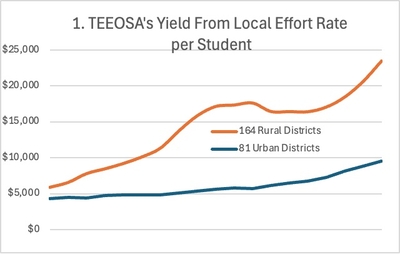
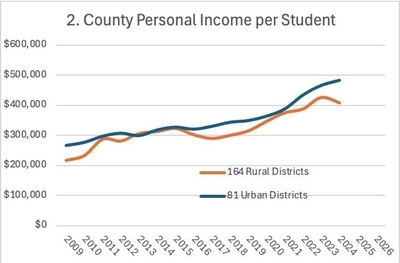
Rural schools have historically been shortchanged by the TEEOSA formula. TEEOSA is meant to step in with state tax dollars only when a school district’s local needs outweigh its ability to support itself from local property taxes. But as farmland values surged over the last two decades, the formula made rural communities look incredibly wealthy on paper, even if residents were not income rich (see Charts 1 and 2).
The numbers show the damage. From 2008 to 2023, state aid to schools in Nebraska’s 75 rural counties dropped from $2,800 to $1,900 per student; when adjusted for inflation it was cut by more than half. Meanwhile, per-student funding for larger, urban school districts grew modestly, eventually reaching more than double the amount per student received by rural schools.
To boost state support for schools, Nebraska began bypassing the broken formula in 2023. Lawmakers instead issued flat per-student payments, known as foundation aid, and offered property tax credits that benefited farm real estate and non-equalized districts more than others.
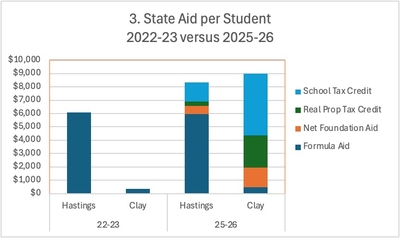
Schools in Clay County, where I live, and nearby Hastings Public Schools illustrate this dual system at work. Clay County’s three small districts, with enrollments of 180 to 440 students, depend heavily on a farmland property base. Hastings, a much larger district with more than 3,200 students, relies primarily on a residential property base.
In just a few years, the funding landscape flipped (see Chart 3). Clay County schools went from receiving a fraction of state aid per student than Hastings, to receiving significantly more. Today, flat-rate foundation aid and tax credits make up the bulk of Clay County schools’ state funding. Hastings, conversely, still relies largely on traditional TEEOSA equalization aid.
This is not an isolated occurrence – it’s happening statewide. Districts that receive the least under the old state formula now get the most from the new outside funding channels, and vice versa.
During the last legislative session, senators considered folding these outside funding streams into a modernized TEEOSA formula. The proposal would have lowered the weight given to farmland valuations and distributed tax credits and foundation aid through the main formula. Larger urban school representatives opposed the change, largely because they questioned whether the proposed lower weighting for farmland was justified.
The issue will likely return to the Unicameral floor next year. Nebraska has made undeniable progress by injecting more state money into education and easing local property taxes, a burden that has historically weighed heaviest on rural areas. Now, lawmakers must decide if they will fix the core formula to better reflect a community’s actual ability-to-pay, or continue running two separate, conflicting funding systems.
Why the new funding tools favor non-equalized, mostly rural districts
- Real Property Tax Credit: Farm real estate receives a larger credit than other property types, directing more relief to rural districts, which are largely non-equalized.
- School Tax Credit: Funds are allocated according to each district’s share of total school property taxes levied. Because rural schools depend more heavily on property taxes, they have a larger share of taxes levied and, therefore, receive a larger share of the available funding.
- Foundation Aid: Non-equalized districts received the full $1,500 per student, while part of this aid to equalized districts is offset with lower equalization aid.
Lincoln, NE