We’ve got ‘historic flooding’ and tornadoes. Is this climate change?
Aug 26, 2026 | 5:00 am ET
Description
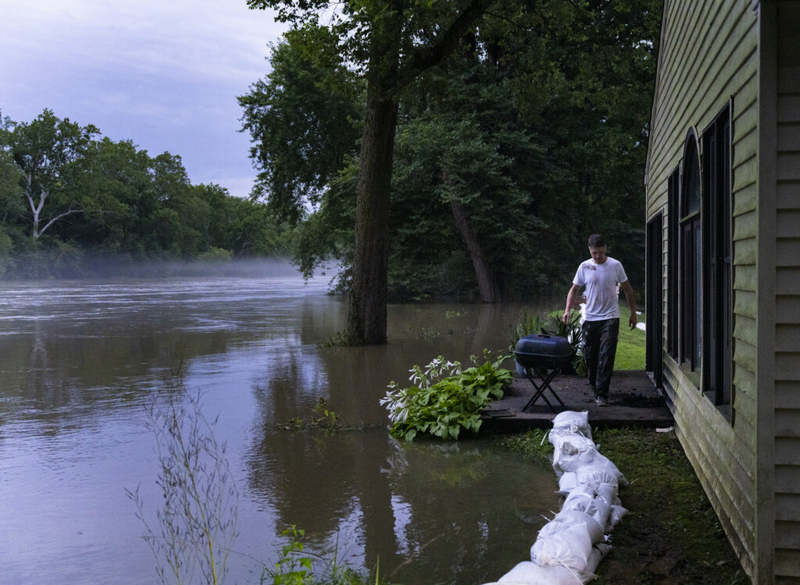
People work to place sandbags to stop floodwaters from the White River from entering the Indianapolis neighborhood of Rocky Ripple on Aug. 15, 2026. (Photo by Brett Phelps/Mirror Indy/CatchLight Local/Report for America)
Storms and tornadoes ravaged our state this month, killing at least seven people. In Hamilton County, the White River surged to a record 24 feet above normal levels, tearing up roads and bridges and destroying homes, sending families fleeing in the dark of the night.
Local meteorologists kept us abreast of the news, warning Hoosiers when they needed to get to high ground or shelter in their basements or bathtubs. The immediacy and accuracy of those reports is job No. 1 for them, and weather emergencies are the top reason that people turn on local TV news.
Given this recent spate of extreme weather, I thought we would also be hearing more from meteorologists about the impacts of climate change. But I was wrong.
While they cover the weather extensively, meteorologists don’t usually address climate change. It’s a weighty issue to unpack in short news segments. But ignoring the patterns during weather emergencies is a problem for Indy residents as we experience them on a more regular basis.
A news consumer who attended one of my recent Indy Public Editor events asked: To what extent is climate change (and other environmental issues) on the radar of the local press?
I reached out to several local meteorologists and was surprised to discover that they do not want to discuss climate change — with me or on the air. When I asked the leaders at several stations for interviews, they all declined.
So I sought out journalists who specialize in covering climate change and a representative from the professional association of meteorologists, and I figured out why.
Both politics and logistics keep climate out of the mouths of local meteorologists
Alan Sealls is the president of the American Meteorological Society. He’s been a meteorologist for close to 40 years.
Meteorologists focus on what the weather is going to do today and tomorrow and maybe next week, he told me. Many of them don’t view the role that climate change plays in our weather as a crucial piece of information when trying to tell people what’s going to happen today. Also, logistically, it’s hard to fit climate change into a two- or three-minute segment, Sealls said.
Sealls said not every meteorologist avoids the topic. Some “see the link” between weather and climate and want to educate their viewers, so they weave it into their weather reports. “It also depends on who your station owner is and what their somewhat political perspective is, as we’ve seen where TV stations have had their licenses threatened in a sense because of what they broadcast or who was on their airwaves.”

As he’s traveled the country, Sealls said he finds that more meteorologists avoid climate change for logistical reasons, rather than out of the fear of retribution from their boss or the audience. However, the current presidential administration’s habit of characterizing climate change as something that’s not real and shouldn’t be talked about is also a deterrent, Sealls said.
Elena González agrees with Sealls that meteorologists in the U.S. are mostly avoiding climate change coverage because of time constraints. She is a journalist and engagement manager for Covering Climate Now, a global organization that trains journalists and newsrooms on how best to report on climate change.
Columbia Journalism Review and The Nation magazine founded Covering Climate Now in association with the Guardian and WNYC, a public radio station in New York City. Over the past two years alone, the organization has trained about 400 journalists in the U.S. and Canada and is expanding into Latin America and other parts of the world.
“If you have four heat waves in a row, and you are not telling that temperatures are intimately linked to climate change – it’s the most clear example – you are not telling your audience the whole story,” González said.
In addition to fearing federal regulatory pressure, some meteorologists worry the audience will tune out if they hear their weather person talking about climate change.
Both Sealls and González say that the actual number of climate deniers in any audience is relatively small but that they can be noisy. According to Yale Climate Opinion Maps, only 15% of people say that climate change is not happening.
The staff at Covering Climate Now understand many meteorologists avoid climate coverage in their forecast because they don’t want to be rejected by their audience. “But they are not aware that, again, the deniers are a very small proportion,” González said.
What makes for good local climate coverage
Quality climate coverage doesn’t just intersect with weather. Instead, it pops up in multiple beats, including health, sports, social justice and the economy, experts say.
“It has to be relevant, it has to be understandable, and, ideally, it needs to be local, where people can literally say, ‘Oh, I’ve seen that; I’ve felt that; I’ve experienced that,’” Sealls said.
Covering Climate Now has its own formula for good reporting, a three-pillars approach that focuses on humanizing stories, making them relevant to the local community and pointing toward solutions.
“We need to try to cover the impacts that are actually affecting our communities and not talking about sad polar bears and shrinking icebergs,” González said. “This is the image that we have, and some editors also have when they are pitched a story about climate change.”
To localize a story, reporters must know how climate change impacts their communities and what their audience is interested in, she said.
“The Midwest has been seeing more tornadoes,” Sealls said. “It’s been seeing more straight-line windstorms recently. So these are all things that people can definitely relate to because it’s not the way it was decades ago.”
Sealls points to agriculture and economic stories, like this one by local WISH-TV, which notes that rising temperatures are causing financial hardship for area farms as good entry points for reporting on climate change.
Beyond the weather report: where to find good climate coverage in Indy
Mirror Indy’s westside neighborhood reporter, Enrique Saenz, directly addressed the issue in an Aug. 6 story he co-wrote with his colleagues. They talked to several state government officials who tied the recent storms to climate change and climate scientists explained that this could be the new normal.
Saenz regularly cites the Indiana Climate Change Impacts Assessment as well. Researchers tap into that database to see how, for example, temperatures and precipitation have changed since the late 1800s.
“I try to use that information to explain why certain changes that have been observed by scientists, like more frequent heavy rain events, are happening,” he said. Saenz was a founding journalist for the Indiana Environmental Reporter. This story about floods, droughts, and heat domes is an example of that reporting for Mirror Indy, which he wrote with fellow reporters Darian Benson and Elizabeth Gabriel.
WFYI also zeroes in on what is happening at the local level.
“We don’t think about it as a do-or-don’t issue,” said WFYI news director Sarah Neal-Estes. “When climate change is the news, we report it. Right now we are reporting an in-depth piece on Tornado Alley expanding and the increase of tornado activity in Indiana.”
She said the station’s nonpartisan service is to cover significant weather pattern shifts, scientific explanations, leaders’ and residents’ perspectives and economic impacts. The news director doesn’t see the station’s reporting as controversial from any angle.
IndyStar’s Karl Schneider covers the environmental beat and Sophie Hartley has the environment and natural resources beat for the newspaper. Both have reported on the link between climate change and extreme weather events, or attribution science.
“Referencing climate change in an article depends on how strong that connection is and how pertinent it might be for our readers’ understanding of the topic,” Schneider said. “This could mean a quick sentence or two, or a full section with broader context.”
Hartley said that readers told the paper that some of the stories that resonated the most with them were the ones that affected residents’ backyards. For example, this story about how changing weather patterns are impacting Indiana’s maple syrup makers.
Other IndyStar climate stories include:
- Warming trends and recent flooding
- National Weather Service in Indiana’s reporting on the frequency of flash floods
- The turbulent tornado season
- Frustrations of local homeowners considering the cost of adding flood insurance
“The topic does stir up controversy when government officials craft policy around climate change, but it is our job as journalists to continue to provide a nonpartisan framework for our reporting,” Schneider said.
We need climate change stories to help us stay informed
As a concerned news consumer, unless you read content from a beat reporter like Schneider, you might have to hunt to find coverage that will help you understand how the changing climate is going to change our region. Expect local meteorologists to continue to document forecast records and extreme weather, but not say much about the cause.
Beyond the weather forecast, especially in the days following such events, look to other beat reporters to fill in the details on community preparedness and accountability.
Are officials insisting on sewer and utility infrastructure improvements that will withstand harsher weather? Do our governments have a plan for the future? Are there things that the government should do in the future? Because science says that these extreme weather events will happen again.
Local TV stations are missing a key opportunity to include information about climate change in stories when the weather is going wild. That’s when the audience is paying the closest attention and looking for immediate advice, as well as guidance on how to better prepare in the future. Reporting on historical weather records is skimming the surface of a larger story. Additional context educates viewers.
“If you don’t link the dots, if you don’t put together the whole story; it’s just to say this is another record,” said González. “It means nothing to me.”

Indianapolis, IN