Operator of Alaska North Slope oil field hit by a second fine for gas flaring
Oct 19, 2026 | 5:07 pm ET
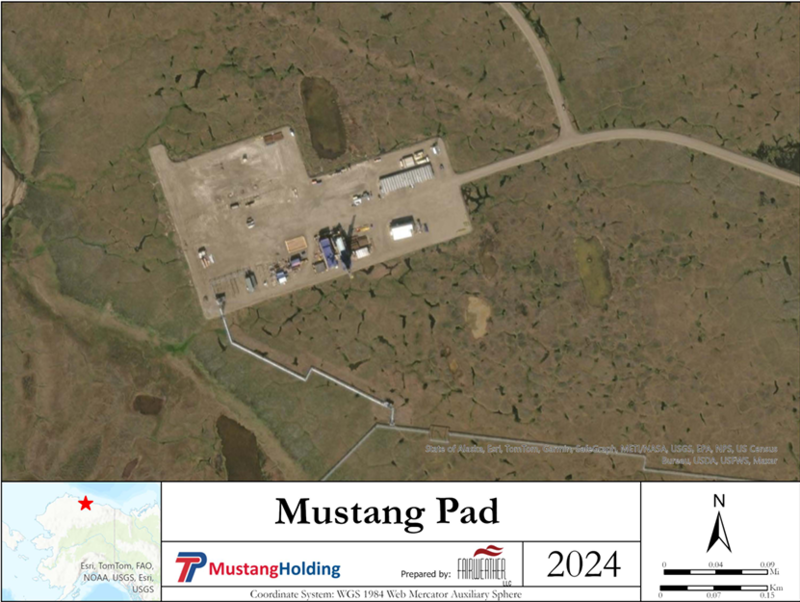
Description
An aerial view of the Mustang pad in the Southern Miluveach Unit on the North Slope is seen in a 2024 application from Mustang Holding LLC to the Alaska Division of Oil and Gas for permission to do certain pipeline maintenance and assessment tasks. The Alaska Oil and Gas Conservation Commission has issued a second order finding unit operator Mustang Holding at fault for unauthorized natural gas flaring. (Image provided by Alaska Division of Oil and Gas)
A small energy company that was assessed a hefty fine in July for what regulators said was five months of illegal natural gas flaring on the North Slope was cited again for another four months of gas flaring.
The Alaska Oil and Gas Conservation Commission, in an order issued Friday, assessed a $195,214 fine against Mustang Holding LLC, the operator of the Southern Miluveach Unit on the western side of the North Slope. It comes after a $741,520 fine for a similar infraction this summer.
The latest assessed fine equals double the fair market value of natural gas illegally flared at the field from April to July of this year, the AOGCC said in its order. That calculation is in accordance with state law.
In an earlier enforcement action, the AOGCC, which regulates oilfield practices, assessed a fine for gas flaring that occurred at the field from November 2025 to last March.
Gas flaring — the burning of unused gas — is allowed in Alaska for safety reasons and for early development of an oil or gas well, though only with state permission. Outside of those parameters, flaring is considered a waste of state-owned resources.
The commission had granted Mustang Holding permission to flare gas for an initial 180-day well-testing period, then granted extensions that ran through October of 2025. But after that, the AOGCC said, Mustang Holding did not have authorization to flare gas.
Continued flaring after the expiration of an authorization violates state law concerning proper oil field engineering practices and the conservation of natural resources, the AOGCC order said.
“The AOGCC further finds that the continued flaring was knowing and intentional,” the order said.
Mustang Holding’s head of operations, Muammer Alboamemah, said the company contends that it remained in a test period during the entire time covered by the two AOGCC orders and was therefore allowed to flare.
“The facility overall was not in the state of regular production, so all the equipment required for gas injection, such as dehydration units, compressors, processing equipment was not commissioned at that time,” he said.
Since then, the company has put “a lot of capital investment” into the project, installed equipment and, as of late September, has been injecting natural gas rather than flaring it, Alboamemah said.
Additionally, the volume of flared natural gas that is the subject of the two AOGCC enforcement actions is small, he said. It amounts to only about 9% of the total volume that the commission had permitted the company to flare during the designated testing period, he said.
Mustang Holding is contesting the fine assessed in July, Alboamemah said. He declined to say whether the second fine will be contested, but the AOGCC order provides a month-long window for an appeal to be filed.
A hearing to consider Mustang Holding’s defense against the fine assessed in July had been scheduled for Oct. 20. However, that has been postponed, said AOGCC Special Assistant Samantha Coldiron. A new hearing date has yet to be selected, she said.
The Southern Miluveach Unit, located just west of the ConocoPhillips-operated Kuparuk River Unit, has had a troubled history. It has had ownership changes and financial problems that prompted a 2021 foreclosure on the property by the Alaska Industrial Development and Export Authority.
That foreclosure happened after Brooks Range Petroleum, a previous developer, defaulted on an AIDEA loan. The foreclosure made AIDEA the owner of Mustang Holding LLC, the state-approved operator, until a company called Finnex LLC acquired it in 2023. Finnex is owned by Houston-based Thyssen Petroleum USA.
Mustang Holding was cited by the AOGCC for two other violations prior to the gas-flaring enforcement action, according to commission records.
An Aug. 29, 2024, order said the company violated state law by changing a well-drilling procedure without regulators’ authorization. The proposed fine for that violation was $50,000. Earlier this year, the AOGCC cited Mustang Holding for reporting lapses, and the April 20 order issued by the commission proposed a fine of $30,000.
Juneau