One of Utah’s hottest Democratic races shows how far left voters are willing to go
Jun 29, 2026 | 7:03 am ET
Description
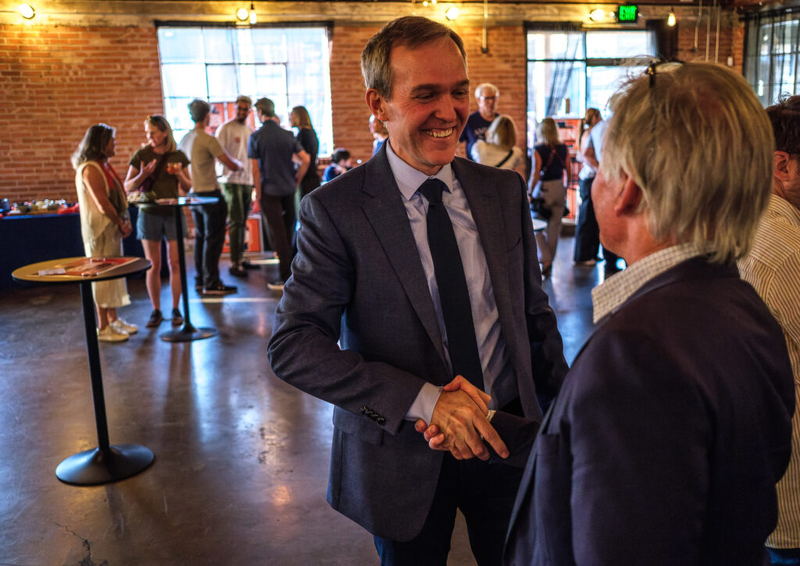
Congressional candidate Ben McAdams speaks with reporters at his campaign's primary election watch party in Salt Lake City on Tuesday, June 23, 2026. (Photo by Marco Lozzi for Utah News Dispatch)
The primary race for Utah’s 1st Congressional District sparked unprecedented energy among Democrats with a new blue-leaning district and a crowded race. The results may reflect how further left Utah Democrats are willing to go.
Ben McAdams, who during his time representing Utah in the U.S. House was labeled one of the most conservative Democrats in the chamber, is poised to win by far the party’s spot on the ballot for the district. Even adding up all the votes for his challengers, who ran on more progressive platforms, McAdams would have secured his victory with 52% of votes.
However, pundits say, in deep red Utah, there’s a little nuance to those numbers, and that’s because Democratic primaries are open to all voters in the area regardless of their party affiliation. Of the 7,500 people who requested a mail-in Democratic ballot, about 6,700 lived in the 1st Congressional District.
“That’s a big deal because they likely voted for Ben McAdams,” said Frank Pignanelli, a political adviser at Foxley & Pignanelli and a former Democratic lawmaker. “Now, Ben did very well, as he should have. He’s well financed. He’s a good candidate. He did well. But he owes a lot also to the Republicans and the independents who crossed the ballot, crossed to the Democratic ballot, to vote.”
McAdams leads on primary election night in Utah’s new blue U.S. House district
A lot of races in Utah are decided in primaries thanks to the strong political inclinations in most areas. And for the first time in decades, there was a congressional map that didn’t split the vote in Salt Lake County, the densest area in the state that usually favors national Democratic candidates.
In 2020, the last time there was a competitive primary for the Democratic presidential nomination, Salt Lake County voters went left, with Bernie Sanders gathering 38.5% of votes, followed by Joe Biden, who got 17.3% of support. But, this year, with the open primary and multiple factors at stake, the needle moved more to the center.
The progressive vote was split between three candidates; Nate Blouin, who was second to McAdams with 27.5% of votes; Liban Mohamed, who won at the Democratic nominating convention and got 16.4% of votes in the primary, and Michael Farrell, who gathered almost 4%. All together, according to unofficial results, they had 27,000 votes.
That’s still less than the 29,500 votes McAdams received. However, according to Pignanelli, subtracting the 6,700 non-Democrats who participated in the primary and who likely voted for McAdams, “then all of the sudden it gets a little closer,” he said.
“If then you look at the numbers in the primary, you look at the numbers in convention, you look at the enthusiasm for Bernie Sanders, you know, it may not be a majority, but it’s a substantial minority of left-wing progressives in Salt Lake County,” Pignanelli said.
But, with Utah being a “fairly moderate place,” progressive candidates have a set of challenges that extend beyond name recognition and fundraising, Pignanelli said.
“They were going to have a hard time selling their agenda, and so even though they did well, if you want to look at the percentage, they got over 40%, I would still say it’s a moderate place here,” Pignanelli said. “And it was going to be difficult for them to unseat Ben. The only way that I think they could have unseated Ben is if Ben made a mistake. And Ben didn’t.”
However, for Brian King, chair of the Utah Democratic Party, guessing who those non-Democrats voted for would be engaging in speculation.
“Is their strategy to vote for the candidate that they would prefer, because they don’t want the most progressive, they want the more moderate, or ‘pragmatic’ candidate, as they perceive it?” King said, “or is their philosophy, and they’re thinking, ‘I want to go in and throw a wrench into the works by voting for the candidate who I think is going to have the hardest time in a general election?’”
During this cycle, King has heard “a handful of people” say they are interested in closing the Democratic primaries. If the state central committee chooses so, the party can evaluate that possibility. But there are no plans to explore that option aggressively at this point, he said.
As for what type of candidate Salt Lake Democrats are more likely to back, King says that the numbers seen on election night speak for themselves.
“But the problem is we don’t know where (McAdams’) competitors’ votes would have gone if it had been just one progressive candidate, and who that progressive candidate would have been,” King said.
Turnout was not overwhelming for such a hot race
There was a lot of energy around the CD1 race. However, that did not translate into a substantial turnout increase in Salt Lake County.
Preliminary numbers from the Salt Lake County Clerk’s office show that there has been similar or better turnout in past primaries, so the short answer is no.
The 2024 primary, for example, had an almost 38% turnout, just one point less than the 39% voting officials have registered so far in 2026. In 2022, the last midterm primaries in the state, Salt Lake County’s voter turnout was 44%.
But, Salt Lake County Clerk Lannie Chapman had never seen such a high volume of requests to participate in an open primary, she said.
“To put that into context, during the 2022 primary, we only received 1,300 requests to participate in the Democratic primary, so the 7,500 number really knocks it for the park,” Chapman said.
Salt Lake City, UT