One group has stayed mostly mum on Bo French’s racist post — Texas’ oil and gas industry
Sep 17, 2026 | 6:59 pm ET
Description
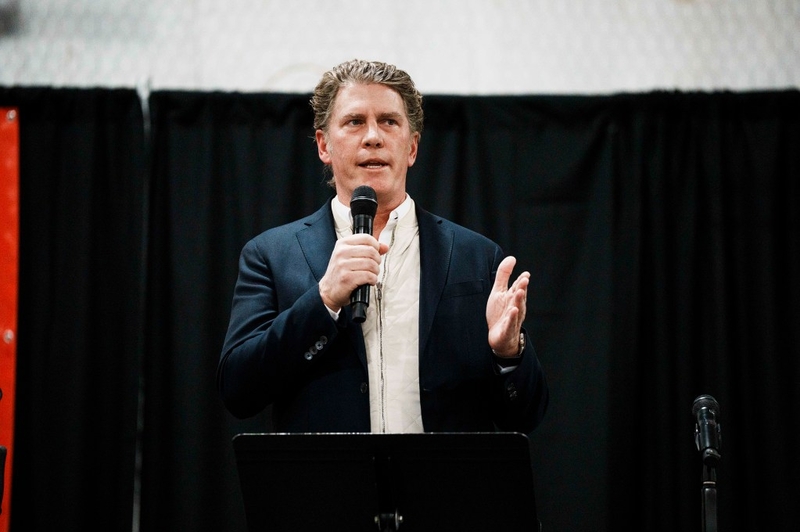
Bo French,Republican nominee for the Texas Railroad Commission, answers a question during a Texas Republican candidate forum at the Civic Center in Canton on Jan. 17, 2026. (Emil T. Lippe for The Texas Tribune)
Bo French, the rabble-rousing candidate for the Texas Railroad Commission, drew national attention this week for singling out a group of students of South Asian descent at a Longhorns game in a racist social media post, thrusting the little-understood regulatory agency into the spotlight.
The post elicited impassioned reactions from the GOP, including U.S. Sen. John Cornyn and former Bush-era presidential adviser Karl Rove, who told a members-only club in Austin that he was voting for the Democrat in the race. French, a far-right Republican, has a long history of inflammatory online comments against Jews, Muslims, Native Americans, South Asian Americans and the LGBTQ+ community.
Yet as Republican leaders publicly decry French’s comments, the oil and gas industry — the very one French would be tasked with regulating — has largely remained silent since the controversy erupted.
The Texas Tribune asked the state’s largest energy companies, including ExxonMobil, Chevron and Occidental Petroleum, about French’s post through media request forms, emails, and phone calls. None responded.
The Texas Oil and Gas Association’s Political Action Committee, which represents the industry in political matters, endorsed French just days before his most recent social media musings. The group later condemned those posts.
“TXOGA PAC unequivocally and without reservation condemns the recent tweet posted September 13th on X by Bo French,” said Todd Staples, treasurer of the Texas Oil and Gas Association Good Government Committee. “Respect is a cornerstone of our industry’s core values.”
French was not TXOGA’s initial preferred candidate. In the spring, TXOGA endorsed incumbent Jim Wright — and gave him about $100,000. Exxon also donated $20,000. Several of the company’s executives also donated tens of thousands of dollars. Diamondback Energy’s PAC and Chevron Employees PAC gave Wright $10,000 each.
The next round of campaign finance reports in early October will show whether oil companies have given French money.
French is “toxic in so many different ways that the oil and natural gas industry does not want to be openly associated with him,” said Mark Jones, a political science fellow at Rice University’s Baker Institute for Public Policy.
French did not respond to requests for comment.
Associating with French and his polarizing online outbursts could imperil business operations and workforce relations, political scientists said, since most major oil and gas companies based in Texas do business in the Middle East and employ South Asian workers — groups that have been repeat targets of French. And publicly backing French could be tantamount to aligning with his views.
“PAC contributions are employee-contributed dollars,” said Nancy Sims, a political scientist at the University of Houston. “They have to be conscious of that.”
French policy proposals still unclear
The Railroad Commission, one of the oldest agencies in Texas, has no involvement in immigration policy, governing the state’s universities or LGBTQ+ issues. Rather, the 135-year-old regulatory body oversees scores of energy issues, from drilling and mining to pipelines. This year, the Railroad Commission was granted the authority to permit carbon capture injection underground. Regulators oversee inactive and orphan oil and gas wells, an expensive infrastructure endeavor, and they govern the underground injection and flow of oil and gas wastewater, known as produced water. It manages a half-billion-dollar budget.
The Permian Basin in West Texas is crucial to the nation’s stockpile, supplying nearly half of U.S. oil in 2025, which experts said helped stabilize skyrocketing demand driven by the Iran war.
For years, the industry has supported candidates — all Republicans — for office who align with its views and policy goals. Companies have deployed their vast financial wealth to boost industry-friendly candidates, long the subject of criticism from watchdog groups and observers. It has been decades since a Democrat held a seat at the Railroad Commission.
But French has complicated things for the industry. Scarcely has he debated these issues at length or expressed policy proposals he believes need improving. A review of his social media, where French is most active, found no evidence of policy discussions, such as the elimination of the public comment period from the agency’s open meetings.
French, instead, regularly comments on federal immigration policy and matters involving the LGBTQ+ community. At the March Conservative Political Action Conference, he called for the deportation of 100 million people, roughly a third of the U.S. population, and suggested the government should deport Native Americans.
On the policy issues French has proposed, such as redirecting money the agency has spent on diversity initiatives to address orphan oil and gas wells, he has not explained how he would implement them.
Only recently has he changed the content on his campaign website to reflect new priorities, including lowering gas and energy costs. However, he hasn’t elaborated on how he would pursue that agenda, only suggesting that high prices are the result of environmental policy.
“When radical environmentalists try to regulate Oil and Gas out of existence, it is a direct threat on your house and home,” his website says. “Bo will push for policies that will expand oil and gas production, and make life more affordable in Texas.”
And despite promising to slash regulations and unleash fossil fuel production — drilling in Texas has reached all-time highs for at least six years in a row, including under a Democratic administration — he has yet to win big oil over.
“Industry actors care less about ideological alignment on national culture war issues than about regulatory expertise, predictability, and policy outcomes that are gonna fall under the agency’s jurisdiction,” said Kimi King, a political science professor at the University of North Texas. “That may be why they’re kind of clawing back a little bit.”
Oil executives have donated. Miles Boldrick, a Midland executive and owner of Statewide Minerals Co., has donated tens of thousands of dollars this year. Luke Dunn, an executive at CrownQuest Operating and son of oil magnate Tim Dunn, gave him at least $50,000. Alex Williamson, who is listed as president of ANW Minerals, has donated at least $50,000.
The Tribune was unable to reach Dunn, Boldrick, or Williamson by phone.
Major oil and gas companies with vast portfolios in Texas have yet to follow suit, like they did with Railroad Commissioner Jim Wright, who did earn their support.
French’s primary benefactor is the Texas Freedom Fund for the Advancement of Justice, a PAC supported by oil tycoons Tim Dunn and Farris Wilks, which has donated nearly half a million in cash and spent $300,000 on ads.
Rosenthal’s long path to November
Experts cautioned against likening a lack of support for French to a boon for Rosenthal, a former oil and gas engineer of more than two decades and a four-term state representative in Houston.
Rosenthal’s campaign has addressed issues the industry has grappled with, including orphan oil and gas wells and industrial wastewater injection underground. He has adopted a more moderate message regarding oil and gas companies, which he said acknowledges the contributions they have made to Texas, such as a surplus of energy and billions in taxes the state benefits from.
“I don’t know how many people out there have ever met what I call a ‘drill baby drill’ Democrat, but I think that makes me different from some other people in my party,” he said. “From that perspective, it’s an opportunity to highlight that and maybe dispel some of the negative narrative that surrounds our industry. It’s also an opportunity for me personally to dispel the negative narrative. That’s around Democrats sometimes, where people just want to claim that Democrats want to destroy the oil and gas industry.”
That will not translate to, or guarantee, industry backing, experts said. Jones, the political scientist at the Baker Institute, said if Rosenthal is elected, he could use his elevated rank to raise concerns that may cause discomfort to oil companies, even though he would be outmatched 2-1.
“The last thing the industry wants is a fox in the henhouse, and that’s a Democrat on the Railroad Commission,” said Jones.
Disclosure: Nancy Sims and University of Houston have been financial supporters of The Texas Tribune within the past five years. The Texas Tribune is a nonprofit, nonpartisan news organization that is funded in part by donations from members, foundations and corporate sponsors. Financial supporters play no role in our journalism. Find a complete list of them and more information about our financial and disclosure policies here.
Austin, TX