Oklahoma tribal leadership fight puts Kalshi’s prediction markets at center of dispute
Oct 28, 2026 | 1:03 pm ET
Description
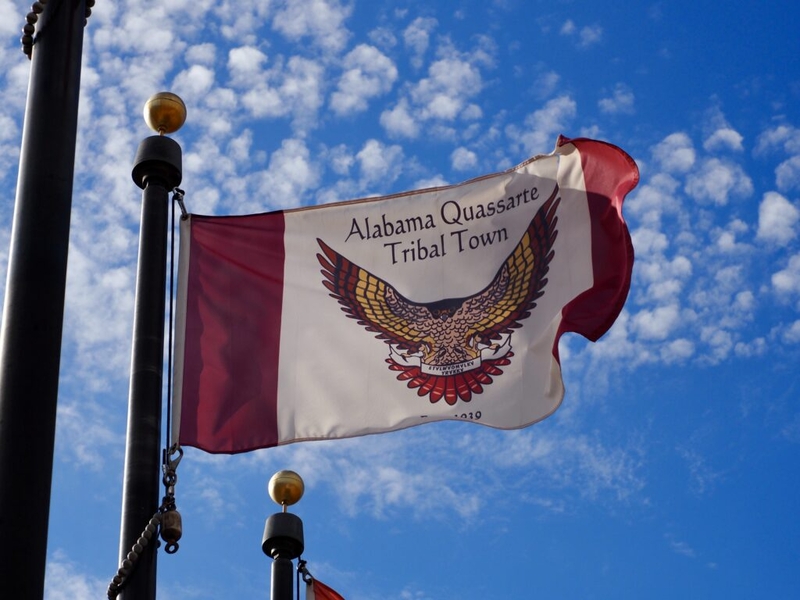
The Alabama-Quassarte Tribal Town's flag flies Oct. 27, 2026 at the Indian Flag Plaza outside the state Capitol in Oklahoma City. (Photo by Emma Murphy/Oklahoma Voice)
OKLAHOMA CITY — A potentially high-paying deal between a major prediction market operator and a small, Oklahoma-based tribe may be in jeopardy amid a yearslong internal fight over who is the legitimate tribal chief.
The dispute over who is the Alabama-Quassarte Tribal Town chief has thrown the validity of an agreement with Kalshi – one of the nation’s best-known operators of prediction gaming markets – into question and raised the possibility of litigation over whether it is legal.
In October, the Alabama-Quassarte Tribal Town became one of the first Native American tribes in the country to enter into a highly touted agreement with Kalshi.
The deal entered into by Wilson Yargee, who claims he is the tribe’s chief, allows the tribe to create PokkeTrades, an app that lets users tap into Kalshi’s prediction markets. Supporters say it will help the nearly 400-member tribe to profit from the fast-growing prediction market sector, which allows people to wager on pretty much anything from the outcome of sporting events to political races to the weather.
Election results were not publicly available, but Yargee’s administration provided a letter dated April 30, 2025, and addressed to the federal Bureau of Indian Affairs that claims he was elected.
But Samuel Marshall Jr., who also claims he is chief of the Alabama-Quassarte Tribal Town, said Yargee did not have the authority to enter into the agreement. Marshall said Yargee was removed from office months after his election in 2021 and has been falsely presenting himself as chief since then, something his administration has also said in court records.
Marshall said he was appointed by the tribe’s governing committee a month after Yargee’s removal. Marshall said he won election as chief in 2025.
Prediction markets ‘undermine’ Oklahoma tribal gaming compacts, association says
“My main focus, still to this day, is to serve and provide our members what they need,” Marshall said. “With all this stuff going on, they’re not getting that help. So as far as that, you know, I’m just trying to keep my focus on our people and let our lawyers handle everything.”
Marshall and his administration said they’ve never seen a contract or agreement with Kalshi. They said they first learned of the agreement after it was made public. They plan to file a suit to stop the agreement. They also do not know what will be done with the revenue PokkeTrades is supposed to generate for the tribe’s benefit.
Yargee, though, contends that his removal was not legitimate and that he was within his rights to forge an agreement with Kalshi. He also said he was reelected in 2025.
While the Kalshi contract hasn’t yet resulted in revenue for the town, Yargee said, any money earned have to go through the tribe’s economic development authority.
“So now we’re here, and we did our business with Kalshi and we made a deal with them,” Yargee said. “And it was a great, lucrative deal, too, for our little tribe at this time.”
Caught in the middle of this dispute, Kalshi said it stands by its agreement with Yargee and his administration.
Jacki McGavick, a Kalshi spokesperson, said in a statement that there is a signed agreement in place that was approved by the tribal council of the Alabama-Quassarte Tribal Town, headquartered in Wetumka, about 90 miles southwest of Oklahoma City.
Neither Kalshi nor Yargee’s administration were willing to provide a copy of their agreement to Oklahoma Voice.
Litigation, federal agencies don’t clarify chief question
Court records show the dispute over who is the rightful chief has been going on for years. There have been at least three lawsuits concerning the town’s leadership.
A case between the two factions in the Muscogee (Creek) Nation District Court was dismissed in 2022 because of a lack of jurisdiction. Only Marshall’s administration, not Yargee’s, had waived their right to sovereign immunity to allow the court to hear the case, according to court records.
The Alabama Quassarte Tribal Town’s enrolled members hold dual citizenship at the Muscogee (Creek) Nation. The tribe was one of several, called tribal towns, that were part of what was previously known as the Muscogee Nation Confederacy.
In the U.S. District Court for the Eastern District of Oklahoma, Judge Ronald White ruled in 2023 that the federal court also had no jurisdiction over the tribal dispute and dismissed the Marshall group’s lawsuit against Yargee and his administration.
In a case filed to determine which faction should have access to the tribal town’s bank accounts, a judge in Okmulgee County in December ruled that Yargee’s administration was not the rightful custodian of the disputed bank account. Judge Pandee Ramirez wrote that the court was not deciding who the legitimate chief was. That was the role of the town’s solicitor, Ramirez wrote in the final order.
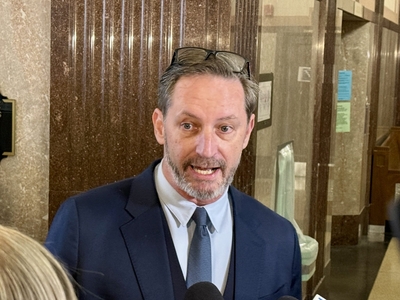
Robert Gifford, an Oklahoma attorney who specializes in Native American law and has served as a tribal court judge, said leadership disputes like this are more common in small tribal towns.
He said changes in power in smaller tribal governments often result in total turnover of tribal employees, which creates struggles with historical knowledge and continuity within the governments.
“Most of the tribes are pretty intimate within itself,” he said. “Everybody knows everybody. Everybody’s related to everybody.”
Gifford said while each tribal government is different, usually an agreement like the one with Kalshi would need to be approved by the tribe’s legislative body.
“The only way that it can be resolved, unless it’s resolved at the lowest level or someone just gives up, is you have to litigate it,” Gifford said.
Litigation must start in tribal courts, he said.
The Bureau of Indian Affairs, or BIA, prefers to see disputes like this resolved internally, Gifford said.
“The BIA will not and does not want to get involved with tribal politics,” he said. “So BIA overall does not try to get in and decide who the elected leader is, and they are very resistant to it and they rarely want to voice an opinion on it.”
Gifford said the same goes for the Muscogee (Creek) Nation which usually does not want to “be the one that decides these internal fights.”
The Bureau of Indian Affairs lists both Yargee and Marshall as chief in their tribal leaders directory with the caveat that the town’s leadership is subject to dispute.
A spokesperson for the federal agency said the Department of the Interior, which houses the Bureau of Indian Affairs, honors tribal sovereignty and supports tribal self-determination, which limits its legal authority to intervene in disputes like this one.
Kalshi deal exposes tension with state gaming compacts
The Oklahoma Indian Gaming Association also got involved, backing Marshall’s position against the prediction markets.
The association, a nonprofit that represents Oklahoma tribes that operate gambling enterprises, had previously said that prediction markets infringed on the tribes’ exclusive gaming rights. Matthew Morgan, who chairs the group, did not return messages seeking comment for this story.
The association includes 25 member tribes. Tribal gambling generates more than $7 billion annually, a portion of which is paid to the state for the exclusive right to offer casino-style gambling through approved compacts.
But Michael Stopp, who said he worked on the Kalshi agreement with Yargee, said the Bureau of Indian Affairs did involve itself in the dispute. Stopp is a citizen of the Cherokee Nation who serves as Yargee’s vice president of economic development.
Stopp said the Bureau of Indian Affairs involved itself by acknowledging a leadership dispute when he said the actions of Marshall’s group were not legitimate under tribal law.
He said PokkeTrades, which is being developed by a business under the tribal town’s jurisdiction, will essentially connect people to the Kalshi platform. This allows smaller tribes like Alabama-Quassarte to access a new revenue stream, Stopp said.
The decision of what this revenue will fund is up to the town’s leadership, like Yargee and the governing committee, and will be made later, he said.
“What the prediction markets do, because of the internet, allows smaller tribes who don’t have access to gaming markets access to the global market through prediction markets,” he said. “And quite frankly, it is not gaming, it is a financial service.”
Prediction markets are currently regulated by the federal Commodity Futures Trading Commission, but many states and the gambling industry dispute that authority. Many industry leaders do not consider prediction markets gambling.
Stopp said while he recognizes why the Oklahoma Indian Gaming Association has concerns about prediction markets, tribes like the Alabama-Quassarte still have a voice.
“What is wrong with them continuing to explore other economic opportunities like prediction markets?” he said.
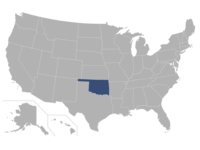
Oklahoma City, OK