Ohio Senate GOP moves to give wealthiest Ohioans tax cut
Jun 05, 2025 | 4:55 am ET
Description
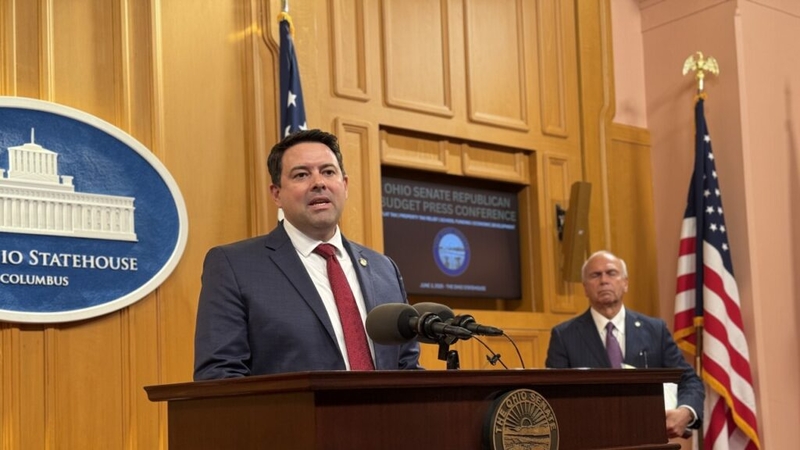
Senate President Rob McColley, R-Napoleon, speaks at the Ohio Senate Republican Budget Press Conference. Sen. Jerry Cirino, R-Kirtland, the chair of the Senate Finance Committee, stands in the background.
Photo: Morgan Trau, WEWS
Ohio Republican senators have proposed a flat income tax for the state’s top earners, which would result in a projected $1 billion loss in the general revenue fund.
Bailey Williams is like the average Ohioan — earning less than six figures a year. According to census data, the median income in the state is about $68,000. He’s worried about the Senate’s newly proposed state budget.
“The services that made me who I am today, public education made me who I am today. I worry about those opportunities being there for my younger siblings,” Williams said.
He is also a researcher with the nonpartisan organization Policy Matters Ohio and is evaluating a budget provision — one that creates a flat income tax of 2.75%.
There are three income tax brackets in Ohio. Those making up to $26,000 do not need to pay state income tax. Ohioans earning between $26,000 and $100,000 pay a tax of 2.75%. Those making more than $100,000 have to pay 3.5%.
Senate President Rob McColley (R-Napoleon) said that the highest earners in the state will have their income tax payment reduced to 2.75%.
“Every tax cut we do in the future will involve every single person equally, on a percentage basis,” McColley said.
State data reveals that this could result in a loss of about $1.1 billion in the General Revenue Fund.
How would Ohio make up the deficit from the tax?
“One of two ways,” Williams said. “We’re going to see increases in regressive taxes, most likely the sales tax, or we have to make do with less — less government services.”
Many cuts for programs that benefit lower-income families have already been proposed in the budget. Funding for schools, Medicaid, libraries, lead abatement, food banks and child care face funding decreases from the current status or from the governor’s budget.
When McColley was asked how he defends cuts to Medicaid, lead poisoning prevention and child care while allowing a lower tax rate for wealthier Ohioans, he said the “growth in Medicaid spending has been exponential.”
According to the Legislative Service Commission, a nonpartisan agency that works with the legislature, the proposed budget would result in a 4% decrease in spending, with billions of dollars in cuts.
He said that there was already an “awful lot” of lead program funding and said that they were keeping child care the same as before. However, the budget would cut the governor’s proposal of offering Publicly Funded Child Care to families earning up to 160% of the federal poverty level, keeping it at the current 145% threshold.
“No multimillionaire needs a $10,000 tax cut bankrolled by cutting lead abatement or Medicaid,” Williams said.
McColley said the elimination of 11% of the state’s income tax revenue would not actually impact funding because he predicts companies will move to Ohio to take advantage of that lower tax rate.
“A lower tax burden has had a positive economic development and brought more jobs to the state,” McColley said. “It’s brought more investment in the state.”
The budget will continue to be heard, and a final version will need to be agreed upon by the Senate and House by the end of June.
Click here to learn more about the House’s passed budget.
Follow WEWS statehouse reporter Morgan Trau on Twitter and Facebook.
This article was originally published on News5Cleveland.com and is published in the Ohio Capital Journal under a content-sharing agreement. Unlike other OCJ articles, it is not available for free republication by other news outlets as it is owned by WEWS in Cleveland.
Columbus, OH