Note to the Ohio legislature: Many school districts are in fiscal trouble.
Sep 17, 2026 | 3:30 am ET
Description
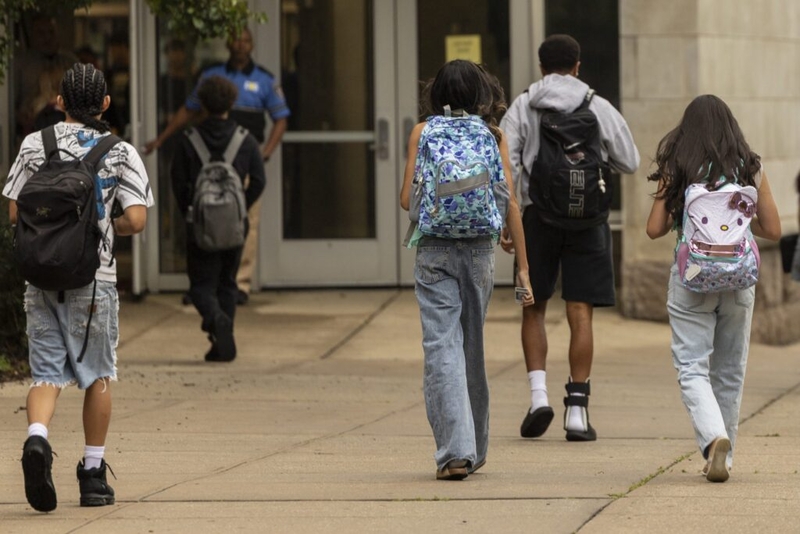
Students head into a high school on the first day of classes. (Photo by Anne-Marie Caruso, States Newsroom.)
Pass the word folks. The Ohio legislature is in recess.
Whew. That’s got to be good news. Maybe this entity hell-bent on wrecking public education can use the recess time for some needed reflection amid the havoc they’ve wreaked on Ohio schools.
While some researchers believe the observation that “No man’s life, liberty, or property are safe while the legislature is in session” is wrongly attributed to Mark Twain, the quotation does sum up strong feelings about how public education has been weakened by the denizens who work part-time at Broad & High Sts. in Columbus.
But weakened might not be the right word choice to describe the current state of public education. Alas, we should be thankful that legislators work part-time.
The extent of that damage to the public’s schools is manifold and can be traced back to 1997, when the original charter school legislation was enacted as a “pilot program” centered on Lucas County.
What is it about pilot programs created by the Ohio legislature that seem to be on autopilot as they continually expand, whether they are needed or not?
The history of the growth of educational vouchers has followed the same pattern, where today there is no income cap on eligibility for tuition support at the state’s private and religious schools.
Enough is too much.
It’s past time for the legislature to hit the pause button.
Indeed, the moment has arrived when the legislature and its leadership must face the stark reality that in the next FY2026-FY2027 budget, the bill for charters and universal vouchers combined is approaching $4 billion, with the various voucher programs alone representing $2.4 billion of the total.
With this amount of scare resources being redirected from the state budget, the public is seeing the strain, as more than 120 school districts — 20% of the state total — have been forced to trim their budgets to address the declining amount of state support for public education.
A look at a few statements made by the legislative leadership provides insight into how the state entered into such a situation affecting essential services, particularly public education, and the mindset that blames public schools for being mired in fiscal troubles.
Here are two examples.
Ohio House Speaker Matt Huffman, a major cheerleader for educational vouchers to fund non-public schools, made a statement in 2025 that contradicts the clear intent of the state’s foundational document.
“The Ohio Constitution is unique. It’s the only state constitution in the United States that requires the funding of religious education by the state,” he claimed.
Never mind that the constitution in Article VI, Section 2 states in part that “… no religious or other sect, or sects, shall ever have any exclusive right to, or control of, any part of the school funds of this state.”
Another example of the legislature’s anti-public education mindset comes from Ohio Senate Education Committee Chair Andrew Brenner, another long-time foe of public education.
In addition to taking campaign contributions from a notorious charter school operator, Brenner is famously known for his 2014 remark that public schools are a form of “socialism.”
Recently, Brenner gained notice for asserting that rural schools are struggling “because urban school systems [are] spending too much money inefficiently.”
That was an all-too-obvious deflection from the real issue — the strain on the state budget caused by the unconstitutional diversion of billions of public funds to support private and religious schools through the universal voucher program.
But Huffman and Brenner are merely the most prominent representatives of Republican school privatization zealots.
Their allies are ever ready to tow the party line when it comes to ignoring the needs of public education while they also ignore the clear language of the state constitution in its declaration that no school funds shall be controlled by sectarian schools, which constitute about 70% of the 1,300 private schools in the state.
While Brenner lost renomination in the May primary and will not be returning for a new term in January, he still has an opportunity along with Huffman and the Republican caucus to reflect on the damage inflicted on public education and consider some remedies that can be advanced during the session to be convened after the November elections.
These two suggestions will certainly not address the fiscal crisis facing public education but are offered as suggestions to initiate a soul-searching discussion in the new legislature about repairing the foundational damage to public education.
Instead, these proposals will address a flaw in state law regarding the qualifications of charter school governing board members as well as needed curriculum enhancement to respond to positive student personal development.
These ideas are considered first-steps in a repair process for public education as well as a test for the legislature to begin acting in good faith to address the damage done to the state’s public schools as part of its privatization initiatives.
Character Education. Brenner is known for his promotion of cursive writing for inclusion in the state’s language arts model curriculum in 2019.
Today, in the present national political climate of gerrymandering, shrill and dishonest speech by elected officials, including false claims of widespread voter fraud and disrespect for recent immigrants, we encourage Brenner and his colleagues to sponsor legislation that incorporates the elements of caring, honesty, integrity, respect, trustworthiness, and citizenship into state curriculum models.
These traits are elements of the Six Pillars of Character, as defined by Character Counts, a national organization centered on positive youth development.
Sadly, our scandal-prone current national leadership has made the topic of positive character development in youth to be a major imperative for incorporation in those “socialist” public schools Brenner disdains.
We would expect that character education and positive youth development would be as important on Brenner’s Senate education committee agenda as cursive writing was seven years ago.
Citizenship. How ironic that citizenship is listed as a pillar of character.
As defined by Character Counts, citizenship involves staying informed, protecting the environment, working to improve your home, school, and community, and protecting the rights and safety of others through good choices and positive action.
An added dimension of citizenship is being a “qualified voter.”
The Ohio School Boards Association defines a qualified voter as an individual who is eligible to run for office and serve as a member of a school district board of education.
Unfortunately, Ohio law does not require a charter school governing board member to be a “qualified voter,” viz., a U.S. citizen, yet these entities are referred to as “public charter schools.”
We suggest that the legislative leadership immediately act to ensure that charter school governing board members are qualified voters, citizens of the United States, as required for elected school board members.
After all, proponents pointedly refer to these entities as “public” charter schools, supported by public funds.
How is it that the Republican Party, the champion of charter schools and enabler of Donald Trump’s aggressive immigration and deportation policies, not in favor of requiring charter school governing board members to be American citizens?
Why shouldn’t the requirements for any “public” charter school board member be the same as those for a public school district board member, viz., a qualified voter?
Surely, these requirements for charter school board members might inject a more positive image for these mostly unregulated entities that are publicly funded but privately managed.
For example, our neighbors Michigan and West Virginia have specific citizenship and residency requirements for charter school governing boards, and Brenner should make such legislation a fast-track priority in the final days of his legislative tenure and in light of continuing concerns about charter school governance and accountability.
With these two specific suggestions for action, we look for a signal from the legislative leadership during recess about the importance of character education in our schools as well as requiring charter school board members to be qualified voters who hold citizenship status, an idea that even Donald Trump would probably not oppose.
Members of the Ohio General Assembly, what say ye, what say ye all?
It’s time for all members to consider their legacies during the last legislative session and act proactively in this time of national upheaval.
P.S. Mark Twain also did not say that “Politicians are like diapers, they need to be changed often and for the same reasons.”
Columbus, OH