From immigration to voting to education, the pointed politics of the deep freeze
Sep 16, 2026 | 4:52 pm ET
Description
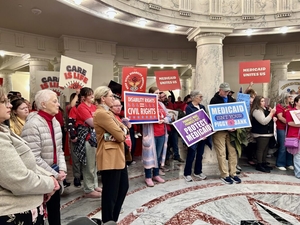
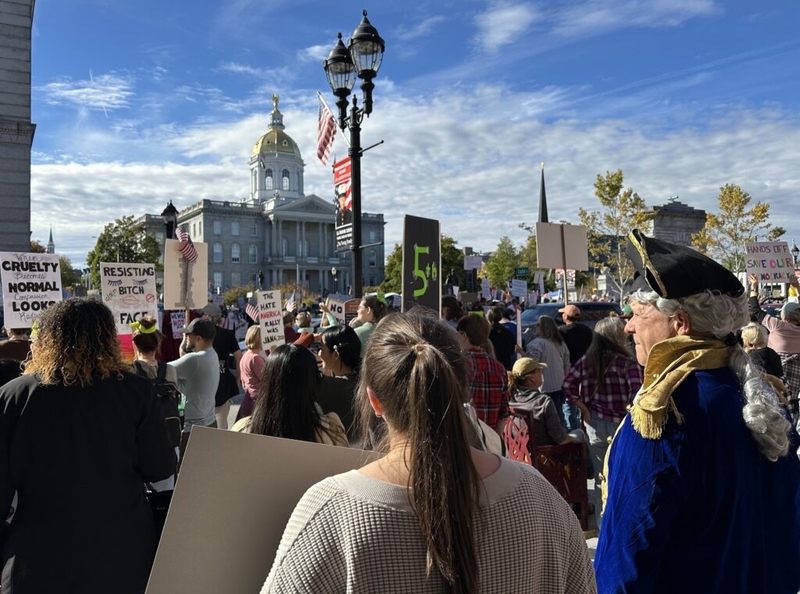
Protesters gather in front of the State House in Concord in October 2025. (Photo by Dana Wormald/New Hampshire Bulletin)
This week, NHPR published an analysis by reporter Lau Guzmán focused on the role local police have played in the recent surge in immigration enforcement in New Hampshire. From May through July, 198 people were detained in the state and nearly half of those arrests came as part of the 287(g) Program, which delegates “state and local law enforcement officers the authority to perform specified immigration officer functions.”
“There is a clear demographic profile of arrests in New Hampshire,” Guzmán writes of the overall enforcement effort in New Hampshire. “Latino men in their 20s and 30s made up 58% of those arrested in the second Trump administration. Seven minors were also arrested and detained in New Hampshire, including a 4-year old from Ecuador arrested in Manchester in July.”
The analysis also found that of the 198 detained from May through July, just 28 had previous criminal convictions. So much for the Trump administration and its state partners going after “the worst of the worst.”
While immigration hardliners no doubt celebrate New Hampshire law enforcement’s support for the administration’s mass deportation campaign — “We’re a nation of laws,” they and their go-alongs argue — a story from Stateline’s Nada Hassanein this week points to the growing collateral damage. “Four in 10 pediatricians reported kids in immigrant families are avoiding coming in for healthcare out of concerns around immigration status, according to a new survey published Tuesday,” Hassanein writes.
But I’ve misused the phrase “collateral damage.” There is nothing accidental or incidental about the freezing out of immigrant populations.
In fact, across policy areas the “freezing” of populations is not only a prong but the point.
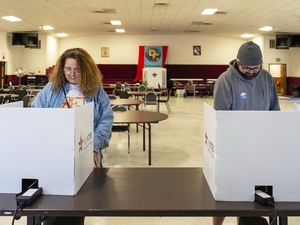
To listen to proponents of ever-broader voter restrictions talk, for example, you would be forgiven for believing the United States was suffering from an epidemic of voter fraud. It’s not. But through an election-meddling partnership with their conservative comrades in the White House, Congress, and the U.S. Supreme Court, New Hampshire Republicans keep challenging or changing state laws — including on voter ID, proof of domicile, and proof of citizenship.
I don’t expect it to stop anytime soon.
Just as claiming “we’re a nation of laws” aims to legitimize inhumane and unjust acts against immigrants, “election integrity” is a marketing slogan that hides a much darker intent: to suppress turnout in favor of a preferred electoral outcome. The idea is not to address fraud but to inject so much confusion in the voting process that people stay home just to avoid the hassles and harassment. So college students stay home, immigrants stay home.
Again, the freeze on selected populations isn’t “collateral.” It’s the point.
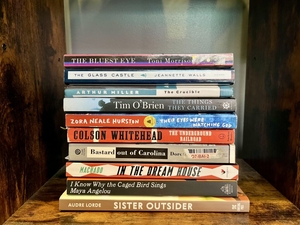
Another example. Even before “critical race theory” entered the political lexicon, lawmakers on the right were obsessed with a self-conjured fear of liberal indoctrination in American public schools. They often frame their panic as concern not only about specific thinkers or theories (which are often too niche even for 400-level college classes), but the overall decline in civics education. But they aren’t so much pushing for a “citizenry that understands, values, and practices democracy” — as outlined by the Center for Civic Education — as much as a specific ideological curriculum that elevates unquestioning patriotism and rigid originalism over intellectual rigor.
The demand seems to be that students view colonialism, slavery, and countless other forms of state-sanctioned violence and subjugation only as products of unique historical moments rather than foundational elements of the national system itself. They want students to arrive at prescribed conclusions without ever having to show their work or defend their thesis. It is better in their eyes, it seems, to be a blindly faithful American than a thoughtful one.
That drive for intellectual control is precisely how New Hampshire, in recent years, has found itself embroiled in perennial debates over “divisive concepts” and its various offshoots, including the broader parental rights movement.
Whether the laws actually stop teachers from challenging students to expand their worldviews, or prevent a troubled student from confiding in a trusted teacher, is almost beside the point. The laws are designed to freeze teachers and students alike, to make what is allowed and not allowed so convoluted that they seek safety in silence.
These assaults on immigrants, voting rights, and education are not disparate endeavors. They are a unified mechanism to assure that one narrow worldview holds sway and power, indefinitely.
The price of that effort is steep, and it is unfolding.
At its heart, the debate over immigration is not about political ideology but suffering. And so if your perception of certain immigrants is that as violators of U.S. immigration laws their suffering is warranted, that position is revelatory. It means you view humanity in terms of a hierarchy, and that is less a political conclusion than a social one.
If you argue for new and broader voter restrictions in the name of “election integrity,” you should be able to do so without relying on false claims of widespread voter fraud or stolen elections. Conservatives cannot simultaneously claim the mantle of protectors of liberty while disenfranchising voters solely to manipulate the makeup of the electorate and, in concert with gerrymanderers, create a closed loop of power.
If your primary concern about public school curriculum is leftist indoctrination, I invite you to search online for the ideas or thinkers that unnerve you the most (or, conversely, that you cherish). It’s all there — usually without context, comparison, or criticism — and it will stay on Google, YouTube, Facebook, X, or Bluesky no matter how many books are banned or how many syllabuses are ripped up by right-wing school boards. What a child is taught matters far less than how they learn to critically interpret and process what they are told by their political leaders, the media, online posters, their parents, or their teachers. That’s your real civics crisis.
And that’s the American crisis, too.
Concord, NH