North Carolina’s Education Lottery sets new records but faces headwinds
Jun 29, 2026 | 2:29 pm ET
Description
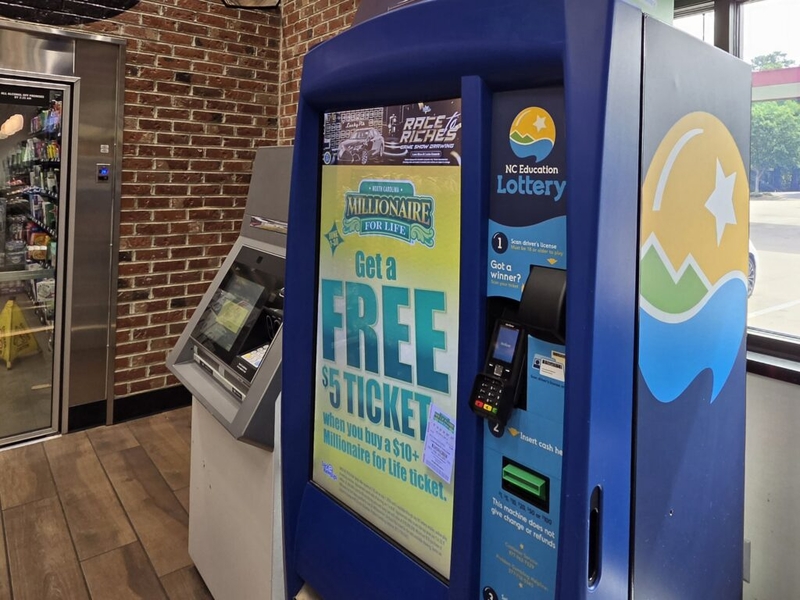
While more North Carolinians are playing the lottery from their computer or smart phone, retail kiosks remain a key part of the lottery's strategy for future growth. (Photo: Clayton Henkel/NC Newsline)
The North Carolina Education Lottery, now 20 years old, continues to set new records, but officials say future success may depend on increasing visibility, national jackpot games, and retaining lottery employees.
Year-to-date sales through the month of May were just under $6.6 billion, according to Greg Bowers, the lottery’s chief financial officer. That’s a 9.2% increase over sales for the same period last year.
“We passed a couple of pretty significant milestones in the fourth quarter. One was the $3 billion in sales for digital instants,” Bowers told members of the North Carolina Lottery Commission during their June 24 meeting. “We’re about 10.5% ahead of our gross gaming revenue targets for the year, which is very, very exciting to say that we’re outperforming the goals for the year.”
Unlike traditional scratch-off tickets, digital instants allow players to set up an account, deposit funds and play instantly on their computer or mobile device.
As scratch-off sales soften, NC lottery officials turn to higher-priced tickets, online games
Digital instants saw a 22% increase for the first 11 months of the fiscal year compared to 2025. Scratch-off sales dipped about 3% for the year, although Bowers said some scratch-offs have outperformed expectations, including a $20 ticket to commemorate the lottery’s 20th year in North Carolina.
More sales means more revenue. Through April, the lottery paid out nearly $4.6 billion in prizes, 76.4% of the money that came in. Bowers said that through May, the games have brought in $1.04 billion for public education, about $45 million more than last year.
That increase is notable because an independent audit released in December found that while total lottery revenue increased over the last two years, contributions to public education have been relatively flat. Lottery officials said higher payouts on digital instant games and smaller jackpots on the multistate games reduced the amount shared with North Carolina schools in 2024 and 2025.
Bowers cautioned the lottery commission that North Carolina is not immune to the current trends other state lotteries are facing. As consumers face more economic pressure, they may stop playing. Multi-state jackpot games can be volatile, and consumers may be less likely to buy a ticket until the jackpot reaches a certain level.
Bowers says the strategy is to optimize the current scratch-off games and digital instant offerings and add more vending at retail stores. Sales are projected to increase by 6.39% in 2027.
Competition for talent may determine lottery’s future success
But to stay competitive, lottery officials say, it will take investments in people, technology and new products.
Last week, lottery commission members reviewed the findings of a year-long study on staff compensation. Martina Young with Gallagher, a benefits consulting company, said base salaries of the lottery’s employees are about 9% behind market pay.
Young said leadership positions are about 22% behind the market rate.
She explained that younger talent is less interested these days in long-term benefits than in cash compensation: ”They’re really focused on the base wages.”
Commissioner Jason Roth said the lottery should perhaps consider reducing benefits to increase base pay.
Commissioner Chris Hayes agreed.
“I know UNC Hospital has been successful at getting out of the state health plan or state pension plan,” said Hayes. “That’s maybe something we need to explore, if we’re going to look at total compensation and how to retain employees.”
But Commissioner Pam Whitaker said the primary reason for the study was to determine what was needed to keep wages competitive against competing states, not subtract from the current benefits.
“If we go down that path, we will have turnover,” Whitaker cautioned. “Why would we want to create that?”
Young said the consulting firm found that for lower-paid positions, employees might leave for a 5% difference in pay.
As the lawmakers prepare to vote on a final state budget, Mark Michalko, the lottery’s chief executive officer, urged the commission to consider pay adjustments in addition to the 3% raises expected in the state budget.
“What I don’t want to do is go into the next hire situation and say to somebody, ‘Sorry folks, we’re not competitive in the marketplace,’” said Michalko. “They’re going to hang up the phone or they’re going to walk away. It’s as simple as that to me,”
Raleigh, NC