NM Primary 2026: New Mexico Commissioner of Public Lands
Apr 27, 2026 | 11:43 am ET

Description
The three-way Democratic primary for New Mexico Commissioner of Public Lands features a long-time state representative, the former New Mexico Farm Service Agency director and U.S. Sen. Martin Heinrich’s former political director. They all say they want to diversify the office’s energy revenue. (Photo of Buena Vista Energy Center on state trust lands courtesy State Land Office)
The New Mexico State Land Office received 9 million acres of land from the federal government over a century ago, and is tasked with using that land to raise revenue for public schools, hospitals, colleges and other institutions.
In recent years, an oil and gas boom has meant the Land Office has received more than $2 billion a year in revenues, largely from oil and gas royalties, offsetting costs of public services that would otherwise fall on taxpayers.
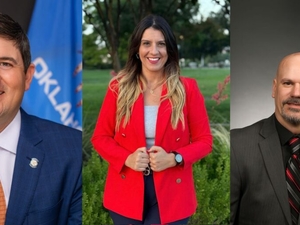
New Mexico Commissioner of Public Lands Stephanie Garcia Richard, a Democrat, is stepping down later this year after serving her second and final term. Three Democrats — State Rep. Matthew McQueen (D-Galisteo), Jonas Moya and Juan de Jesus Sanchez III — are competing in the June 2 primary election in hopes of replacing her.
If elected, they’ll be tasked with balancing the state’s need for revenue with environmental considerations, as well as diversifying the office’s revenue streams to reduce reliance on the volatile oil and gas industry.
They’ll also be forced to contend with shifting federal priorities related to public land, including border security, domestic energy production and logging. The land commissioner will also face renewed pushes to use State Trust Land for affordable housing and carbon-free energy sources like wind, solar and geothermal.
Republican Michael Perry is running unopposed in that party’s primary. Source NM asked questions of all three Democratic candidates seeking to face Perry in the general election. Their answers below are edited for clarity and concision.
Rep. Matthew McQueen (D-Galisteo)

New Mexico State Rep. Matthew McQueen, 58, is a property attorney who has served in the Roundhouse for the last 12 years. He said his experience leading the House Energy, Environment and Natural Resources Committee, where he worked with the Land Office to levy fines on “bad actors” in the oil and gas industry and raise royalty rates in the Permian Basin, makes him the most qualified of his primary opponents.
“I not only have way more experience than my opponents, I actually have way better experience,” he said. “I’ve already done the work that the Land Office is doing.”
Why are you running for this office?
Ever since I was a kid, I’ve been concerned about the natural world and conservation. That’s what I studied when I was in school. I’ve been an attorney for over 30 years, practicing in the area of real property law. My specialty is land conservation. Based on that experience, I ran for the Legislature, and my legislative work has all been on natural resource protection and energy issues. I think that’s gone well, and I think I just have a ton of the right experience for the Land Office.
What would be your top priority for the office if elected?
I think Stephanie Garcia Richard has done a great job, and the Land Office is going gangbusters. We definitely need to diversify the revenue in the Land Office. They’re taking in over $2 billion a year in revenue. They might hit $3 billion this year for the first time, but 97% of that revenue comes from oil and gas. So we need to do more with renewables, with solar, geothermal, commercial projects on appropriate parcels, and even housing projects, affordable and workforce housing, on appropriate parcels.
What is the most important aspect of the State Land Office that the public should understand?
The core mission of the Land Office is to earn money for education. A lot of people don’t understand that. They hear the word “land” and then they think it’s like [Bureau of Land Management] or Forest Service or something like that, but the Land Office is given all this land by the federal government to hold in trust for the people of New Mexico, to earn money for public schools, universities and hospitals. They can do a lot, and they can balance recreational use and hunting and fishing and wildlife and all those things that we hold dear, but really, the core mission is to earn money for education.
Are you generally supportive of using the State Trust Land to reduce the state’s housing shortage?
Absolutely. It really comes down to the parcel. And there are parcels where that’s appropriate, and partnering with developers or finding other ways to make sure that land gets used for that purpose, that’s something I’m really interested in. I’d like every New Mexican to have the opportunity to own their own home. The Land Office can help.
Where does geothermal energy fit into your vision for the State Land Office?
New Mexico is an energy-producing state. We always have been, and I think we always will be, but in the future, we have tremendous wind, solar and geothermal potential. The Land Office just published a new geothermal rule, which allows the commissioner significant discretion to issue geothermal leases. I think that technology is less advanced than where we are on wind and solar, and if they can catch up, that’s fantastic, because geothermal is a 24/7 power source. It’s not wind- or sun-dependent, and that would be a really good complement to our renewable portfolio.
Given the federal government’s shifting policies and protections for public land, should the Land Office take any steps to create greater protections?
They should. But then, of course, with state-controlled trust land, there are limits. In a lot of areas of New Mexico, the surface management, in particular, is checker-boarded or fragmented. And sometimes the feds want to do something that the State Land Office doesn’t want to do. We don’t have to cooperate on bad projects, and I think Commissioner Garcia Richard has done a really good job at resisting the federal government if they’re going down the wrong path.
What’s the biggest change you would make from the current commissioner upon taking office?
The first is diversifying the revenue of the Land Office. That’s not a criticism of Garcia Richard. She knows that, too. It’s just easier said than done. You just have to stick to it. I would also, on commercial projects, like to see the Land Office take an equity position in those projects. So if there’s a parcel of land that’s appropriate for commercial use, instead of just auctioning it off to a developer, we can partner with that developer and include revenue to the Land Office as part of that transaction. And I’d also like to reinvigorate land swaps, which are a good way to address that fragmentation, but those are complicated, labor intensive projects, and we need to build the staff at the Land Office in order to tackle all three of those things.
Jona Moya

Jonas Moya, 35, grew up on his grandmother’s ranch in Tucumcari and said, if elected, he would ensure rural New Mexico’s priorities are represented at the Land Office. After graduating from New Mexico State University, he served as the state director for the federal Farm Service Agency, where he oversaw about 75 employees in 22 field offices overseeing agriculture grants and programs for New Mexico farmers.
“Working on this at the federal level, with a large staff with a big budget, and actually implementing policy that was handed down to me through the Farm Bill, I’ve seen how policy impacts people’s day-to-day lives,” he said. “And that’s a unique perspective that I don’t think many people that are running in this race have.”
Why are you running for this office?
I would bring a unique perspective back to the Land Office about agriculture, rural economic development opportunities, as well as good land stewardship, being a rancher as well.
What would be your top priority for the office if elected?
My top priority is diversifying our state land leases and diversifying our revenue streams along that same line. I want to lean more into renewables, despite what’s going on politically nationally. I think there’s still a lot of opportunities for New Mexico to lean into solar, wind energy, and then continue to expand into geothermal, as well as promoting and being supportive to our ranchers who lease our land for grazing, and helping them be better land stewards.
One big thing about my campaign is that I care about jobs, economic development and making sure we’re keeping New Mexicans here. Growing up in New Mexico, I’ve seen my town shrink over the years. So many kids were educated in our public schools, went to our public universities, but now live outside of the state. They live in Phoenix or Denver or Dallas, just because there’s not enough job opportunities to keep them here in New Mexico. I hear that story way too much.
What is the most important aspect of the State Land Office that the public should understand?
I think people kind of forget about our field offices and the people that go day-to-day, to not only inspect state lands, but also work in the background to make sure our leases and everything are executed as well as developed. What I want to bring to the picture is a little bit more of a capacity building as well as efficiency building within the State Land Office. It’s well known that it’s a desirable place to work, and it’s won awards state and throughout the country. But I want to lean into that and further empower the State Land Office and empower the people that work there. If the public knew just how long sometimes these leases take to get out the door, they would be a little shocked.
Are you generally supportive of using the State Trust Land to reduce the state’s housing shortage? How would you approach doing so?
I think there’s opportunities, from strategic land swaps to doing long-term leases, to taking it on as an investment to our portfolio. We can generate revenues from those leases with a long-term agreement with a developer. That’s how I would lean into it, and one of my top priorities is making sure that we’re building houses and we’re creating economic opportunity with our state lands. I strongly say this along the campaign trail all the time: Economic opportunity and land stewardship can be had together instead of one or the other.
Where does geothermal energy fit into your vision for the State Land Office?
The employees of the State Land Office have done a great job of mapping out pockets of thermal energy throughout the state. And I think with technology and the way that the market for thermal energy has adapted over the years that it would be a wise man to lean into that, and it’s a good way to also diversify revenues, create jobs and create some economic opportunities in these rural towns.
Given the federal government’s shifting policies and protections for public land, should the Land Office take any steps to create greater protections?
I think we should always be aware of what’s going on on the federal level. Any time there’s a piece of federal lands next to ours that takes a drastic shift in how it’s managed, the State Land Office should definitely be reactive and come with a response that is beneficial and reflective of what New Mexicans need.
What’s the biggest change you would make from the current commissioner upon taking office?
I would prioritize hiring in rural areas, as well as prioritizing remote opportunities for folks that are living in rural communities. I’ve seen firsthand how being able to advertise jobs in a small community plays a domino effect in helping a family stay there. It keeps a family in a rural town. That’s what I want to instill: Prioritizing rural jobs and making sure that all of New Mexico is represented when it comes to our decisions.
Juan de Jesus Sanchez III

Juan de Jesus Sanchez III, 34, describes himself as a 13th generation New Mexican whose family ranch near Belen relied on a State Trust Land grazing lease. He worked as a natural resources specialist for the U.S. Army Corps of Engineers and at the New Mexico Acequia Commission before becoming the political director for U.S. Sen. Martin Heinrich (D-New Mexico.)
“I understand our lands because I’ve grazed cattle on them, I’ve hunted on them. I’ve recreated on them,” he said. “I’m the candidate that brings on the ground experience to the office that won’t really be making our decisions from a desk in Santa Fe looking at lines on a map and dollars on a spreadsheet. But I’m someone that has been on the land, understands the land, and I’ll be making my decisions based on experience on the land.”
Why are you running for this office?
I’ve been working the land since I could walk, essentially, and in my professional career, I’ve worked to protect the land, our water and our resources in many different capacities. It’s something that I care deeply about.
What would be your top priority for the office if elected?
The most important thing is making sure that we continue to fund our education system. That’s kind of the role of the land commissioner. But beyond that, I think we need to be doing that with an eye on the future. We need to make sure that we’re not only doing what we can to fund our education, but also making sure that our future generations have opportunities to enjoy our public lands. It’s important that our children and their children have those same opportunities that we have to be able to enjoy our outdoors.
What is the most important aspect of the State Land Office that the public should understand?
That it generates billions of dollars annually, and that money goes to help pay for our public education system. I think it’s really important for folks to know that because of the money that’s coming from the State Land Office, there’s a much lower tax burden on them to help pay for education generally.
Are you generally supportive of using the State Trust Land to reduce the state’s housing shortage? How would you approach doing so?
I am going to be very particular on the parcels that can be used for housing. There are some that could be appropriate that are within cities that aren’t providing any other kind of beneficial, recreational outdoor use. But I do think that we need to be very particular whenever we’re thinking about housing on our state trust land, because one of the roles of the land commissioner is to make sure that we have land that our children and their children are able to enjoy in the future. Whenever you’re making a decision on any kind of development, it needs to be thinking much farther in the future than five or 10 years. So, I’ll be particular.
Where does geothermal energy fit into your vision for the State Land Office?
I think geothermal is a huge renewable opportunity for us to be able to help diversify our economy, allow us to have more energy being produced here in New Mexico. We’ll be able to diversify the economy, but also it is a renewable energy and is something that’s not harmful to the environment.
Given the federal government’s shifting policies and protections for public land, should the Land Office take any steps to create greater protections?
Absolutely. We’re seeing attacks from the Trump administration at places like the headwaters of the Pecos, Chaco Canyon, even attempts to use land at the border. This is an opportunity for New Mexico to lead and to stand up to the Trump administration and use our plots of land that we do have in those specific areas to make sure we have long-term protection on there, and find ways that we can push back against the administration to do long term against these policies.
What’s the biggest change you would make from the current commissioner upon taking office?
I think the current land commissioner has done an amazing job with things like expanding renewable energy and continuing to get more funding from oil and gas. One of the things that I would like to focus on is access to state trust land, making sure that we can open up more access to our state trust land so people have opportunities to be able to recreate, responsibly. I think there’s a real opportunity for us to try and repair some of our range lands, and that is definitely helpful in biodiversity [and] wildlife. It’s also helpful in ways that you can address climate change by having our grasslands and our soils be restored to a place where they can actually absorb more carbon as well.
Santa Fe, NM