NJ’s top court says defendant can seek sex assault victim’s mental health records
Jul 09, 2026 | 3:22 pm ET
Description
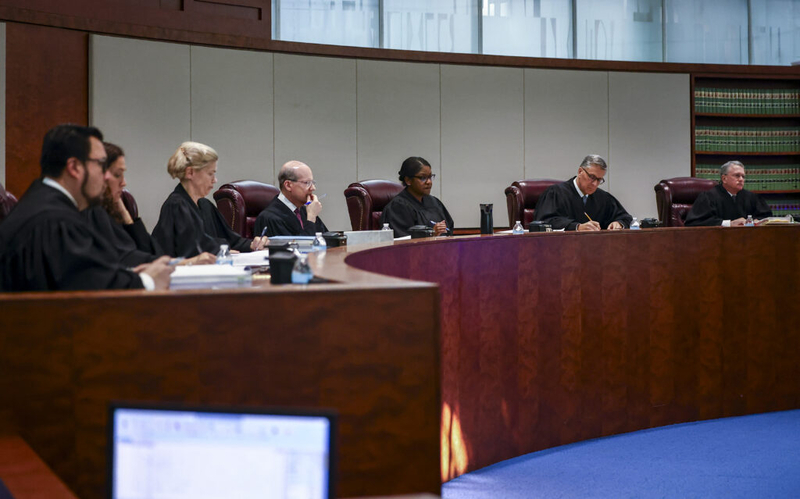
The seven members of the New Jersey Supreme Court listen to arguments on April 28, 2025, at the Richard J. Hughes Justice Complex in Trenton. (Photo by Dana DiFilippo/New Jersey Monitor)
The state Supreme Court ruled Thursday that a Bergen County man charged with sexually assaulting his niece can move ahead with getting a judge to privately look at her mental health records, reversing a lower court that previously shut that request down.
The majority in the 5-2 ruling said the trial judge who first agreed to look at the records didn’t do anything wrong in allowing it, citing a 2023 case laying out when defendants in sexual assault cases can access a victim’s mental health history. Justice Douglas Fasciale wrote that the court found “no abuse of discretion in his finding that defendant made a sufficient showing for the judge to conduct a limited and narrow” review.
A woman referred to in the court documents as Kim was 18 in 2021 when she told her father that her uncle sexually assaulted her in his bedroom while she was looking for her cat. But his attorneys said Kim — who reported her medical history to include autism, bipolar disorder, PTSD, asthma, seizures, hypothyroid and anxiety and said she was on medications — gave conflicting accounts of the incidents. The defense counsel retained an investigator to see whether her mental illnesses and her ability to recall and recount details had any connections.
A grand jury indicted her uncle, identified as R.F.P in court records, on sexual assault charges. His lawyers said they needed access to Kim’s mental health records which might explain gaps or contradictions in her account. They also pointed to interviews with Kim’s family and friends who said she may have been off her medication, which could lead to making up stories, along with medical research that says PTSD and bipolar disorder can cause false memories.
A trial judge agreed to privately review a limited set of records from her most recent hospital stays without handing them over to the defense. The state and the New Jersey Crime Victims’ Law Center filed motions for reconsideration, which were denied by the trial judge. They then appealed to the appeals court, which sided with them and blocked the review, saying the defense hadn’t met the legal bar required to get the documents.
The state Supreme Court disagreed with the Appellate Division and reinstated the trial judge’s original order.
Fasciale said a defendant must show three things before a judge will privately review a victim’s records — a specific need for the records, that the records are relevant to the case, and that the same information can’t be found another way. Fasciale said that no single piece of evidence would have been enough on its own, but “collectively, the evidential record amounts to more than bald assertions.”
Justice Fabiana Pierre-Louis, in a dissent joined by Chief Justice Stuart Rabner, argued the opposite — the uncle’s own statements undercut his stated reason for wanting the records in the first place. He corroborated many details of the incident, yet moved to access her mental health records based on a belief that her mental health conditions could affect her ability to recall the events of that day, she noted.
“Even if Kim has lied every day of her life about everything and anything, it is of no consequence because defendant has stated in his own words that she did not lie this time,” she wrote, adding that ignoring such statements would “continue the historical distrust of victims with psychological illnesses.”
In the dissent, the judges warned the ruling could make these kinds of requests more common and discourage sexual assault survivors — particularly those with mental illnesses — from reporting attacks.
The court also flagged that Kim wasn’t notified about the records request early on, even though state law requires victims to get notice and a chance to respond before a judge rules on this kind of motion.
Trenton, NJ