Under new agreement, federal government limits obstacles to oil leasing in Alaska’s Arctic refuge
Jul 09, 2026 | 9:45 am ET
Description
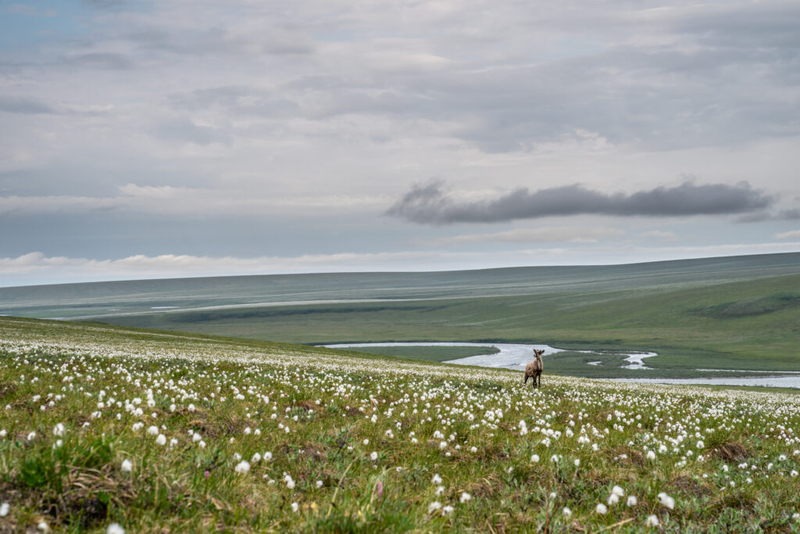
A single caribou stands in 2019 amid cottongrass and other tundra plants near the Hulahula River in the Arctic National WIldlife Refuge. (Photo by Alexis Bonogofsky/U.S. Fish and WIldlife Service)
The federal government has agreed to permanently loosen rules for oil and gas lease sales in the Arctic National Wildlife Refuge, according to a draft settlement agreement filed this week in the U.S. District Court for the District of Alaska.
Adam Gustafson, an attorney with the U.S. Department of Justice, said in a statement that the agreement “means more oil leasing, more domestic energy, and more independence from foreign sources of energy.”
The document filed this week would settle lawsuits filed by the state of Alaska and its investment bank over the 2025 Arctic National Wildlife Refuge oil lease sale that drew no bids.
That sale, mandated by a 2017 law, took place after the Biden administration restricted the available acreage. The Alaska Industrial Development and Export Authority and the state of Alaska sued over the Biden-era limits.
This week’s agreement states in part that the federal government will not limit oil and gas leasing in ANWR until oil and gas equipment covers at least 2,000 acres in the refuge’s coastal plain.
“The 2017 Tax Act does not authorize (the Bureau of Land Management) to deny or unreasonably limit development of production and support facilities to the Coastal Plain until 2,000 surface acres are covered by production and support facilities,” it states in part.
That’s a small fraction of the size of the leases being put up for sale but could represent a significant length of pipeline and a large number of drilling pads.
AIDEA and the state remain in court against the federal government over the result of a 2021 ANWR lease sale. AIDEA won leases during that sale, but the Biden administration canceled those leases, then attempted to re-sell the affected land during the 2025 sale.
The ANWR leasing program overall has been challenged by a coalition of environmental groups, and that case also remains in court.
By email on Tuesday, an AIDEA spokesperson said it would be accurate to call the new agreement a victory for AIDEA and Alaska because it “includes a clear admission that the … Lease Sale ‘violated the 2017 Tax Act by preventing meaningful leasing, exploration, and development of oil and gas on the Coastal Plain, as Congress mandated.’”
Through a spokesman, acting Alaska attorney general Cori Mills noted that while Alaska’s attention has recently focused on a successful lease sale in the National Petroleum Reserve-Alaska to the west of the Prudhoe Bay oil field, the state continues to be interested in ANWR, which is to the east.
The new settlement agreement increases the odds that ANWR will stay open to drilling even when a new president comes after Trump.
“While the State is ecstatic about the progress in the NPR-A, we cannot lose sight of the potential in ANWR. The problem is not a lack of potential or even lack of infrastructure; it is the lack of a stable investment climate without burdensome and unnecessary strings attached,” Mills said by email.
“The last administration did everything they could to shut down development in ANWR that our congressional delegation and numerous state administrations had fought long and hard for. But that doesn’t have to be the future. We are grateful that the federal government recognizes the unlawful actions taken previously and was willing to enter into the settlement and essentially admit the error,” she said. “There is still hope that ANWR can provide economic prosperity and crucial resources for local communities, the state, and the nation.”
Juneau