Ninth Circuit panel appears to lean Nevada’s way in legal battle with Kalshi, Crypto.com
Apr 16, 2026 | 5:58 pm ET

Description
Kalshi photo illustration, Tuesday, April 7, 2026. (Photo by Anne-Marie Caruso/New Jersey Monitor)
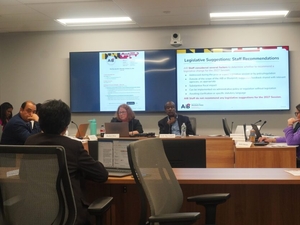
The Nevada Gaming Control Board and the Nevada Resort Association on Thursday defended the state’s right to regulate gambling within its boundaries during a hearing before a three-judge panel of the Ninth Circuit Court of Appeals in San Francisco that, at times, appeared to side with the state.
The case is one of many pitting states against prediction markets and the Trump administration, which contends the platforms are exclusively regulated by the Commodities Futures Trading Commission (CFTC) and permitted under the Commodity Exchange Act (CEA) to take bets on sporting events.
Federal law, the prediction markets and the federal government argue, preempts regulation by Nevada and other states, including those that prohibit gambling. Nevada, represented by Washington, D.C. attorney Nicole Saharsky, argued the CEA lacks the clear intent required to preempt state law.
Judges Ryan Nelson, Bridget Bade, and Kenneth Lee, all of whom were appointed by President Donald Trump during his first term, heard consolidated appeals brought by North American Derivatives Exchange Inc. (Crypto.com), Kalshi, and Robin Hood Derivatives LLC against the state, which has prohibited prediction markets from taking bets.
The Trump family has a direct interest in the outcome of the case. Trump Media is launching its own platform called Truth Predict, while Donald Trump Jr. advises and has financial interests in Polymarket and Kalshi, two of the largest prediction markets.
At issue is the interpretation of the Commodities and Exchange Act and whether sports event contracts are swaps under CFTC jurisdiction.
The CFTC argues the contracts are not gaming and fall exclusively under federal jurisdiction. The state asserts that under Nevada law, the contracts amount to illegal bets.
A ruling otherwise “would be a sea change,” Saharsky told the judges. “It would be a huge deal. It would take away the power from the states. It would have financial consequences. For the state of Nevada, it’s like a third of the general fund that comes from gaming revenues.”
Saharsky contends a federal rule enacted in 2011 prohibits trades on gambling. CFTC Rule 40.11 excludes agreements, contracts, transactions, or swaps on “terrorism, assassination, war, gaming, or an activity that is unlawful under any State or Federal law.”
Judge Ryan Nelson appeared to agree. “The language says it can’t go up (on the platform). I don’t know how you can read it differently,” he told an attorney representing Robinhood, a broker that offers derivatives to Kalshi.
Attorneys for the appellants and the CFTC countered that the platforms ‘self-certify’ events on the platforms and that the rules merely allow the CFTC to weigh in. They acknowledge regulators have not weighed in, nor have they been asked to do so.
The platforms argued that via the Dodd Frank Act of 2010, which was designed to reform financial regulation following the bailouts of the Great Recession, Congress gave the CFTC wide latitude to define a swap.
Nelson told attorneys for the prediction markets that their clients “had the obligation” to gain approval of sports betting from the CFTC. “You signed an agreement and said, ‘We will abide by the regulations.”
He added that Congress put the CFTC in place as a “gatekeeper” to determine whether individual swaps, such as bets on sporting events, are in the public interest. “Maybe it’s in the public interest, maybe it’s not in the public interest.” Seeking approval from the CFTC, he said, “would have been so much easier for all of you when you had billions of dollars on the line.”
The hearing is the latest round in what is expected to be a protracted legal fight among states, the platforms, and the federal government.
Last year, the GCB issued a cease and desist letter to the prediction platform when Kalshi began a sports betting pool.
Kalshi responded with a federal lawsuit and successfully sought an injunction from Nevada U.S. District Judge Andrew Gordon. In November, Gordon lifted the injunction and Kalshi appealed to the Ninth Circuit Court of Appeals.
In February, the Ninth Circuit rejected that appeal, opening the door for Nevada to file suit in state court. The GCB also filed a civil enforcement action seeking an injunction to stop Kalshi from taking bets in the state.
In March, a Nevada judge granted the Nevada Gaming Control Board’s request for an injunction prohibiting Kalshi from taking bets in Nevada, at least temporarily.
This month, the Third Circuit Court of Appeals ruled in favor of Kalshi in a challenge brought by New Jersey regulators. The court held that sporting event contracts fall within the definition of a swap, and are subject to exclusive jurisdiction of the CFTC.
Saharsky said Thursday that ruling, and others in the platforms’ favor, glossed over critical issues.
Nelson said the panel would rule on the appeals “as quickly as we can.”
Las Vegas, NV