The Blueprint board makes legislative recommendation, more could be coming
Oct 15, 2026 | 6:24 pm ET
Description
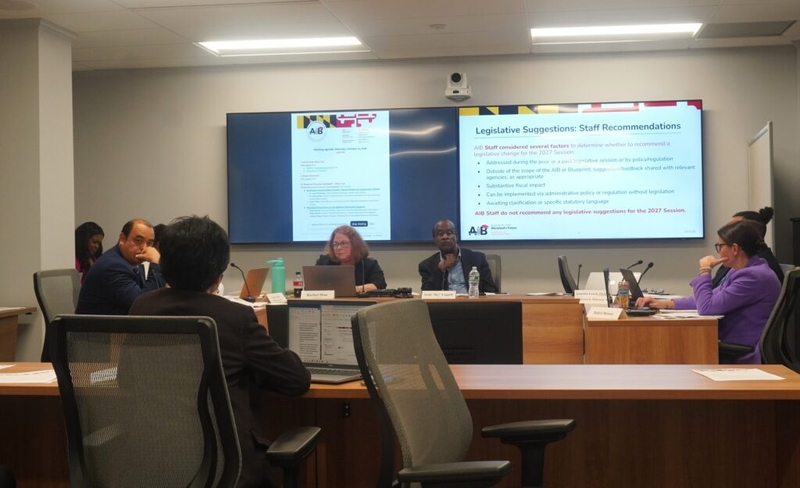
Joy Schaefer, government relations director for the Accountability and Implementation Board sitting at table, summarizes a legislative recommendation Thursday during a Blueprint for Maryland's Future AIB meeting. It was the first in-person meeting held inside the board's new office in downtown Annapolis. (Photo by William J. Ford/Maryland Matters)
The board overseeing the state’s Blueprint education reform plan wants to pause expert review teams visiting schools through fiscal year 2029, and instead allocate funding toward coaching teachers.
That decision was the only recommendation that came out of the Blueprint for Maryland’s Future Accountability and Implementation Board meeting Thursday. It was the seven-member board’s first in-person meeting in their new 3,000-square-foot office in downtown Annapolis. Only board vice chair William “Brit” Kirwan participated virtually because he was at a conference in Ocean City.
The visits are mainly done to observe math and literacy practices as implementation of the Blueprint plan is halfway through. They were already paused this fiscal year, but were scheduled to resume in fiscal 2028 based on a legislative proposal from the state Department of Education. Although review teams visited nearly 300 schools since the 2021-22 school year, “the snapshot visits only allow for a limited understanding of the school’s strengths and areas needing additional support and have had a limited impact on improving student outcomes,” according to the department.
Joy Schaefer, who handles government relations for the board, said work would be done to assess and redesign the expert review team program. It would resume in fiscal year 2030 which includes funding for it.
The board also said the legislature should allocate fund the existing statewide teacher development program.
The General Assembly approved $14.2 million during this year’s 90-day legislative session toward the program to hire more than five dozen literacy and math teachers for this school year.
Although there’s support for the training, a few board members asked why not keep both programs running.
“I recognize that this is a better spend of the money. I’m always for instructional coaching,” said board member Justin Robinson, a middle school math teacher in Prince George’s County. “But I think the ERT (expert review team) program also provides a school level lens, and I think that’s missing often — the opportunity for schools to learn from each other, the opportunity for us to learn from those schools that are doing things well, and schools that might need to partner with schools with a similar demographic.”
Board chair Isiah “Ike” Leggett said the pause would allow for additional time to assess how to make the expert review team program better.
Last month, the board reviewed 15-pages of legislative recommendations that included funding for more college and career readiness classes; conducting a study to assess how much to increase the base level of per pupil funding; and easing certification requirements for private providers who employ educators who teach prekindergarten students.
Any legislative changes must receive approval by the General Assembly when it convenes for the 2027 session that begins Jan. 13.
But how extensively any changes would be made remain unknown as the state faces a projected $3 billion budget gap for the upcoming fiscal year, about $1.8 billion of which is tied to education under the Blueprint, according to the Maryland Associations of Counties (MACo).
The projected budget shortfall for fiscal 2028 also comes in the first year in which Blueprint costs will exceed dedicated revenues.
Leggett said Thursday the board may present more legislative recommendations based on at least three reports due later this year: special education funding study from the Department of Education by Dec. 15; increasing teacher diversity from the Accountability and Implementation Board by Dec. 31; and another report due by that same day on compensatory education from both the department and the board.
The board’s next meeting is scheduled for Nov. 19, but this time strictly virtual.
Annapolis, MD