New Mexico Secretary of State agrees to turn over voter death error records following lawsuit
Jul 30, 2026 | 6:00 pm ET
Description
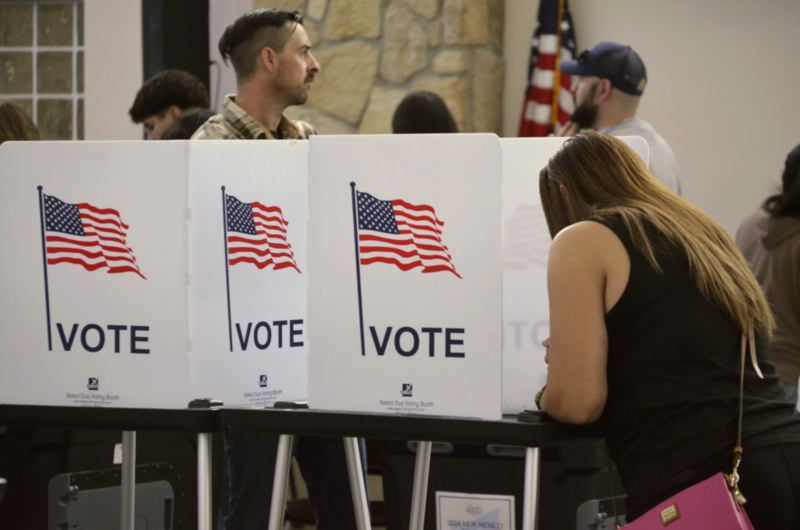
The New Mexico Secretary of State’s Office on July 13, 2026, settled a lawsuit with the Public Interest Legal Foundation to turn over records regarding voters erroneously being labeled dead in state voter rolls. (Photo by Leah Romero/Source NM)
The New Mexico Secretary of State’s Office agreed earlier this month to release records related to state voters erroneously labeled as deceased, following a lawsuit from a national foundation that has filed similar lawsuits against states across the country.
The Public Interest Legal Foundation filed a lawsuit in June after the Secretary of State did not produce records that would show how often and how quickly the state corrected its voter rolls upon learning it had erroneously deemed a voter as deceased.
Central to the lawsuit is the Electronic Registration Information Center, also known as ERIC, which New Mexico and 27 other states use to share information regarding voters who have moved or died. ERIC notifies New Mexico and other states when it learns, primarily through the federal Social Security Administration, that a voter has died. ERIC also notifies states if it later learns that state election systems wrongly marked voters as deceased.
A report last week from the national nonprofit think tank Brennan Center for Justice characterized the Public Interest Legal Foundation as a critic of ERIC and as “long a promoter of misleading claims about the breadth of errors on voting rolls.”
The report notes that so-called “election integrity” organizations have targeted ERIC in legal challenges intended to destroy it and “replace it with something weaker.”
But Logan Churchwell, the foundation’s research director, told Source NM in a recent interview that the lawsuits are simply trying to understand better how states deal with deceased residents on voter rolls.
“It’s early days, but the goal is to understand not just how many people, but how long does it take to get corrected?” he said. “And if there is a significant gap between the correction and them being re-established, are they missing opportunities to vote?”
Churchwell declined to provide Source NM with the records his foundation successfully sued over, saying he was still analyzing them.
Churchwell’s foundation also successfully sued Arizona and Oregon for its ERIC-related death records, according to a news release.
The Secretary of State’s Office also did not provide Source NM the full list of records, but did provide an “example” of three voter records.
The records show that three voters — two in Doña Ana County, one in Lea County — were erroneously declared dead between September 2020 and May 2021. The state restored all three to the voting rolls by early December of 2021.
Brennan Center report predicts mass voter challenges likely in midterm elections
In an interview this week with Source NM, New Mexico State Elections Director Mandy Vigil defended the state’s participation in ERIC, which has access to federal death records that the state does not, as well as the state’s efforts more broadly to maintain accurate voter rolls.
She also said the risk is “extremely low” of anyone wrongly deemed deceased being prohibited from voting.
If a voter wrongly listed as deceased tries to vote, Vigil said, they can file a provisional ballot. Doing so gives the state the opportunity to “research and get it right” while preserving a voter’s right to cast a ballot.
“Based on the controls and the system that has been built over time, I just don’t think PILF is accurately reflecting the realities of how it works,” she said. “I think they’re attempting to create this idea that these corrections are unusual, widespread or significant in a way that people should be concerned. I don’t share that sentiment.”
Vigil cited an “administrative error” for the state’s failure to quickly provide the records the foundation requested. But she stressed that the state never refused to produce the records and produced them in full during the litigation.
The records do not include Social Security numbers or other sensitive personal information like dates of birth.
Churchwell’s foundation also successfully sued Arizona and Oregon for its ERIC-related death records, according to a news release.
Federal judge dismisses USDOJ lawsuit seeking New Mexico voter rolls
The July 13 settlement agreement between the Secretary of State’s Office and the foundation requires the state to maintain each “deceased retraction” record it creates for at least two years. The state also agreed to release the records upon request as required under the federal National Voter Registration Act.
The settlement agreement also required the state to pay the foundation roughly $2,800 in legal fees.
Vigil said she hopes New Mexicans maintain their faith in the state’s election security despite efforts from the foundation to “sow doubt in the integrity of elections.”
“We’re highly ranked in the country for a good reason, and so [voters] should feel confident in their ability to participate,” Vigil said.
Santa Fe, NM