New Mexico Democrats propose revamped consumer protection, digital safety laws
Sep 23, 2026 | 2:47 pm ET
Description
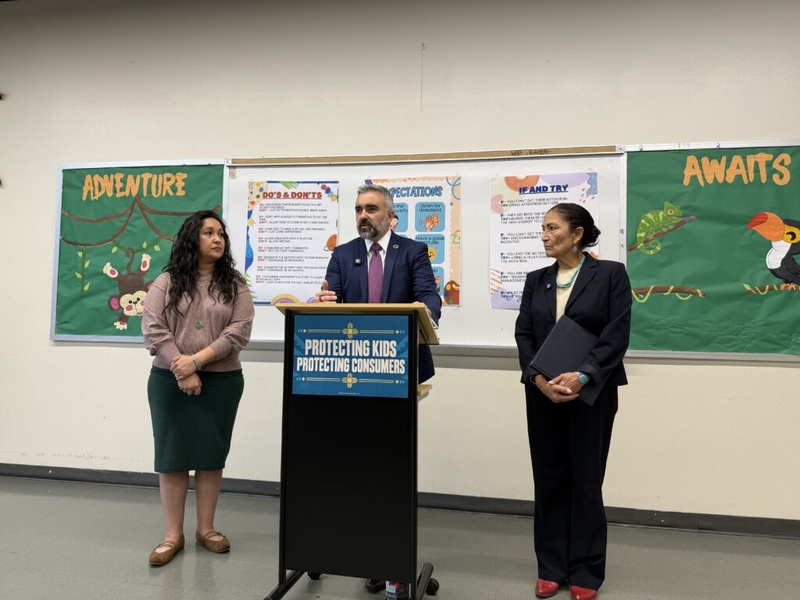
Left to right: state Rep. Linda Serrato (D-Santa Fe), New Mexico Attorney General Raúl Torrez and Democratic gubernatorial nominee Deb Haaland, on Sept. 23, 2026, announce plans to modernize the state’s consumer protection law and to create an Online Safety and Accountability Act in the 2027 legislative session. (Joshua Bowling/Source NM)
New Mexico Attorney General Raúl Torrez, state Rep. Linda Serrato (D-Santa Fe) and Democratic gubernatorial nominee Deb Haaland on Wednesday announced their plans to modernize the state’s consumer protection law and to craft new regulations for kids on the internet.
They said they intend to introduce a bill during next year’s legislative session called the Consumer Protection and Fair Pricing Act that would update the penalties and regulations under the state’s decades-old consumer protection law. A proposed Online Safety and Accountability Act would more closely regulate online content aimed at children, in particular.
Torrez has invoked the late-1960s Unfair Practices Act when suing the social media giant Meta and retailers he’s accused of marketing vaping products to underage youth. The state Legislature last updated the consumer protection law in 1970, Torrez said, setting a maximum penalty of $5,000 per violation of the law.
Earlier this year, a Santa Fe jury ordered Meta to pay the state $375 million in damages after Torrez’s New Mexico Department of Justice argued the company had misled the public regarding child exploitation and adverse mental health effects. If the maximum penalty had been adjusted for inflation, Torrez said at a Wednesday Albuquerque news conference, that judgment would have been around $3 billion.
“The penalty that we have, while meaningful and important…is simply not enough on its own to change behavior at the corporate level,” he told reporters. “New Mexico needs to update its penalties to match the scale of the harm and match the scale of the resources that are brought to bear by these companies.”
Torrez said he hopes to see the Legislature take up a bill that establishes tiered penalties depending on the level of harm. The proposed bill would increase penalties to $50,000 per violation, and could increase further when companies target children, people with disabilities or people under a guardianship.
Torrez and Serrato, the Santa Fe Democrat who said she plans to sponsor the legislation, said the bill would also update the consumer protection law to account for modern technology. It would more closely regulate “personalized pricing,” the practice by which companies use artificial intelligence to offer differing prices on goods and services depending on who the customer is.
It would also ban “manipulative” design elements, such as a ticking clock on an online shopping cart.
And, Haaland said, the law would take the step of prohibiting landlords from using AI to “rent fix” by giving different rates to different prospective tenants.
She cited a range of issues, “from digital price tags that can raise prices on shoppers in real time to subscription services that make it nearly impossible to cancel to corporate landlords using AI to coordinate and drive rents higher and higher,” as areas the legislation would meaningfully address.
Serrato also said she’d sponsor legislation to create an Online Safety and Accountability Act, which would specifically focus on digital content aimed at children, including AI companion chatbots and “addictive design features.” It would mandate safety precautions for young users, such as requiring developers to disclose that AI programs do not “represent or mimic” how real people act.
It would also require that developers make products with youth-specific features, including a chronological feed; a two-hour daily default; silenced notifications overnight and during school hours; and automatic blocks on profiles that exhibit sexual extortion or grooming behaviors.
Under the law, AI chatbots could not sexualize minors, pose as licensed professionals or discourage minors from seeking behavioral healthcare. A new Office of the Online Safety Monitor within the New Mexico Department of Justice would be responsible for investigating potential violations, which could carry penalties up to $150,000 for repeat offenders.
Serrato cited her recent work in calling on the state Public Education Department to work more closely with parents after it implemented a controversial AI program in classrooms across the state.
“In so many ways, New Mexicans are unprotected,” Serrato said. “Our data is out there and we are flailing in this system that our federal government has no protections for.”
Santa Fe, NM