Nevada workers are losing almost $123 million a year to wage theft, says report
Mar 11, 2025 | 8:00 am ET
Description
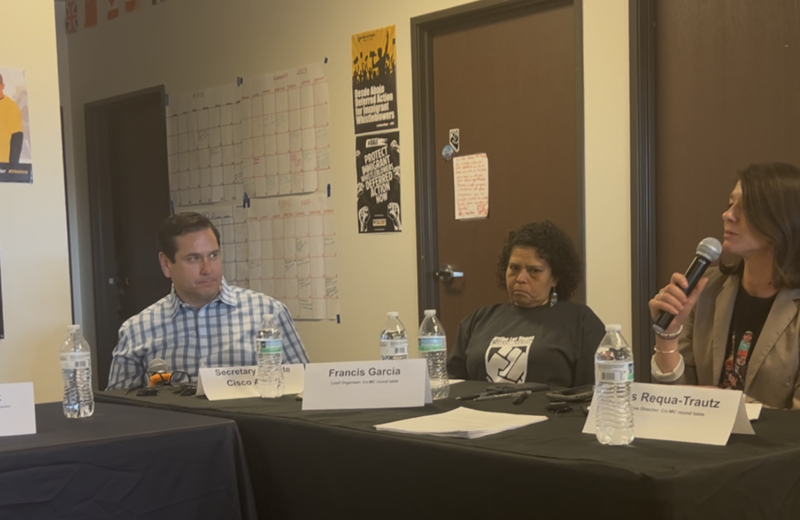
Secretary of State Cisco Aguilar takes part in a roundtable on wage theft at Arriba Las Vegas Worker Center alongside lead organizer and co-emcee Francis Garcia and executive director Bliss Requa-Trautz. (Photo: Dana Gentry/Nevada Current)
Wage theft is costing Nevada workers an average of $122.8 million a year – or some $2.4 billion over the last two decades, says a report from Rutgers University’s Workplace Justice Lab and Northwestern University, which conduct research on workers’ rights and economic inequality.
The report, based on data from the U.S. Census’ Current Population Survey, found just under 40,000 Nevadans are underpaid an average of $3,132 a year.
The average worker in Nevada has a 3.4% chance of being underpaid, the report says, but the rate is much higher in occupations dominated by women, especially in domestic and service industry jobs.
- Personal service workers, such as hairdressers, cosmetologists, manicurists, animal caretakers, and laundry service employees are at three times greater risk (10.5%) of being underpaid than the average Nevadan.
- Farmworkers (9.8%) and food service workers (8.4%) are two to three times as likely to be cheated out of the minimum wage than the average Nevadan.
- Domestic workers, those employed by individuals in the home, such as housecleaners, childcare workers, and personal care attendants, are five times more likely (18.1%) to be paid less than the minimum wage than the average worker in the state.
Domestic work “is a complex patchwork,” said Ai-jen Poo, president and founder of the National Domestic Workers Alliance. “Isolated, formal and informal, immigrants and citizens, home-based and agency-based, no clear job description or job security, and yet generating billions in economic value, touching every sector of the economy in a way that enables people across our labor market to work.”
Working in the home, she said, “is like the wild wild west. It’s the luck of the draw in terms of who you might get as your employer and what the conditions might be. You never quite know what to expect as a lack of standards and protections in this sector has deep historical roots,” says Poo, adding some of the first domestic workers in the U.S. were enslaved African women.
When the nation’s Social Security laws were enacted, Southern members of Congress refused to support the law if it included protections for domestic and farm workers, who were overwhelmingly Black.
White, male citizens in Nevada have a 2.3% chance of being underpaid, while women of color who are not U.S. citizens are almost three times more likely to be cheated out of their wages.
Workers without a high school diploma are around twice as likely as those with a diploma to be paid below the minimum wage of $12 an hour.
Workers who are not paid by the hour, but rather weekly or at a rate per piece, are also more likely to be cheated by their employer. Part-time workers are more likely to be underpaid than full-time, the report says.
“Employers in low-wage service industries with small profit margins may be particularly willing to take advantage of workers’ vulnerabilities by underpaying them, especially given the limited likelihood of investigation or detection by under-resourced enforcement agencies,” the report said.
‘Tip of the iceberg’
The Rutgers report cites a recent study from the Economic Policy Institute that found state and federal authorities in the U.S. recovered $1.5 billion in unpaid wages between 2021 and 2023.
“Wage theft is pervasive across all industries and income levels in the country, but workers who can least afford to bear the cost of lost earnings—particularly low-wage workers—are disproportionately vulnerable to wage violations,” the EPI study reported.
“This figure represents only the tip of the iceberg, however, as most instances of wage theft still go unreported,” the Rutgers report says. “Unfortunately, the concerning patterns and trends in wage theft in Nevada are likely to persist without active intervention and vigorous enforcement.”
In Nevada that job falls to the Office of the Labor Commissioner (OLC), where the average caseworker carries 113 cases a month, which is “just way too many,” says Janice Fine, the director of the Workplace Justice Lab at Rutgers University. “We think it’s actually triple the number of cases that a single investigator can carry, certainly double the number of investigations.”
The Department of Business and Industry confirmed each caseworker carries an average of 113 cases a month.
Heavy caseloads incentivize caseworkers to close cases quickly, often missing the opportunity to question other workers in the same company.
“We want to encourage the labor commissioner to think about a series of practices that will lead to really going to the root of this wage theft problem,” Fine said during a roundtable on wage theft at Arriba Las Vegas, a worker center that partnered with Rutgers on the study. “It’s important to note that Nevada’s $12 minimum wage is not a living wage. Research finds that a single adult in Nevada today must make $23.85 an hour to support themselves working full time. Yet we find that tens of thousands of Nevadans are still paid below the state minimum wage every year.”
Some 40% of workers don’t come forward because they fear retaliation, said Fine, and many don’t know their rights have been violated.
Until a month ago, Nevada Secretary of State Cisco Aguilar was unaware of the prevalence of wage theft in Nevada, he acknowledged, or how businesses that evade registering with the state exploit employees. Aguilar said it’s now his responsibility, along with the Attorney General, “to help make sure that people are not abusing our office to hurt people.”
Fine of Rutgers’ Workplace Justice Lab says attorneys general and secretaries of state can take “a deep dive into their own statutes, and figure out what powers do they have, what powers could they use that they’re not using now and what powers can they go and get.”
Officials in other states, she said, are working with tax collectors to bring offending businesses to justice. “Because when people aren’t paying their workers, we can assume that they’re not paying their taxes.”
Fine says some of the most consistent violators, such as unregistered businesses, have been “left out of labor laws,” which she says have not kept pace with the economy. “So we have this problem that government is trying to catch up, while labor and employment practices are evolving much, much faster.”
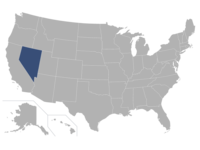
Las Vegas, NV