Nebraska Supreme Court hears arguments over validity of ‘fairness for girls’ ballot measure
Sep 30, 2026 | 4:49 pm ET
Description
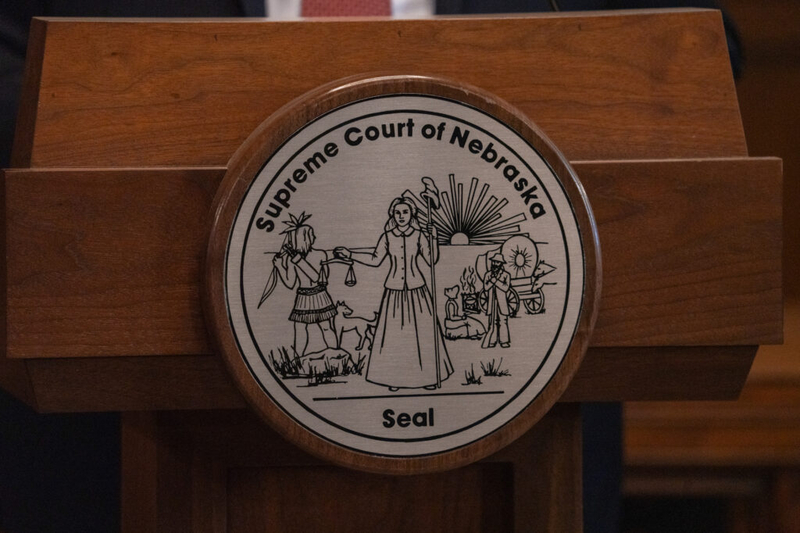
The seal of the Nebraska Supreme Court. May 4, 2026. (Zach Wendling/Nebraska Examiner)
LINCOLN — The Nebraska Supreme Court heard arguments Wednesday in a lawsuit attempting to disqualify a ballot measure that would cement sex-separate school sports requirements in the state Constitution.
Plaintiff Cara Ullman’s lawyer argued that the ballot measure’s sponsors failed to “adequately inform the public of what they are trying to accomplish.” Lawyers for Nebraska Secretary of State Bob Evnen and the ballot sponsors said the sponsors followed the steps needed to be on the ballot.
Ullman originally had asked the Nebraska Supreme Court to weigh in earlier in September, but the high court declined. Ullman then went through Lancaster County District Court, where a district court judge dismissed all objections to the case. The Supreme Court decided to hear the appeal.
The main argument from Ullman’s lawyer, Sydney Hayes, is that the measure’s object statement lacks specificity about what it aims to do, so it doesn’t comply with state law.
“The purpose is essentially to inform the public the gist or the key points of a measure on the very front of the petition page, and while talking to voters and soliciting their signatures,” Hayes said.
Zachary Pohlman, the lawyer for Evnen, said the object statement follows state law because it identifies the legal effect of filing the petition, states the object or goal of the proposed measure, and does so concisely.
“The best evidence of legislative intent is to look at the text of the statute, and so in deciding, does the object statement accurately capture the proposed measure. We look at the text of the proposed measure itself, and this one again plainly satisfies that test,” Pohlman said.
The ballot is already certified, but the measure will appear on the ballot regardless. However, a successful appeal could invalidate the vote in November. Pohlman said that if the court wants to overturn the lower ruling, it would need to do so by Oct. 27, giving state election officials enough time to work out how to withhold the results from the public since the ballot measure would be invalid.
Former state Sen. Andrew La Grone of Dunbar, on behalf of the three sponsors behind Fairness for Girls, agreed with Pohlman’s argument.
The Fairness for Girls proposal would make permanent part of a 2025 state law that requires public K-12 schools, colleges and universities, and any private schools or colleges in the state that play against those schools, to designate sports and athletic teams as male, female or coed. Male students couldn’t play on female-only teams.
The ballot language wouldn’t define “sex” in the state constitution itself, relying on the definition in state law that was passed last year that defines sex as whether someone “naturally has, had, will or would have, but for a congenital anomaly or intentional or unintentional disruption, the reproductive system that at some point produces, transports and utilizes” either eggs (female) or sperm (male) for fertilization.
Editor’s note: Corrected spelling of Zachary Pohlman.
Lincoln, NE