Nearly half of AAPI women lack a reproductive health provider, survey finds
Oct 27, 2026 | 12:55 pm ET
Description
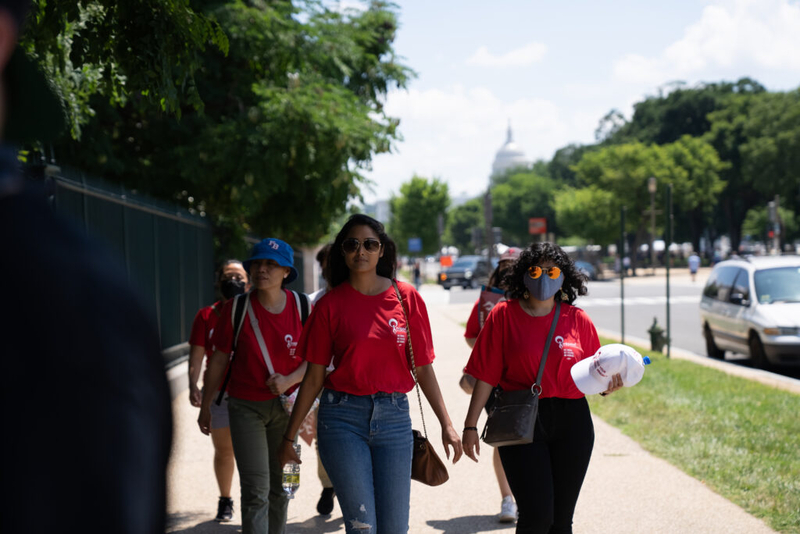
Women with the National Asian Pacific American Women’s Forum walk down the streets of Washington, D.C., at a 2022 Unity March against anti-Asian racism. A recent survey led by the group found nearly half of Asian American, Native Hawaiian and Pacific Islander women don’t have a reproductive healthcare provider. (Photo courtesy of National Asian Pacific American Women’s Forum)
A survey of Asian American, Native Hawaiian and Pacific Islander women and gender-expansive people found nearly half of respondents don’t have a reproductive healthcare provider and more than half don’t know how far they would need to travel for abortion care.
About 57% also said they are caregivers to a child or aging family member, and 23% said they themselves or someone they know have avoided travel, medical care, work or public spaces because of immigration status concerns.
Fajer Saeed Ebrahim, vice president of policy and research at the National Asian Pacific American Women’s Forum, which commissioned the survey, said it’s the first of a five-year survey project the organization has planned to observe trends over time.
Early prenatal care declines across US, reversing years of progress
“I think our women face many of the same challenges as many other communities of color, but our experiences are often missing from policy discussions,” Saeed Ebrahim said.
Most of those who responded lived in states with legal access to abortion, while about 20% lived in states where it was illegal or heavily restricted. About 56% were unsure how far they would need to travel for an abortion, and 31% were unsure how far they’d need to go for general reproductive healthcare. Of those who did have an estimate, most said they would need to travel less than an hour for reproductive healthcare other than abortion. Japanese women and those with lower incomes were most likely to say they did not have a reproductive healthcare provider.
Saeed Ebrahim said some of those issues may connect back to cultural stigma. About 60% of AAPI women said it was difficult for people in their communities to talk about abortion, even though many of them are strongly in favor of abortion rights. But the survey also showed a lack of knowledge about state abortion laws.
“People are confused,” she said. “They often don’t know what their state has to say about abortion care, and many are surprised to learn their state is more restrictive than not. … A lot of our community members were surprised that providers could be punished.”
Saeed Ebrahim said having more health providers with training to provide culturally sensitive and responsive care for AAPI women would help bridge gaps in care, including expanded language access.
“We’ve heard from many of our community members and our past research has shown … providers just are not familiar with our communities and some of the cultural expectations that come with identifying this way,” she said.
The survey was offered in June in several languages besides English, including Korean, Chinese, Vietnamese, Hindi and Tagalog. About 45% of respondents were located in the Western U.S., 23% in the South, 20% in the Northeast and 11% in the Midwest, and represented more than 20 ethnic backgrounds. It was conducted on behalf of the National Asian Pacific American Women’s Forum by research and public opinion firms Lake Research Partners and Sprout Insight.
Stateline reporter Kelcie Moseley-Morris can be reached at [email protected].