Indiana unveils medical frailty exception to upcoming HIP work requirements
Oct 27, 2026 | 1:44 pm ET
Description
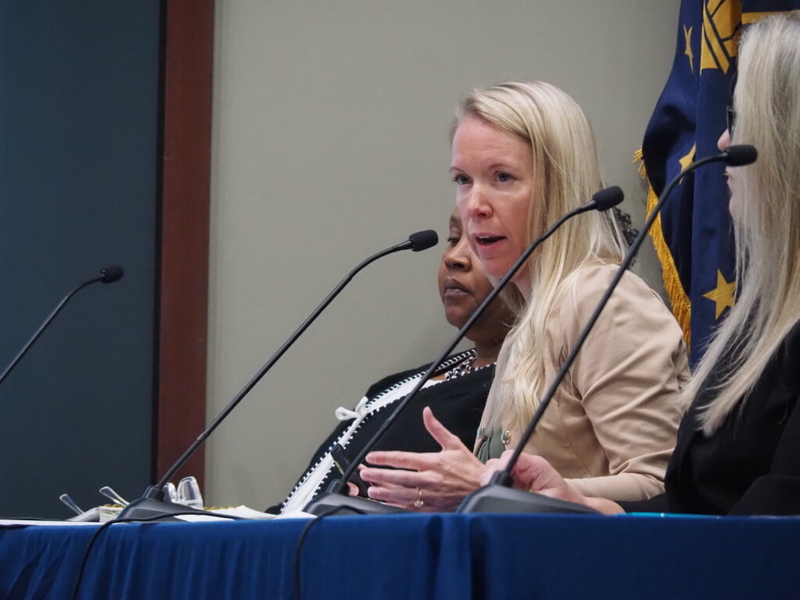
Medicaid Chief Clinical Officer Katrina Etter speaks on Tuesday, Oct. 27, 2026, at a quarterly financial review meeting. (Photo by Leslie Bonilla Muñiz/Indiana Capital Chronicle)
State officials on Tuesday revealed how they’ll apply a new federal definition for medical frailty, a key but contested exemption to fast-approaching work requirements for tens of thousands of Medicaid expansion enrollees.
The Healthy Indiana Program served roughly 475,000 Hoosiers as of Sept. 30, according to a quarterly financial presentation from the Family and Social Services Administration, with an “expansion” population of of 355,00 working-age adults who earn slightly too much for traditional Medicaid coverage.
Expansion enrollees face work requirements starting Jan. 1. They will need to demonstrate they’ve been working, volunteering or in school for 80 hours a month — for three months prior to their application or redetermination — to remain insured. Earning at least $580 a month — the equivalent of 80 hours at a minimum-wage job — would also count.
How will Indiana define medical frailty? State is still working out the details.
There will be exceptions for people considered medically frail, along with parents of younger children, participants in certain drug treatment programs, and more.
The state already uses the concept of medical frailty, but for a different purpose: a distinct benefit package within the HIP program. Now, it’ll be redefined for use as an exclusion from the work requirements.
A new federal framework narrows medical frailty to five statutory categories, like people considered blind or disabled under the Social Security Act. The other categories include physical, developmental or intellectual disabilities; disabling mental disorders; substance use disorders; and serious or complex medical conditions.
There’s another key change: someone who falls within one of the categories is only considered medically frail when their condition significantly impairs their ability to satisfy the work requirements.
The state will make decisions starting next year. Officials will use a new tool called Milliman Advanced Risk Adjusters, or MARA, which will sweep through all of the claims data available to the state.
“We have specifically customized it for the purpose of evaluating claims against the new federal definition,” Chief Clinical Officer Katrina Etter said of the tool. The frail will be excluded from work requirements for six months at a time.
New tool to determine frailty, with clinician team backup
Officials outlined three paths to the exemption.
Tier 1 is “diagnosis-based.” MARA will identify members with a medical diagnosis off a state list of conditions. Tier 2 is “evidence-based.” MARA will review qualifying conditions along with treatments, services or supports a member is receiving. Both will be reviewed continually.
A Sept. 30 run of the tool estimated nearly 140,000 people will qualify as medically frail under those mechanisms.
“If somebody does not hit medically frail through the use of that tool in one of those first two tiers, that’s when they can submit supplemental information for our clinical team to review,” Medicaid Chief Operating Officer Lindsey Lux said.
Under the third tier, a participant, provider, managed care organization or the state can make a recommendation or referral. State clinical staff will evaluate supporting documentation — medical records, treatments notes, medication lists, lab results — and make a decision.
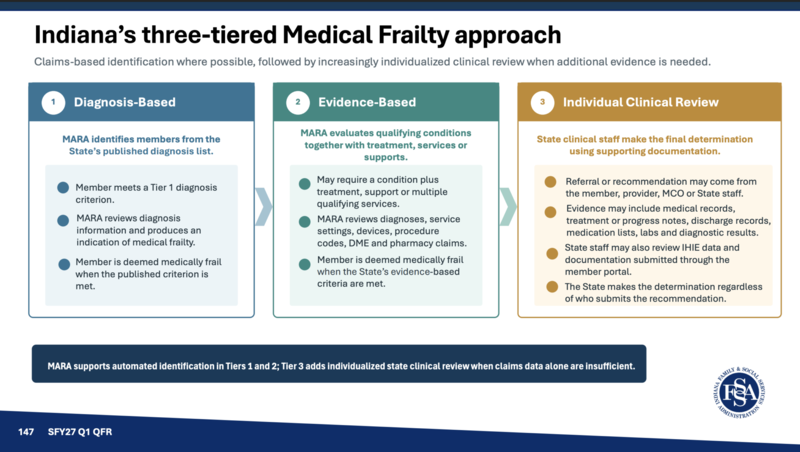
The clinical team has just three full-time staff members for now.
“I do anticipate that we will need to build the team over time,” Etter said. “But I do think we want to see the volume of that tier three pathway, which will help inform what that looks like.”
Along with hiring, officials are working to refresh online guidance, create forms and more. They plan to run MARA again next month and send out mailers with medical frailty determinations by late November or early December, according to Etter.
“It’ll say: based on the information that we have today, we deem that you are meeting frail status, and then they won’t need to do anything,” she said. “If they get a notice that says, ‘Based on the information that we have today, we cannot determine that you are medically frail. If you believe that is an error, here’s your pathway to submit information.'”
The state estimates that nearly a quarter of the projected medically frail plan members will qualify through disabling mental disorders alone. There’s no tier 1 pathway for that category of conditions, meaning that MARA will need to capture those people under tier 2 or they’ll have to undergo manual review by the state’s clinical team.
Indianapolis, IN