NC Republicans Tillis, Moore prepare for GOP losses in upcoming election
Oct 15, 2026 | 2:33 pm ET
Description
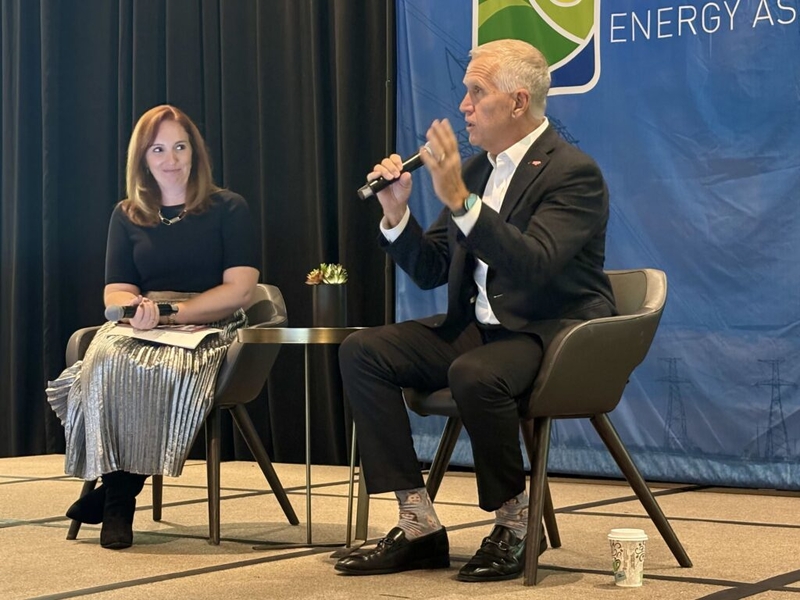
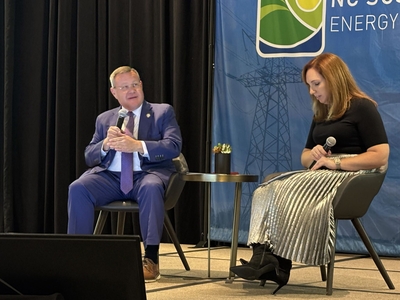
U.S. Sen. Thom Tillis speaking at an energy conference in Cary on Oct. 15, 2026. (Photo: Christine Zhu/NC Newsline)
Two sitting GOP members of North Carolina’s congressional delegation say they’re bracing for Republicans to lose seats in November.
Speaking at an energy conference in Cary on Thursday, retiring U.S. Sen. Thom Tillis said the Republican party has changed over the 20 years he’s spent in public office.
“The election’s in 19 days,” Tillis said. “Twenty days from now, I’ll be reaching out to Republicans who aren’t crazy and try to figure out how we can recover from what I think are almost certain losses this election cycle.”
Recent polls have shown a tough political climate for the GOP. President Donald Trump’s approval rating hovers in the upper thirties in the Tar Heel State. That’s been a problem for Republican U.S. Senate candidate Michael Whatley, who’s tied himself closely to the president ever since entering the race with Trump’s endorsement.
In the contest to succeed Tillis, Whatley, a former Republican National Committee and North Carolina GOP chair, has consistently trailed his Democratic rival, former Gov. Roy Cooper. With little movement in the polls, national groups on both sides have pulled funding from the race, choosing to focus on other states instead.
NC elections board to notify 1,392 voters flagged as potential noncitizens
The seat could play a pivotal role in control over the Senate. Republicans currently hold a 53-47 majority, so Democrats would need a net gain of four seats to flip the chamber. In the House, the GOP has a 218-212 majority, with four vacancies and one independent who caucuses with Republicans.
“I’m happy to help any candidate, and that includes Whatley and anybody else,” Tillis told reporters. “What we have to do in the state is resonate with unaffiliated voters and have some separation from the president when you legitimately have a difference in opinion.”
Towards the end of his two terms in the U.S. Senate, Tillis has become known for straying from the party line and going against Trump. Rather than face a Trump-backed candidate in the primaries, Tillis decided not to run for reelection in 2026.
Tillis delves further into his quarrels with Trump in his memoir, How to Lose Friends and Antagonize Presidents: The Trouble with Sycophants, Courage Outsourcing, and Partisan Groupthink. The book was released last week.
“I still have a good relationship with the president, and I will as long as he wants to have it,” Tillis said. “Then I’ll have whatever relationship, if it’s other than that, that he chooses to have.”
Last year, Tillis voted against Trump’s “One Big Beautiful Bill” due to its language regarding Medicaid. The measure cut about $800 million from Medicaid funding in North Carolina.
The senator said he opposed the bill because it hurt North Carolinians, and advised Trump against the Medicaid provisions.
“I’m here to try and make policy better and get Republicans elected every election cycle,” Tillis said. “I was just saying, ‘This is not going to work, and it’s not going to help your legacy. It’s certainly not going to help our chances in the election cycle.’ And I think both are proving to be true right now.”
U.S. Rep. Tim Moore, who represents the state’s 14th Congressional District, served as the Speaker of the North Carolina House before his election to Congress. He succeeded Tillis in the state House leadership role.
Moore said he thinks Republicans will retain their majority in the U.S. Senate, but is unsure about the U.S. House. He’s more confident in his party’s performance at the state level, where Republicans have drawn legislative districts to maximize their partisan advantage.
Republicans hold a 30-20 majority in the North Carolina Senate and a 71-47-2 majority in the House. After the 2024 election, they fell one seat short of a veto-proof supermajority in the lower chamber.
“Absolutely, Republicans will maintain a majority in the state legislature,” Moore said. “I’m very familiar with those legislative districts, and I see the quality of the candidates who are working. I do think that the Republicans may lose about three seats.”
Raleigh, NC