Morrisey’s State of the State missed the mark on some of West Virginia’s biggest issues
Jan 20, 2026 | 5:55 am ET
Description
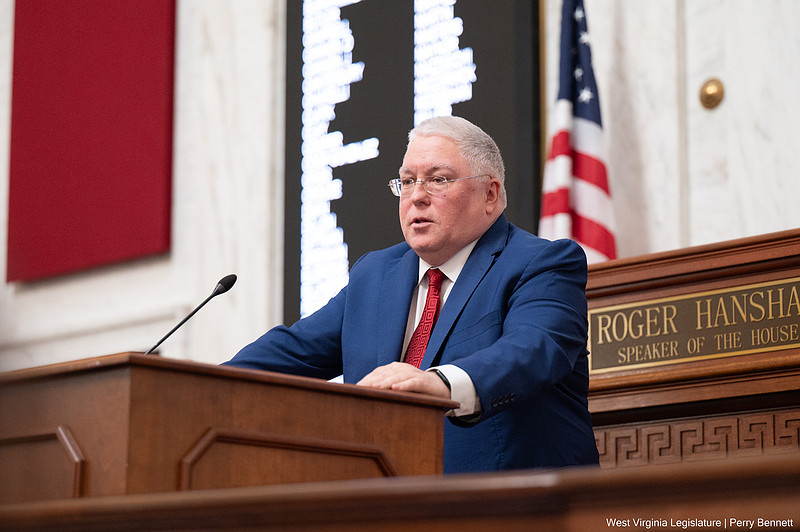
Gov. Patrick Morrisey gives his State of the State address in the West Virginia Capitol in Charleston, West Virginia, on Wednesday, Jan. 14, 2026. (Photo by Perry Bennett/West Virginia Legislative Photography)
Gov. Patrick Morrisey gave his second State of the State address last week, and the speech failed to touch on some of the state’s biggest problems.
Many of West Virginians’ issues stem from poverty, yet Morrisey only mentioned a 3% raise for state employees. Why not raise the state minimum wage? The last time West Virginia saw an increase in the minimum wage was in 2015. The $8.75 an hour isn’t even half of the $19.43 living wage that a single person with no children needs to support themself.
West Virginia has the highest average utility bill in the nation, with residents paying about $42 more per month than they were last year. WTOV talked to Delaney Eddy, state coordinator for West Virginia 211, who said there’s been an increased demand for utility assistance.
Morrisey did acknowledge “significant increases in all forms of energy” prices for West Virginians, but didn’t share any plans on how West Virginia can control those costs.
Health care costs are increasing and people who rely on the Public Employee Insurance Agency or use the Affordable Care Act Marketplace to purchase insurance are particularly feeling the pain. Morrisey said that instead of a 14% increase in premium rates for PEIA users, this year they would only see a 3% increase, and that in order to fix PEIA the “Legislature will need to work with me on real reforms.” He gave no hint on what his ideas for reform were.
People who use the ACA Marketplace are seeing their premiums increase by 133%, because of expiring premium tax credits that Congress hasn’t renewed. West Virginians already have poor health; in 2021, the state per capita led the nation in deaths caused by cancer (184.7 deaths per 100,000), drug overdoses (90.9), diabetes (47.6) and kidney disease (25.8), according to mortality data from the Centers for Disease Control and Prevention.
This won’t change if people can’t afford to go to the doctor. They’ll suffer, get worse, self medicate or die. When we already have such a severe drug problem, we can’t afford to let our people continue to self medicate.
West Virginia is losing more than $1 billion per year in Medicaid funding for its hospitals under cuts in the One Big Beautiful Bill Act. The Rural Health Transformation Program will only provide the state $199 million for 2026 — and some of that money is going to go to salaries of temporary state employees.
So what did Morrisey have to say about our health crisis? He talked about his Mountaineer Mile initiative, which encourages everyone to walk one mile a day, last year’s law to remove artificial food dyes from food — which is now being held up in court — and banning SNAP recipients from buying soda with their benefits. He also mentioned the reinstatement of the Presidential Fitness test, a way to make children hate gym class by making them feel bad for not being able to climb a rope.
Thousands of West Virginians don’t have access to clean drinking water, but there was no mention of a solution for that. At least Morrisey did ask lawmakers for $10 million to fund a flood preparation initiative. The state’s flood fund has been empty since its creation, and multiple devastating floods happen each year in the state.
There wasn’t a single mention of schools closing and consolidating.
According to the state Department of Education, at least five public schools closed in 2025, and 16 closed in 2024, up from nine in 2023 and five in 2022.
Instead, Morrisey focused on the state’s school voucher program, the Hope Scholarship, which is expected to cost around $230 million. Morrisey said that the state has “built it into our baseline so that Hope funding is not dependent upon surpluses.” He also said the state is “pre-paying” all of next year’s Hope Scholarship “as a commitment to this policy.”
Some Republicans have raised concerns over the increased costs of the program, and House Democrats are expected to introduce bills to put guardrails on how the money can be spent.
I will give Morrisey credit for addressing two issues — bridge infrastructure and literacy.
Morrisey said he wants to give $100 million to supplement road and bridge repair work. About 17% of the state’s bridges are in poor condition, about 56% are in fair condition, and only about 27% are in good condition. This money is desperately needed.
He also said the state will implement LETRS, a program that Mississippi used to go from being ranked at the bottom in public education to the top. In 2024, 75% of West Virginia’s fourth graders were not proficient in reading.
We’re only a week in, but hopefully soon we’ll get more details on how Morrisey hopes to tackle some of these issues.
Charleston, WV