Morgantown City Council moves to eliminate ‘hostile architecture’
Jul 10, 2026 | 6:00 am ET
Description
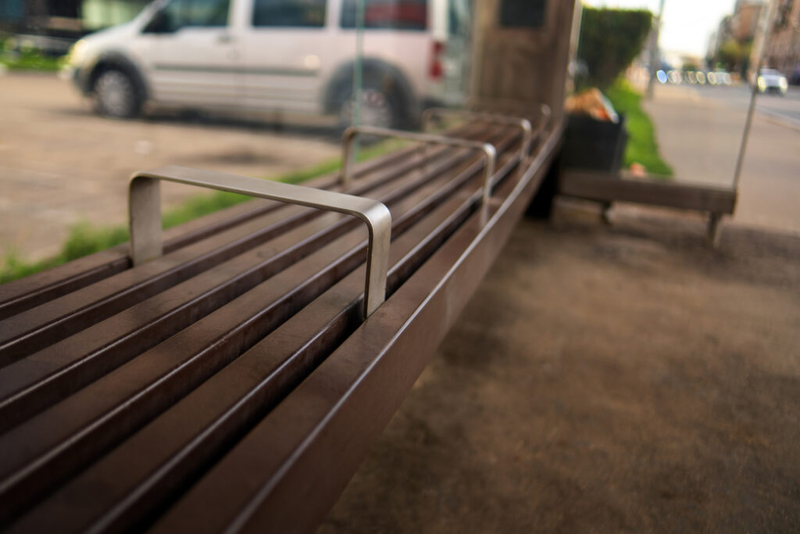
Morgantown City Council voted Tuesday to approve a resolution that prohibits the city from installing “hostile architecture” in public infrastructure, such as benches with bars that prevent homeless people from sleeping on the bench. (Photo by Tatiana Stephanishcheva/Getty Images)
Morgantown, West Virginia, has taken a step away from park benches and other equipment designed to discourage unhoused people and others from resting or lying down.
Morgantown City Council voted 5-2 on Tuesday to approve a resolution that prohibits the city from installing “hostile architecture” in public infrastructure, including new projects, repairs and replacements.
The National Coalition for the Homeless defines hostile architecture as “urban-design strategy that utilizes elements of the built environment to intentionally guide or restrict behavior deemed undesirable by urban leaders.”
It can include slanted benches or uneven pavement that make it difficult for homeless people to sleep on, spikes in doorways or in windowsills that prevent people from sitting or lying down, locked benches and sprinklers.
Morgantown’s resolution defines the term as “physical design features installed on public infrastructure primarily intended to deter people from resting, sitting, lying down or remaining in a particular area, when such features operate as a deterrent through discomfort, exclusion or restriction rather than through legitimate safety, security or operational necessity.”
Brian Butcher, one of three council members who sponsored the resolution, said it’s something that he’d been thinking about since he was elected. The issue was highlighted recently when the city installed a small bench with a divider in the middle in a city green space, he said.
“It’s a pretty small bench, but still has a divider,” Butcher told West Virginia Watch Wednesday. “I don’t think you could even lay down on it as a full-grown man, but it still has a divider at the center, right? And I was just like, ‘That is so silly.’”
Morgantown’s resolution doesn’t require the city to replace every piece of “hostile architecture,” but contemplates the city replacing equipment as needed with pieces that are not hostile, Butcher said.
A preliminary inventory found the city has around 15 park benches that are considered hostile, the Mountain Line Transit Authority has 18 to 20, and the Morgantown Board of Parks and Recreation has three. The preliminary audit focused on park benches because other types may be more difficult to identify, he said.
“We don’t have just straight up spikes on concrete surfaces… but there probably are places where we have planters and stuff like that that disallow you to sit down,” Butcher said. “But I’m not immediately aware of them. They don’t stick out as much, so it was kind of the low-hanging fruit that was put in for that inventory.”
Morgantown resident Paige Reiring spoke in support of the resolution during Tuesday’s meeting.
“As someone who lives downtown and who shops and visits our parks here and generally spends the majority of my life down here, I love seeing our city become more accessible to people,” Reiring said. “I have noticed that the lack of seating has been a major barrier not only for me to enjoy being in the city but also for my friends as well. I have friends who are disabled and need frequent breaks to avoid hurting themselves when they’re traveling, especially with some of the hills that are throughout downtown.”
Another woman urged council members not to pass the resolution. She said some people need benches with armrests on both sides in order to push themselves up to a standing position from the structures.
“I, in fact, see your proposal to eliminate these benches as exclusionary, discriminatory, unwelcoming, and in fact hostile to those of us in the (age) 55-plus community, as well as those who are handicapped either temporarily or permanently,” she said.
Councilwoman Lousie “Weezy” Michael, one of two votes against the resolution, agreed that it may exclude seniors and people with disabilities and mobility issues.
Funding for some of the city’s benches came from AARP-West Virginia, the state’s largest non-partisan membership organization representing older residents. The organization provided a Community Challenge grant to the city in 2018 that the city used the grant to install benches in its business district.
A spokesman for AARP said the organization has no comment on the resolution.
Nick Ward, legal director for Disability Rights West Virginia, a nonprofit that advocates for disabled people in the state, told West Virginia Watch Thursday the organization supports Morgantown’s resolution.
“Disability Rights of West Virginia (DRWV) supports the Morgantown City Council’s effort to move away from hostile infrastructure,” the organization said in a statement Thursday. “We are encouraged by the city’s proactive approach to making the community more accessible, welcoming, and accommodating for everyone. DRWV will always support efforts to create public spaces that remove barriers rather than create them, and that promote equal access for everyone in our community.”
Both Michael and Councilwoman Jennifer Seline, who also opposed the resolution, said they disliked the framing of some benches as hostile.
“I am unequivocally in favor of benches,” Seline said. “I wish that it wasn’t in the format of hostile architecture that we were talking about benches. I wish we were doing our inventory, having our model benches of what we wanted in the positive versus framing it in this way.
“I would like to see this wait until we had something in the positive that we could promote as Morgantown wanting to develop ways to get more benches, have people consider donation, have a model versus calling a bench potentially hostile that might be useful to some and not useful to others,” Seline said.
In response to comments about older and disabled people needing certain types of benches, Butcher said that hostile architecture can discriminate against a wide variety of people — including those with low or no vision, people with bigger bodies and those that have difficulty walking. He said guidance from the Americans with Disabilities Act centers around having one armrest on an end of the bench.
“The large research, the preponderance of research that I’ve done on the topic, finds that the sort of partitions that are meant for one person to sit in in between on a bench largely are only there to stop people from lying down and creates a bunch of other knock-on effects for the other affected groups that I mentioned earlier,” Butcher said.
The city of Morgantown is one of several in West Virginia that have banned homeless people from sleeping on public property in the wake of the 2025 Grants Pass decision by the U.S. Supreme Court of Appeals.
Other discussion about the resolution included comments that the city of Morgantown generally already does not use hostile architecture. Butcher said the resolution aims to make sure the city does not do so in the future.
“I don’t see a reason why our city would want to promote spikes on the ground or rollers that prevent people from sitting in a space or utilizing our public spaces,” Butcher said. “I think our public spaces are for everybody, and that we should try to make sure that absolutely everybody who is in our city feels like they can be welcomed into our public spaces.”

Charleston, WV