More housing, less asphalt, say Colorado lawmakers who want to scrap parking minimums
Mar 07, 2024 | 6:00 am ET
Description
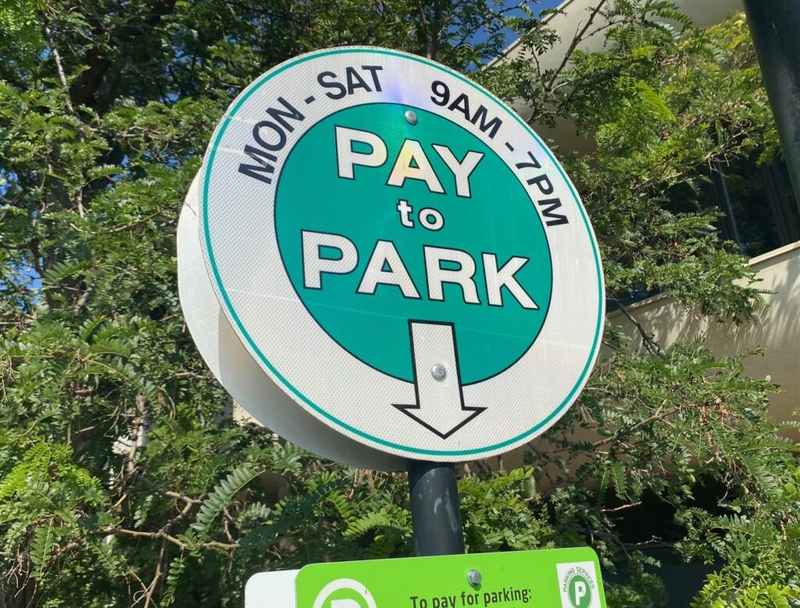
A parking sign stands in downtown Boulder on Aug. 14, 2021. (Quentin Young/Colorado Newsline)
A bill backed by Democrats would eliminate parking minimums in Colorado’s largest cities in an attempt to make development such as new multifamily housing easier and more affordable to construct.
House Bill 24-1304 passed out of its first committee on Tuesday.
“We’ve ended up with an abundant supply of asphalt and a scarcity of housing and transportation choices,” bill sponsor Rep. Stephanie Vigil, a Colorado Springs Democrat, said about the consequences of decades-old parking mandates that require a certain number of spaces per residential unit or square footage.
Parking minimums vary across the state. In Colorado Springs, a detached single-family home needs two off-street parking spots. In most parts of Boulder, each housing unit needs one parking space. In Castle Rock, there needs to be two spaces for every unit in a multifamily building.
Such standards are a component of building codes in most cities, born out of the post-war construction boom, Vigil said, to ensure there was enough space for people to keep their cars in an increasingly vehicle-dependent society. What ended up happening in some cases, however, was the creation of too many parking spaces for a given development. Not only does that add cost to a project, it also takes away space that could have been used for more housing units or additional community features.
“This isn’t something the free market decided to do. It’s the result of government regulations that don’t allow households and communities to use the market in an intelligible way and adapt to changing variables,” she said.
Rep. Steven Woodrow, a Denver Democrat and bill sponsor, said it costs an average of $28,000 to build one parking space, and even more if the space is underground.
“That financial burden is passed on to consumers whether or not they drive or can afford a car. Builders bundle the cost of parking into the price of goods, services and housing,” he said. That price increase is an average of $225 per month for renters.
This isn't something the free market decided to do. It's the result of government regulations that don't allow households and communities to use the market in an intelligible way and adapt to changing variables.
In some cases, the cost of parking prevents builders from going forward with a project.
The bill would prohibit the enforcement of parking minimums in cities within a metropolitan planning organization, including most of the Front Range and Grand Junction. That is the group of cities targeted in many of the housing-related bills introduced in the Legislature this year.
That would allow the market and individual developers, supporters say, to determine the actual number of parking spaces needed to make a project successful.
“Largely, what we have seen is that wherever a city or region has eliminated their parking minimums, the supply still meets the demand with very few exceptions,” Vigil said.
Opponents of the bill argued that while eliminating parking requirements makes sense in some scenarios, like where there is ample public transit, it should be up to local governments to decide. Cities are already doing the work to “right-size” parking requirements.
“Local governments understand the needs of local land use best and are best equipped to determine what works in our communities,” said Littleton Mayor Kyle Schlachter.
Additionally, some cities, like Littleton, have reduced parking requirements in their inclusionary housing ordinance. If that incentive goes away, developers could be less willing to build affordable units.
The Colorado Municipal League and individual city governments including Cherry Hills Village, Colorado Springs and Centennial are opposing the bill. It has the support of organizations including the American Planning Association, the Colorado Apartment Association and the Denver Metro Chamber of Commerce.
The bill would also direct the Department of Transportation to study parking space usage in metropolitan planning organizations by next summer.
Denver, CO