Moore signs environmental justice order, amid federal government’s anti-DEI push
Jul 18, 2025 | 4:54 am ET
Description
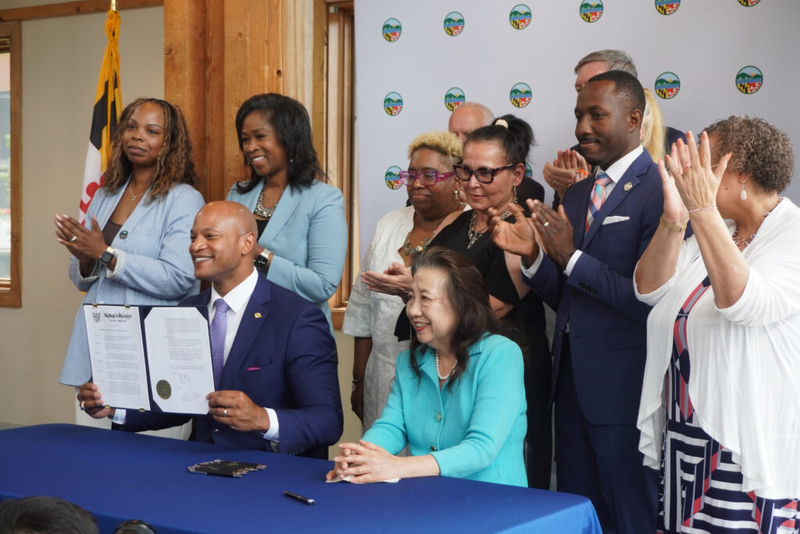
Gov. Wes Moore (D), flanked by Cabinet secretaries, advocates and a lawmaker, signs the VOICE executive order, geared toward bolstering environmental justice efforts in the state. (Photo by Christine Condon/Maryland Matters)
In 2022, Maryland released its Environmental Justice Screening tool, a map that allowed users to view data on pollution burdens and health metrics Census tract by Census tract.
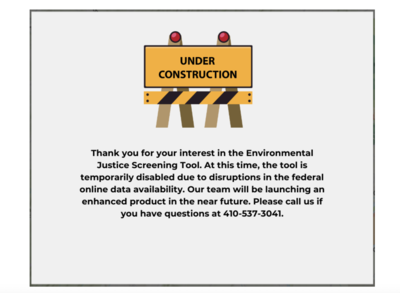
But earlier this year, it ran into a President Donald Trump-sized problem. The webpage temporarily gave way to a cartoon roadblock sign, bearing the words “Under Construction.”
“At this time, the tool is temporarily disabled due to disruptions in the federal online data availability,” read the Maryland website.
But now, the tool is back online and functioning, this time, independent of federal data.
In an executive order — which he signed Thursday at Baltimore’s Living Classrooms campus in Harbor East, as young summer campers played outside — Gov. Wes Moore (D) ordered his administration to “use this new, improved, data-driven map to inform their policy work and to inform the decisions of their agencies and departments.” Speakers called it a first-ever executive order in the state on environmental justice.
“Since the new Trump-Vance administration took office, we haven’t been able to rely on federal data because that data is not being released, and that data is not now readily available,” Moore said. “But in this administration, that won’t be enough to make us give up.”
The executive order also creates an interagency advisory council focused on environmental justice and equity that Moore said will serve as a “hub for collaboration across 13 different state agencies,” which will be required to designate environmental justice officers and create environmental justice strategic plans within a year.
“Environmental justice won’t just be the work of a single department. Environmental justice is not a lane. It is a lens,” Moore said.
The council, which will meet at least quarterly, is tasked with collaborating on environmental justice training programs for state employees and identifying opportunities to streamline grant funding for environmental justice communities, among other tasks. It must submit status reports every Dec. 1, starting this year.
The order, nicknamed VOICE — for Valuing Opportunity, Inclusion and Community Equity — also directs state agencies to “prioritize opportunities for meaningful engagement with impacted communities on policies and priorities related to Environmental Justice.”
The order “solidifies Maryland’s unwavering commitment to environmental justice, irrespective of what the noise is around us,” Maryland Environment Secretary Serena McIlwain said during Thursday’s event.
“You know what I mean,” she added.
That “noise” is likely coming from the Trump administration, which has sought to eliminate “diversity, equity and inclusion” programs around the country, and targeted environmental justice staffers at federal agencies for reassignment or layoff.
The executive order also includes provisions calling on state agencies to “accelerate progress removing barriers that have always historically stood in the way of our underrepresented farmers,” Moore said. That includes difficulties that farmers face accessing land and accessing financing, Moore said.
It comes after legislators failed to advance an environmental justice-focused bill in the 2025 General Assembly. Called the CHERISH Our Communities Act, it would have set new requirements on permits issued by MDE to polluting sources in areas overburdened with a high environmental justice score.
The sponsor of that bill, Del. Jazz Lewis (D-Prince George’s), said during Thursday’s press conference that both executive and legislative actions will be needed to improve conditions for Maryland communities grappling with environmental justice.
“I say this with conviction as a sponsor of the CHERISH Our Communities Act: This executive order is not just welcome. It is necessary, because this movement for environmental justice will take all of us,” Lewis said. “It will take legislation, executive action and the voices of everyday Marylanders standing up and demanding better.”
Annapolis, MD