Mixed reception in Trenton for union-backed bill to revamp school health benefits
Oct 15, 2026 | 4:54 pm ET

Description
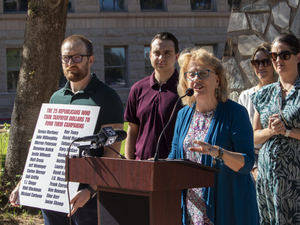
Teachers union officials have a plan to help fix the state-run health benefits plan for school workers. Critics say it needs more work. (Photo by Dana DiFilippo/New Jersey Monitor)
hA proposal to shift public health plans for school workers to a new trust where state officials play a lesser role in governance received a mixed reception during discussion before a Senate panel Thursday.
Though union officials who back the bill said its changes are needed to maintain health coverage, groups representing school boards and school administrators, among others, warned that the proposal would do too little to rein in rising health insurance costs.
“You can put a new name on the box. You can give it a gold-plated guarantee, but you don’t fix what’s inside the box, you’ve just made a prettier box. The bill as proposed right now is a prettier box,” said Patrick Duncan, legislative co-chair for New Jersey Statewide Recruitment of Visionary Educators. “There’s really not the material, significant changes that are needed to control the costs going forward.”
The bill discussed before the Senate’s state government committee would sunset plans under the School Employees Health Benefits Program and require all school districts to join new plans run by a trust the bill would create.
It comes as public plans for school and local government workers swirl in a death spiral, riven by years of departures prompted by steep premium hikes that have left their risk pools increasingly smaller and sicker, driving up costs for units that remain and pushing more to seek cheaper options in the private market.
The bill’s supporters said mandating membership in the trust plan would stabilize risk pools and bring down rates for school districts facing the worst of the increases while boosting purchasing power across the board, potentially enough to bring down healthcare costs for units that already moved away from the public option.
“You’re probably going to hear people say there’ll be winners and losers in this pool. There’ll be winners, but I’m not too sure there’s going to be a loser in this pool because when you have a pool, it doesn’t mean you have to pay the same amount,” said Kevin Kelleher, executive director of teachers union the New Jersey Education Association. “I’m in a car insurance pool. My car insurance is different than my neighbor’s, but we both have the same insurance company.”
But forcing school districts to join the proposed new plan is opposed by some districts whose premiums would likely rise if they joined a risk pool formed of all public education workers across the state.
Elizabeth Ginsburg, executive director of the Garden State Coalition of Schools, which represents close to 100 New Jersey school districts, said the bill relies on the provision too heavily and would be better served by limiting districts’ ability to freely move in and out of state plans.
The new plan would effectively be the current plan “cloaked in a shiny new outfit that is secured by only one giant safety pin: the compulsory district participation,” Ginsburg said.
“It is imperative districts be able to leave the state plan if they can find more cost-effective coverage elsewhere,” she said.
The bill’s extension of salary-based premiums for school workers also poses a problem, detractors said.
They warned that a 2020 law, known as chapter 44, that set school workers’ health premiums to a percentage of their salaries eliminated incentives for unions to negotiate to reduce costs, at least until districts’ healthcare burdens became dire enough to prompt layoffs.
“While chapter 44 has indeed delivered a tremendous amount of financial relief for employees, it did nothing to produce long-term savings for boards of education and taxpayers, which have been forced to absorb nearly all of the increase in premiums,” said Jonathan Pushman, senior director of advocacy at the New Jersey School Boards Association.
Union officials indicated they were willing to cede some ground and insisted they already had in some cases.
The premium levels set by chapter 44 were a starting point for negotiations, unions said, and the bill discussed Thursday would allow the 10-member board overseeing the trust to alter the percentage of a worker’s salary that went to health premiums. Still, unions said the bill should be amended to make that flexibility more apparent.
“We’ve been asked: Can they negotiate the plan value? Well, yes, they can. Can they negotiate the percentage of salary? Well, yes, they can, but it’s not said explicitly,” said Deb Cornavaca, director of government relations for the New Jersey Education Association. “So for some of our partners who seem unsure of what the scope is, we feel that being a little more explicit would be helpful.”
Other changes to the bill should ensure the trust’s fiduciary duty is applied to the plan’s health as well as to its beneficiaries, witnesses on both sides said.
Cornavaca added the board’s makeup, which would be split evenly between labor and management, should change somewhat to reflect school supervisors’ and principals’ labor status. They’re currently counted among the board’s management members.
The bill isn’t the only plan percolating to rework health benefits for public workers. Gov. Mikie Sherrill has convened a working group to weigh changes to the State Health Benefits Program. That group’s first meeting is Friday.
Trenton, NJ