Montana FWP: State has overestimated wolf population by hundreds
Jul 24, 2026 | 7:10 pm ET
Description
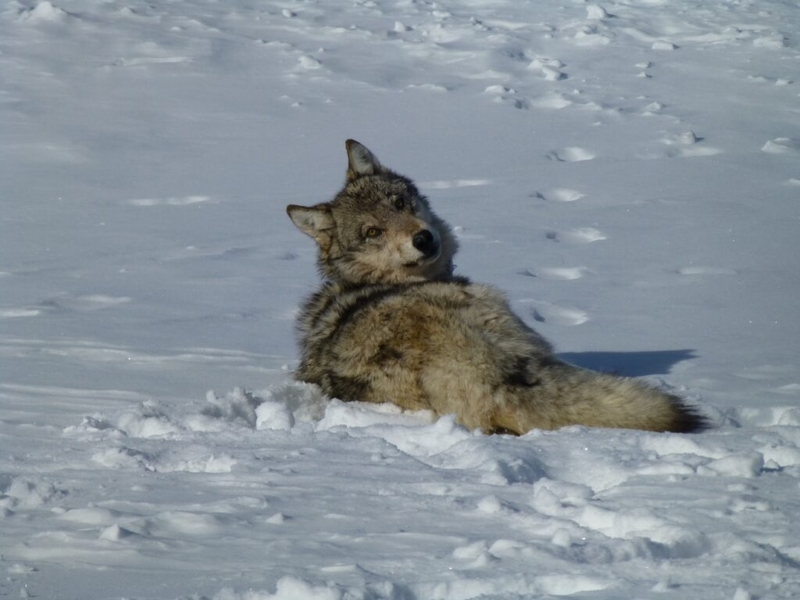
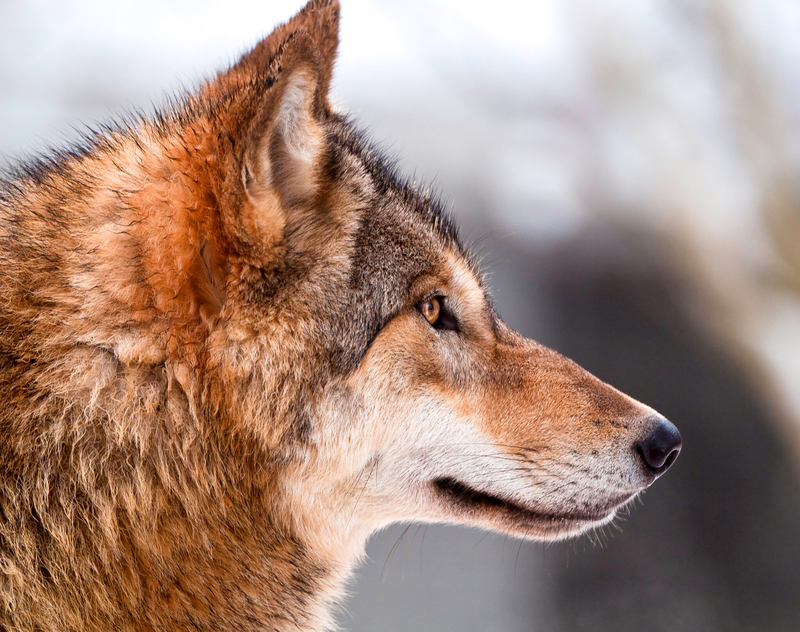
A gray wolf in snow. (Eric Cole/U.S. Fish and Wildlife Service)
There are several hundred fewer wolves in Montana than previously estimated by Montana Fish Wildlife and Parks.
That’s according to the department’s latest report showing the wolf population in Montana has likely been overestimated for years, leading to a recommendation that the upcoming hunting and trapping quota be cut in half.
Wildlife managers in Montana estimate the number of wolves in the state using a formula called the integrated Patch Occupancy Model, or iPOM. It uses annual hunter surveys, known wolf locations, and estimates of pack size and territory range — not direct counts of animals in the field. This year, FWP announced a revised version of its model, iPOM 2.0, which shows significant changes in population data.
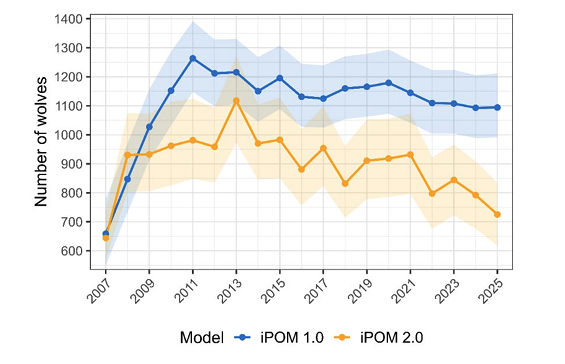
In 2025, FWP estimated the statewide wolf population at 1,094 animals based on the original model, an increase of three animals from 2024 numbers.
But using the updated model, the number drops to 725 wolves, with a range from 618 to 836 animals statewide.
In response, wildlife managers are recommending reducing the next wolf harvest quota to 250 animals, down from 450 last season. Hunters and trappers killed 247 wolves last year.
State officials said they have confidence in the new model, which has yet to go through a peer-review process, and are changing management strategies to reflect the latest data. And while many wolf advocates who have criticized the state and its formula for estimating wolves say the data represents a good first step, they would like to see further reductions in wolf kills.
“FWP finally admitted what we’ve been saying for years: the state’s wolf counts were wrong and they’ve been misleading the public,” said Lizzy Pennock, carnivore coexistence attorney at WildEarth Guardians, which has criticized the state’s methodology for years. “Yet FWP is still proposing to kill a third of Montana’s wolves in one season. The agency remains more interested in managing wolves for the bare minimum instead of treating this beloved species with respect.”
Quentin Kujala, conservation policy director for FWP, said the department wants to be transparent and offer the most up-to-date information to the public and policy makers.
“Some people are going to be disappointed, some people are going to feel vindicated,” Quentin told the Daily Montanan, acknowledging wolf management is among the most controversial topics in Montana.
Kujala said the revised model has been in development for a while but only became widely available in its current form in recent months, making the 2025 report the first public release of the data.
The state released both models’ estimates to give the public and the Fish and Wildlife Commission, which sets state regulations including hunting quotas, a full picture of what the data says. The commission will meet Aug. 19 to consider the proposal.
“Numbers have always been a big part of this conversation,” Kujala told the Daily Montanan. “The scrutiny, the expectation from the engaged public, is often polarized — more or less wolves, more or less quota, more or less hunting. And then there’s the context of numbers in the conversation of maintaining a commitment to a viable, healthy wolf population in the state of Montana.”
Wildlife advocates have criticized Montana’s use of iPOM to estimate wolf populations, and multiple lawsuits have been filed by conservation organizations over the years arguing the numbers are lower than the state says they are.
One vocal critic is Rob Crabtree, a researcher with the Yellowstone Ecological Research Center, who has published papers breaking down misleading biases involved in the survey method. He argues hunter surveys are inaccurate, individual wolves are often counted multiple times or assumed to be packs when they are lone animals, and that spatial estimates of pack territory are much lower than they should be.
“This is a great first step. They’re correcting some of the stuff that I suggested,” Crabtree told the Daily Montanan.
Crabtree said that another critique he has of the state’s wolf management is not treating wolves as a social species. Killing an alpha wolf in a pack, he said, will lead the pack to disband a third of the time.
“These are social animals with a social structure different than all the other species that Montana Fish, Wildlife and Parks manages,” Crabtree said. “And when you decrease pack size and you inflict mortality without really knowing how many wolves you have, you’re risking a lot.”
With the new population estimates, the state is proposing to cut the hunting and trapping quota in half from last season, when state lawmakers and wildlife managers pushed for increased killing of wolves in an effort to decrease the state population, a goal of the Legislature for the last few years.
The state in 2025 established a benchmark metric for a minimum wolf population at 450 wolves. Wildlife managers say that is a large enough population to ensure 15 breeding pairs, which meets the federal recovery standard for wolves to remain off of the Endangered Species List. The department emphasizes that 450 wolves is not a management goal.
During the 2025-26 wolf season, which ended on March 15, harvest totaled 247 wolves, including 145 by hunters and 102 by trappers. The number was the lowest since 2016. The number of animals taken in the state tracks with population density, with 98 wolves taken from Region 1 (northwest); 79 from Region 2 (west central); 54 from Region 3; and 10 from Region 4 (central); and 2 from Region 5 (south). Four total wolves were also killed from two smaller management units directly north of Yellowstone National Park.
Under the new regulations FWP is proposing to the Fish and Wildlife Commission at its meeting next month, the statewide limit will decrease to 250, which includes regional quotas. The regulations also propose a 15-wolf quota for management removals due to threats to human safety, livestock or dogs.
If approved, hunters and trappers will be able to kill 10 wolves per license.
Marc Cooke, with the nonprofit Wolves of the Rockies, said he was glad FWP is proposing to lower the quota in light of the new numbers, but said it should be even lower.
“It’s just good wildlife management,” Cooke said. “I think the sad thing, or the concerning thing, is we want science, not politics, to guide wolf management. And not just wolves, but all wildlife in general.”
The hunting and trapping quota is based on statistical models that show a population reduction of 250 animals per year will not reduce the number of wolves below the 450 benchmark, Kujala said.
“We look at the forecast number for next year, but recognize that we’re going to revisit this topic again next year,” Kujala said. “Unlike other species, it’s but one year away from the next model run, one year away from the next proposal, and only one year away from the next decision by the commission.”
The state’s wolf report lists several of the changes made in the iPOM 2.0 model that led to the lower estimate of wolves.
Among the bigger changes was a decision to incorporate “moderate-quality” observations of wolf packs. The original model only incorporated “good-quality observations,” which Kujala said represent times when an observer has a “really good sense for what number of wolves are out there in a pack.”
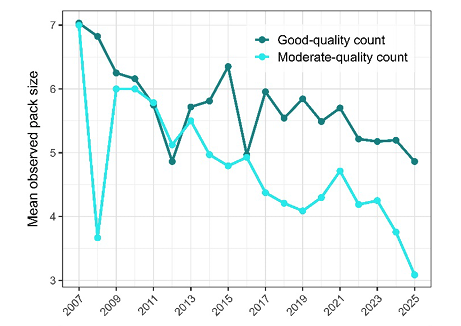
“On its face, it makes sense,” to lean into higher-quality observations, Kujala said, but there has been an increasing discrepancy in pack size between moderate- and good-quality observations for several years. He said using more observations results in more accuracy overall.
“At a relatively coarse level, that’s how the process has changed,” he said.
With changes to some other inputs, the new model shows that estimated pack size has decreased steadily since 2013 (the original model shows size has stayed steady) and pack territory size is around 60 square kilometers larger than under the old model.
Those combine for a smaller number of packs, and fewer overall wolves than previously estimated.
“This is a significant change,” said Cooke.“I think whenever new science changes our understanding of a population, wildlife managers need to slow down, explain those changes — especially between iPOM and iPOM 2.0 — and make sure the public and even the advocate community has confidence and trust in the process.”
According to FWP data, the original model shows wolf population peaked in 2011 around 1,250, dropping to around 1,094 last year, while the updated model shows a peak population of just over 1,100 in 2013, and a drop into the low 700s since then.
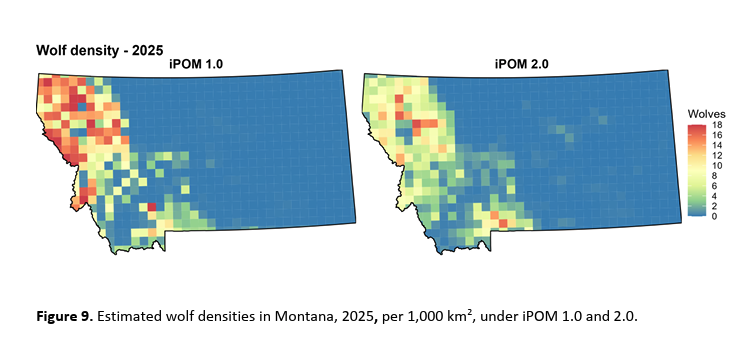
Wolves occupy roughly 64,000 square kilometers across Montana, concentrated in the state’s western region.
Helena, MT