Gina Hinojosa won the governor’s race. What happens to Texas data centers now?
Nov 04, 2026 | 3:41 pm ET
Description
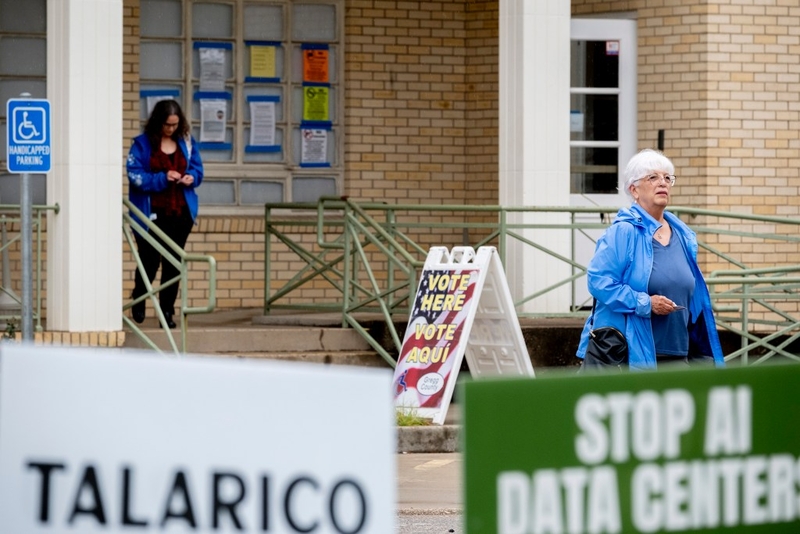
Voters make their way in and out of the polling location in the Longview Community Center to cast their ballots on Tuesday, Nov. 3, 2026. (Michael Cavazos for The Texas Tribune)
Data center approvals could remain paused in Texas until legislators pass new state laws next year if Democrat Gina Hinojosa keeps her campaign promises after winning the governor’s race in a stunning victory Tuesday.
Her statements on the campaign trail went beyond Gov. Greg Abbott’s current freeze on environmental permitting and grid connections for data centers during an audit period expected to be completed this year.
Grassroots opposition to data centers has mounted in communities across Texas, where critics across the political spectrum expressed concerns about the almost unbelievable projections for how much power the facilities could draw from the state’s grid and the unknown amount of water they would need to operate in a state with serious drought concerns.
Hinojosa attacked Abbott’s handling of the matter. She called for a data center moratorium to last until the Texas Legislature meets in January to pass “real protections so Texans can have a seat at the table to decide if and how data centers come into their communities.”
“When I am governor I will issue a moratorium — a ban — on all data center approvals until laws can be passed by the Legislature to protect Texans,” Hinojosa said in an Oct. 22 video posted to X.
Hinojosa’s plan for data centers
The governor-elect during her campaign outlined a slate of priorities for lawmakers that included requiring data center operators to hire union workers, protecting communities’ water supplies and stopping data center companies from using nondisclosure agreements that make it harder for the public to track project developments.
Similar to Abbott, Hinojosa also said she would push to ensure Texans wouldn’t pay more for electricity because of data centers, and to stop tax subsidies that were depriving the state of billions in sales tax revenue.
“We can have economic development and we can have protections for Texans. These things are not mutually exclusive,” she said in a September interview with Politico.
Hinojosa will be working with a Democrat-dominated Texas House. She takes office Jan. 19.
Abbott slowly cracked down on the facilities, turning from a politician who in November heralded Texas as the “epicenter of AI development” to one who, starting in August, began issuing pauses on data center approvals at the state grid and then the environmental permitting agency so information about the facilities could be audited and collected.
The audit by grid regulators and operators was expected to last until December. Abbott had also demanded that officials collect information on tax incentives and water use, whether data centers were bringing their own power or water supplies and whether data centers were taking measures to reduce impacts on the neighbors for light and noise pollution.
How that information would be used remained to be seen, but Abbott had demanded data centers pay for their own electrical infrastructure — a process being worked out by state regulators — in addition to using water-efficient technology. He promised to pursue getting rid of tax breaks for data centers during the legislative session.
Data center-related donors, meanwhile, gave Abbott some $9 million since July 2025, the Texas Tribune reported. And in October, environmental and community advocates identified some environmental permits related to data centers they said had gotten approval anyway despite Abbott’s pause, forcing the permitting agency to shut down its online filing system.
Some county officials had also expressed frustration with their lack of authority under current state law to regulate data centers.
“Real anger in communities”
Data Center Watch, which researches opposition to data centers in the United States, in a Tuesday analysis said the state “offers one of the clearest examples of data center regulation becoming an election issue.” The group found that 43% of the 74 gubernatorial candidates they studied in 36 states supported a data center moratorium or ban.
“We’ve just seen real anger in communities — big, small, in solid red counties and in deep blue counties alike,” said Kathryn Guerra, the Texas Commission on Environmental Quality watchdog campaign director for Public Citizen, which identified the errant permit approvals.
“What happened yesterday just seems to have been a reflection of that anger,” she added. “We’re in a position now to listen to Texans and help advance solutions to those concerns that they have raised over the past year with the massive influx of data centers that Texas has seen.”
Jess Heck, director of government affairs in Texas for the industry association Data Center Coalition, said in a statement that data centers could continue to advance job creation and strengthen the state’s economy through investments in communities and tax revenue generation.
“The data center industry is committed to advancing America’s digital infrastructure, including here in the Lone Star State, as well as supporting energy reliability and affordability and promoting long-term, responsible economic development,” Heck said.
The coalition, Heck continued, “looks forward to working with state leadership along with local officials, stakeholders, and Texas communities to continue building trust and supporting responsible data center growth.”
Elon Musk, who founded artificial intelligence company xAI and supported Abbott, posted on X: “Data centers in space looking pretty appealing right now.”
Austin, TX