A modest proposal for AI data centers: Invest in small and local solar projects
Nov 20, 2025 | 5:20 am ET
Description
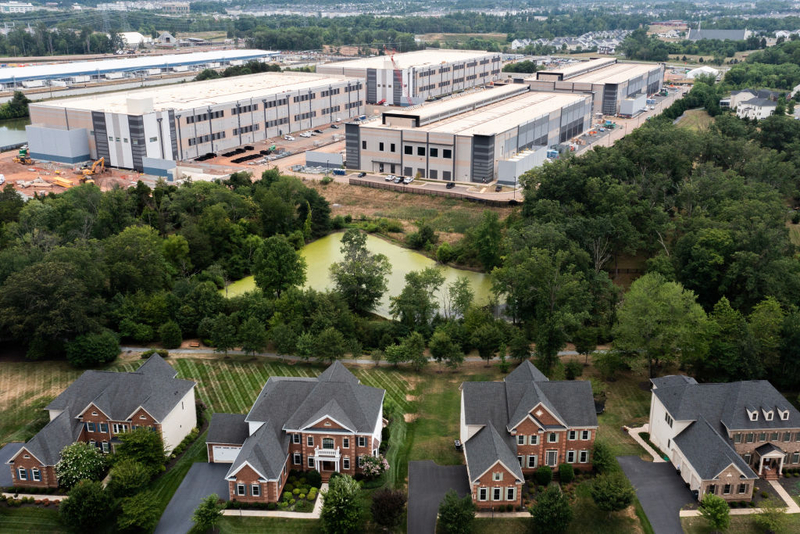
An aerial view shows a data center situated near single-family homes in Stone Ridge, Va., last year. Local communities around the country are seeking more input on where and how data centers are built. (Photo by Nathan Howard/Getty Images)
Over the past decade, Virginia has become home to more than 650 data centers — the largest concentration on Earth — including roughly 150 hyperscale facilities operated by Amazon, Microsoft, Google and Meta. Loudoun County alone hosts nearly 200 operating sites, with more than 100 additional facilities in development.
Regulators and lawmakers are now confronting soaring peak demand and rising grid costs for Virginia ratepayers. Now is the moment for the commonwealth to adopt a straightforward, market-based solution that delivers more affordable energy and ensures data centers pay their fair share — all for only a modest contribution.
Data center growth has come at a cost. They already consume more than one-quarter of Virginia’s electricity, a share projected to approach half of statewide demand by 2030. Dominion Energy has told regulators that serving this new hyperscale load will require billions of dollars in new generation and transmission infrastructure — costs increasingly passed on to ordinary Virginians through rate hikes.
As it is, Virginia imports roughly 39% of its electricity — more than any other state — according to the U.S. Energy Information Administration, buying much of that power at a premium. Options to meet that demand require five to ten or more years of development, whether new natural gas, small modular nuclear, or utility-scale solar. In contrast, small-scale rooftop and ground-mounted solar can be built and interconnected in less than a year.
Since 2010, Virginia’s sales- and use-tax exemption has provided data-center operators with more than $2 billion in cumulative subsidies, justified as job creation. Yet most jobs were temporary construction work.
We suspected data centers were creating an energy crisis for Virginia. Now it’s official.
The Joint Legislative Audit and Review Commission (JLARC) reported last year that the sector supports about 74,000 jobs statewide, mostly indirect or short-term, while a typical operating facility employs only around 50 full-time workers. In FY 2023 alone, this exemption cost taxpayers $928 million.
A modest, market-based solution
Gov.-elect Abigail Spanberger said it best in her acceptance speech: “Data centers need to pay their fair share.” Virginia can take her message to heart by inviting the industry to make a small, voluntary, high-impact contribution toward the commonwealth’s clean-energy goals and local development.
Here’s the proposal: Data centers would contribute a small percentage of their avoided state sales-tax liability each year toward purchasing Solar Renewable Energy Credits (SRECs) under the distributed generation (DG) carve-out for small-scale solar projects operating in Virginia. Each SREC represents one megawatt-hour of solar generation; purchasing them helps finance projects and provides verifiable carbon offsets to the buyer.
The program would support any and all solar systems under 3 MW on public schools, hospitals, community colleges and municipal buildings — projects that lower energy bills and strengthen local economies.
With Democrats in charge, Spanberger targets lower energy bills — and higher costs for data centers
Using JLARC’s FY 2023 figure of $928 million in annual tax savings, a 5% annual contribution would yield about $46 million per year for the purchase of Virginia-generated SRECs — enough to help finance over 500 MW of distributed solar capacity annually to benefit schools and communities.
According to the U.S. Department of Energy’s Jobs and Economic Impact (JEDI) model, this voluntary program would each year:
- Leverage $1.1 billion in private-sector investment in distributed solar
- Generate more than $700 million in local economic activity
- Create over 2,800 good-paying Virginia jobs.
All of this would be achieved without adding a single cent to ratepayer bills, while reducing taxpayer subsidies and helping stabilize Virginia’s solar industry by offsetting the abrupt and disruptive phase-down of federal investment tax credits.
From additionality to multiplicity
For years, the technology industry has subscribed to what might be called the Gospel of Additionality — the idea that eco-virtue is earned by sourcing the largest and cheapest quantities of clean energy. This approach has sent corporate energy dollars to Texas wind farms and Arizona solar plants while companies continued to draw fossil-based power here in Virginia.
Our modest proposal offers a different creed: Multiplicity — where one small investment multiplies benefits across the commonwealth’s schools, hospitals, and communities.
By purchasing Virginia DG SRECs data-center operators could:
- Lower energy costs for public schools, hospitals, and local governments at no capital cost to them
- Help offset summer coincident peak demand in the Mid-Atlantic PJM grid area more quickly and affordably than any other generation option
- Reduce taxpayer burden by cutting energy costs for public institutions
- Avoid ratepayer-funded SREC subsidies through a voluntary, market-based mechanism
- Create durable local jobs and workforce training tied to installation, operations and maintenance
A good-neighbor contribution would show that an industry running on public infrastructure can also reinvest in the communities that power it. Data-center operators could help schools, hospitals and small towns across the commonwealth generate clean, affordable solar energy — a sure and equitable way for them to pay their fair share.
And importantly, this modest proposal is designed to complement, not replace, a longer-term, holistic strategy for meeting Virginia’s energy needs by offering a simple, fast, and low-cost way to buy the commonwealth the time it urgently needs.
Richmond, VA