Missouri Supreme Court weighs who can challenge Kansas City stadium incentives
Sep 01, 2026 | 11:53 am ET
Description
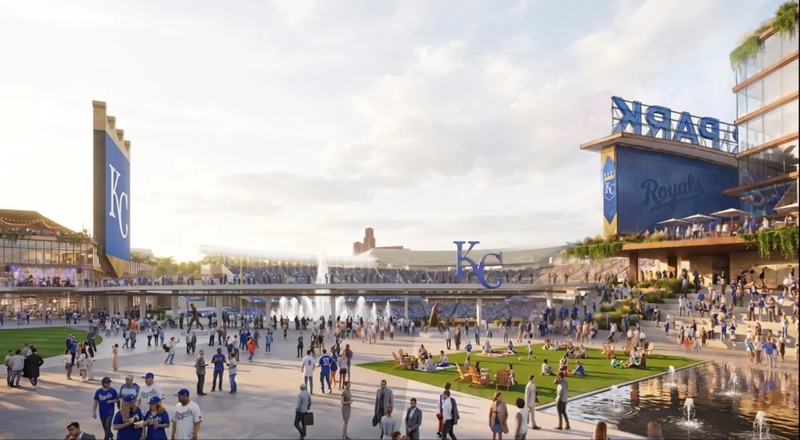
A rendering of the entrance of a proposed new baseball stadium in Kansas City (courtesy photo).
The Missouri Supreme Court wrestled Tuesday with whether three opponents of the state’s sweeping stadium tax incentive law have the legal right to challenge it.
State Sen. Mike Moon, an Ash Grove Republican, state Rep. Bryant Wolfin, a Ste. Genevieve Republican, and conservative activist Ron Calzone sued last year seeking to overturn the law, which lawmakers passed during a special session called partly to keep the Kansas City Chiefs and Royals from leaving Missouri.
But the judges Tuesday were not deciding whether the law itself violates the Missouri Constitution. First, they have to decide whether Moon, Wolfin and Calzone have standing to sue.
Bevis Schock, an attorney for Moon, Wolfin and Calzone, argued Tuesday that the law is already filled with the kind of spending necessary to give taxpayers standing.
He pointed first to a form the Department of Revenue had to create to implement the law and computer programming needed to process applications. A fiscal analysis prepared while lawmakers considered the legislation estimated $10,000 for the form and $175,000 for computer work.
“It has to be created. It has to cost something,” Schock said.
Michael Patton, the state’s deputy solicitor general, countered that a fiscal note is only a projection and does not prove that money was actually spent. Routine work by existing state employees also does not automatically become a new public expenditure every time lawmakers give an agency another responsibility, he said.
A Cole County judge dismissed the case in January without considering its constitutional claims. If the Supreme Court reverses that decision, the lawsuit would return to the lower court and the challengers would get a chance to argue the law should be struck down.
The lawsuit claims legislators violated several constitutional restrictions when they passed the stadium incentives, including requirements that bills stick to a single subject and not stray from their original purpose. They also challenge provisions allowing public money to help finance privately owned professional sports facilities.
Gov. Mike Kehoe signed the law in June 2025 after calling lawmakers into special session amid a bidding war with Kansas over the Chiefs and Royals.
Missouri legislators file lawsuit claiming stadium funding for Chiefs, Royals is unconstitutional
It offered state aid worth up to half the cost of qualifying stadium projects, but the legislation stretched well beyond professional sports. Lawmakers also expanded tax credits tied to sporting events, created tax relief for people affected by natural disasters and required voters in 97 counties to decide whether to provide certain property tax breaks.
The Chiefs have since announced plans to move to Kansas. But Missouri’s stadium incentives remain very much alive.
The Kansas City Council voted 11-2 last month to commit $600 million toward a proposed $1.9 billion Royals ballpark at Crown Center. The current financing plan anticipates roughly another $540 million from Missouri.
And the Missouri Development Finance Board has started preparing for the possibility of financing the state’s share, seeking a financial adviser to help structure potential borrowing for a professional baseball stadium and assist with any eventual bond sale.
Cole County Circuit Judge Christopher Limbaugh ruled Jan. 16 that the challengers lacked standing.
One week later, however, the Supreme Court issued another ruling that has become central to their appeal.
In Nicholson v. State, the court found that a taxpayer had standing to challenge a different 2025 law because carrying it out required the state to spend public money.
Schock argued taxpayers do not have to wait until money has actually left the treasury if an expenditure is sufficiently threatened or likely.
The state reads Nicholson more narrowly, emphasizing that the attorney general had already acted under the law being challenged in that case.
The judges repeatedly tested where that line should be drawn. When one asked about the new tax forms, Marc Ellinger, an attorney representing legislative leadership, argued the law did not specifically require the state to create one and that handling applications was simply part of normal government operations.
The judges must also decide whether refundable tax credits should be treated differently from ordinary tax credits.
The Supreme Court ruled in 2011 that tax credits generally do not give taxpayers standing because the state is collecting less money, not spending money already in the treasury.
Schock argued refundable tax credits for amateur sporting events differ from traditional tax credits because the state can send recipients money rather than merely reduce what they owe in taxes.
Patton disputed that distinction, arguing the credits are not simply cash payments from the state but instead “correspond directly with the recipient’s tax liabilities.”
The biggest potential expenditures under the law are the stadium subsidies, and there the state and legislative leaders argue the challengers are getting ahead of themselves.
Before Missouri can spend money on a stadium, Ellinger said, a team must apply, the state must approve the application, local governments must commit their share of the financing, state officials must sign off and lawmakers must appropriate the money.
“It has to be a direct expenditure,” Ellinger said. “That means there can’t be intervening steps.”
One judge pressed Ellinger on what happens if all those steps occur and the state eventually appropriates money for the Royals.
“I don’t think it closes the door for a future challenge,” Ellinger said. “You just have to get to that future.”
Schock argued that asks the court to ignore why the stadium law exists in the first place.
Calling it the “ostrich defense,” he said it strains credibility to suggest a professional sports team won’t seek money lawmakers specifically made available to keep it in Missouri.
“Are we going to say, ‘Oh gee, the sports team owners aren’t going to apply for the money?’” Schock said. “Of course they’re going to apply for the money. That’s the whole idea of it.”

Jefferson City, MO