Missouri is No. 3 in the number of cyclosporiasis cases in the nation
Aug 10, 2026 | 6:45 am ET
Description
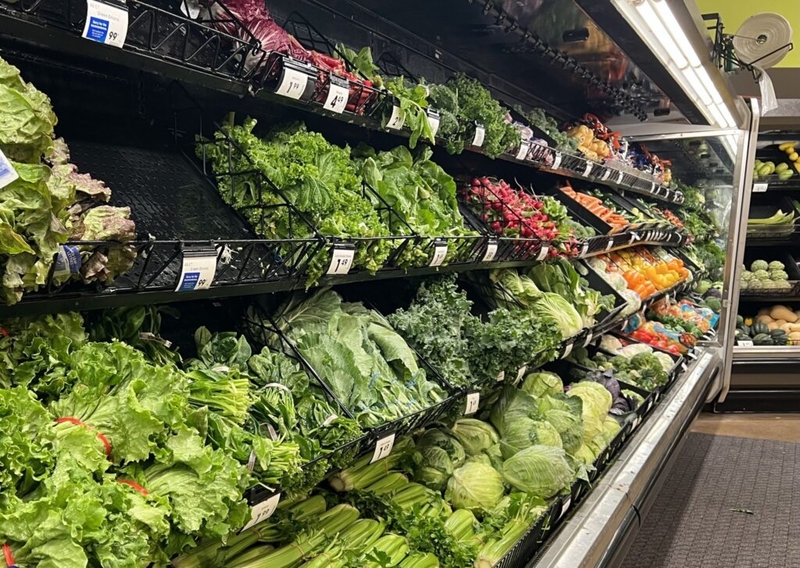
Vegetables and lettuces at a grocery store in Michigan. Michigan health officials say lettuces and salad greens are emerging as a likely source in the nationwide cyclosporiasis outbreak, which has sickened hundreds of people across 31 states (Jon King/Michigan Advance).
Missouri has officially been added to the list of states linked to the shredded iceberg lettuce from Taylor Farms that caused cyclosporiasis.
Five other states — Arkansas, Iowa, Nebraska, New Hampshire and North Carolina — are also new to the list. They join Illinois, Indiana, Kansas, Kentucky, Michigan, Ohio, Oklahoma, Pennsylvania and West Virginia.
Boone County counted 97 cases by Thursday, said Austin Krohn, spokesperson for the Columbia/Boone County Public Health and Human Services Department.
As of Sunday, the Missouri Department of Health and Senior Services reported 1,095 cases — nearly double the number of cases it reported last week.
The Food and Drug Administration and Centers for Disease Control and Prevention determined that 568 of the Missouri cases are directly tied to lettuce from Taylor Farms, likely infected by contaminated water in the fields in Mexico. Missouri now ranks No. 3 in the country for the highest number of cases linked to the outbreak, after Michigan and Ohio.
The lettuce was widely distributed to Taco Bell outlets, Walmart stores and various food service locations in 29 states. Taco Bell has removed the affected lettuce from its supply chain and restaurants nationwide.
“We can expect to continue to see the number of confirmed cases rise, despite the recall, due to the fact that it can take as long as six weeks for CDC and state officials to determine if a sick person is part of this outbreak,” the FDA reported this week on its website.
Nationwide, 6,358 cases are directly tied to the outbreak, and another 10,468 may not be connected. Additionally, more than 12,000 cases are awaiting laboratory testing or require further investigation.
Taylor Nelson, an infectious disease specialist with MU Health Care, said Thursday that 96 cases had been reported in the UM Hospital System, with one hospitalization.
“Everything has been able to be managed on an outpatient basis, and there probably are more cases that are pretty mild that haven’t been identified,” Nelson said. “It can be a fairly prolonged illness, but oftentimes, it’s not a fatal or severe illness.”
Cyclosporiasis is not a new infection, he said. There are small, produce-related outbreaks every summer.
“It’s not like this is completely out of the norm to see things like this, but it’s definitely the biggest outbreak that we’ve seen,” Nelson said.
This outbreak is likely much larger than previous ones because of the number of people who eat at Taco Bell, and because the lettuce was distributed across the nation, Nelson said.
The first two deaths due to cyclosporiasis were reported recently in Michigan, where the majority of the cases have been tracked.
According to Michigan Health and Human Services, “Both individuals had significant underlying health conditions that may have been impacted by cyclosporiasis and dehydration.”
Dehydration due to diarrhea and vomiting is a major concern for health care professionals.
Generally, the infection is highly treatable by antibiotics, but people with weakened immune systems, the elderly and children might have more severe symptoms and require longer treatment, Nelson said.
Ensuring people are hydrated is a high priority for medical personnel, Nelson said. If someone can’t stay hydrated through oral intake of fluids, that may be a reason for hospitalization.
According to the CDC and the FDA, the investigation into cyclosporiasis cases will continue.
“I would be hopeful, now we’re several weeks out from the recall, that we would start to see a decline,” Nelson said.
This story originally appeared in the Columbia Missourian. It can be republished in print or online.
Jefferson City, MO