Oklahoma’s next state auditor plans to tackle backlog by modernizing tech, rebuilding workforce
Sep 24, 2026 | 6:30 am ET
Description
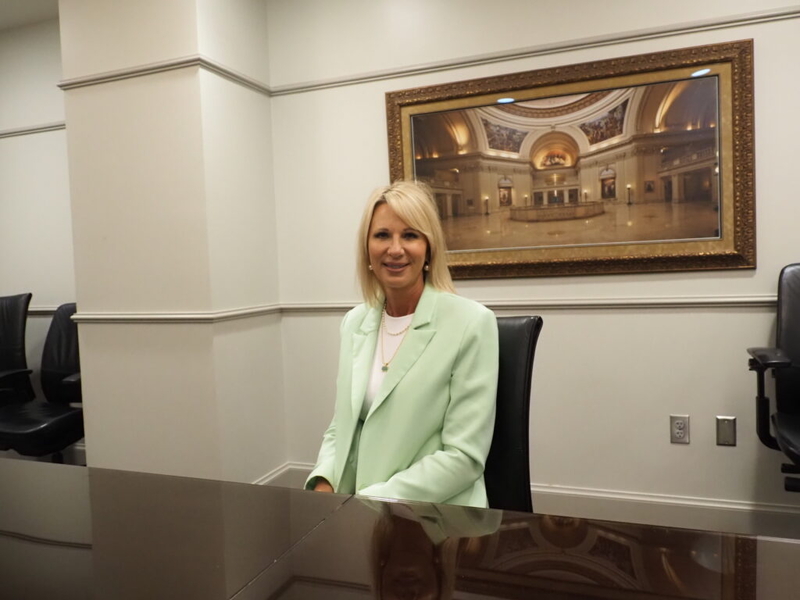
Oklahoma's next State Auditor and Inspector Melissa Capps smiles in the State Auditor and Inspector's office in the state Capitol on July 17, 2026 in Oklahoma City. (Photo by Courtney Bell/Oklahoma Voice)
OKLAHOMA CITY — Though the work might not be glamorous, the next state auditor says she finds fulfillment in holding government entities accountable for how they use Oklahomans’ money.
Melissa Capps said she’s looking forward to having her chance to make the State Auditor and Inspector’s Office more efficient and responsive to Oklahomans by hiring young talent, utilizing artificial intelligence to work through the office’s audit backlog and bringing her staff’s findings to the public’s attention.
Capps, 52, of McLoud, won her bid to become the state’s next auditor and inspector after running unopposed, which is uncommon in a statewide election. She has 26 years of experience in the auditor’s office, where she now leads the division tasked with investigating the effectiveness and spending of about 85 state agencies.
When the Republican assumes the role on Jan. 11, she will have to manage a 115-person office that has struggled with retention and faced scrutiny over the time it takes to complete audits.
“I’m very happy to do this job,” Capps said. “It’s a very challenging job because as the auditor, obviously you’re not always making people happy … But it’s also exciting because we’re holding government accountable, which is what the taxpayers expect us to do.”
Capps earned a bachelor’s degree in finance at the University of Central Oklahoma and is a certified fraud examiner, a specialty focused on prevention, detection and investigation. From leading the Performance Audit Division to her early experience investigating the state’s financial statements, Capps says she has been involved in almost every kind of audit the office is responsible for.
She worked on an investigation into the Oklahoma Department of Health that found the state paid $5.4 million for medical gear and services it did not receive during the COVID-19 pandemic. She was also part of the team that found the state was not properly verifying income eligibility for certain residents enrolled in Medicaid from July 2018 to June 2019.
Her goals
The auditor’s office has been criticized by at least one state leader for how long it has taken to complete investigations. The office works on about 350 audits a year, including 10 to 15 requested audits. Officials were not able to say how many special audits were currently pending.
Capps said this was fair criticism, though she noted that each audit requires a lot of information be gathered and reviewed. Auditors must be prepared to testify on findings. She wants to work through the office’s backlog of audits and improve the wait times for results.
She plans to modernize the auditing process by using AI to automate repetitive tasks and identify anomalies in financial reports. Capps said the office is still weighing costs, security and implementation strategies for the technology. She is watching how other states are using AI in their auditing process.
AI will not replace professional judgment, Capps said, but it would hopefully minimize the wait times for audits by reducing manual efforts.
“It’s going to take a little bit of time, but I know it will provide efficiency in our work,” she said.
Capps said the auditor’s office has also struggled with high staff turnover and replacing auditors has been challenging.
Since 2018, the office’s turnover rate has decreased by about 14%, partly because current State Auditor and Inspector Cindy Byrd raised salaries by about $13,000. Most auditors now make between $60,000 to $65,000, Capps said. Oklahoma’s Statewide Official Compensation Commission raised the state auditor’s salary to $150,000 in November.
Capps hopes to retain staff by continuing to be more competitive with salaries, offering flexible work schedules and diversifying the assignments auditors work on.
She is also hopeful she can recruit new talent by showing up to career fairs and offering internships, with the goal of rebuilding the office’s staff.
This marked Capps’ first time running for public office, but she said running unopposed did not stop her from traveling around the state to meet with certified public accounting groups, Republican organizations and towns to explain what her office does and why she wants to lead it.
She plans to continue these outings once she takes over the office, using the public appearances to explain audit findings to residents.
“Auditing can be very hard to understand,” Capps said. “…It’s a lot easier when you can go out and speak about it.”
‘Impartial judge’
Keeping politics out of the office is something former State Auditor and Inspector Gary Jones said Capps will have to do to be successful.
Jones, who ran unopposed when he sought reelection in 2014, was the chair of the state’s Republican Party before resigning to run for state auditor. He said auditors before him often replaced the staff with members of their political party when they took office.
Losing this institutional knowledge, Jones said, was detrimental. It also introduced politics into the work, which Jones said made people question findings.
“Your job is to be an impartial judge or report impartially, and let the facts fall as they may,” he said.
Jones worked with Capps while he was auditor and supported her candidacy. He says Capps succeeded in each role she held at the office and was “always able to step up to the task.”
Byrd, the current state auditor, said she worked closely with Capps and supported her candidacy because of her strong work ethic, professionalism and her commitment to the taxpayers of Oklahoma.
“I think she’s a very smart, kind individual who has the best interest in place for Oklahoma, and I know that she will do a fabulous job,” ” Byrd said.
Earlier in Capps’ tenure with the office, she took off four years to raise her three sons. Now that her kids have grown up, Capps and her husband enjoy traveling whenever possible.
She said traveling helps her regenerate so she returns to the auditor’s office refreshed and ready to get to work.
“The work is so important,” Capps said. “The work is so important for state government, and however I can help everyone understand that or continue to understand that, is what I want to do.”
Oklahoma City, OK