Missouri House speaker faces conservative challenge in key state Senate primary
Jul 13, 2026 | 12:05 pm ET
Description
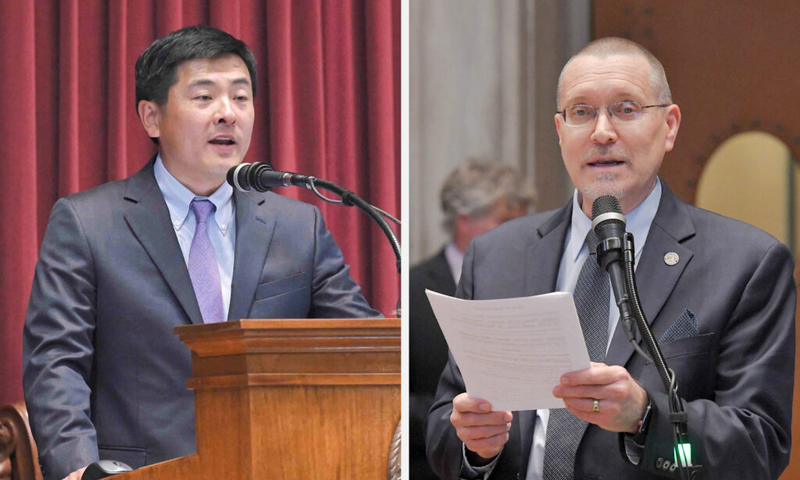
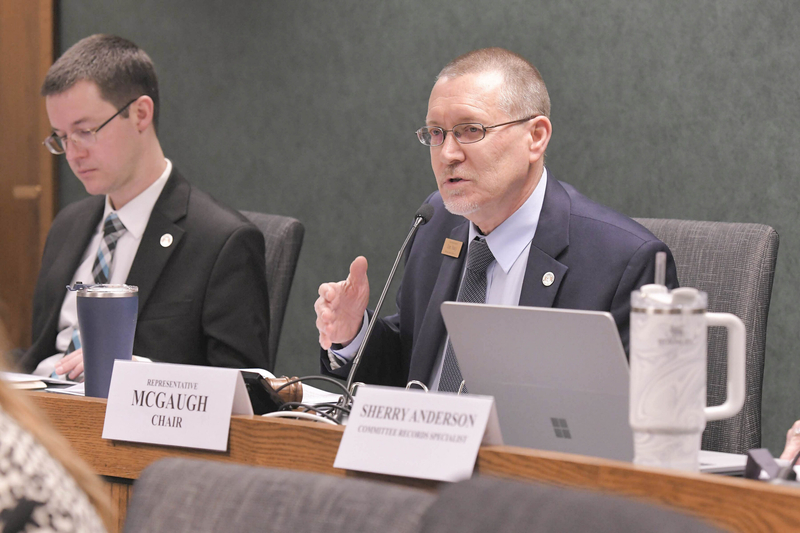
Missouri House Speaker Jon Patterson, from Lee's Summit, faces former state Rep. Dan Stacy, of Blue Springs, in the Republican primary for the State Senate's 8th District (Tim Bommel/House Communications).
Dan Stacy knows exactly what he’s up against, down to the dollar.
“I will not be able to match in any way his resources as far as the dollar value he has amassed,” the former state representative said of his opponent in the Aug. 4 Republican primary for Missouri’s 8th Senate District. “But I have got shoe leather.”
He means it literally. In May, Stacy posted a photo of the campaign’s key asset: a pair of all-black New Balance sneakers, parked beneath a yard sign recycled from his 2020 House race, a sticker converting “representative” to “Senate District 8.”
The man he is hoping to outrun is Jon Patterson — the sitting speaker of the Missouri House and a Lee’s Summit surgeon who has amassed roughly $2.9 million between his campaign committee and his political action committee, Missouri Alliance PAC, according to Missouri Ethics Commission filings.
Stacy has $43,000 — $15,000 of it loaned from his own pocket, the rest raised almost entirely from individual donors.
That’s a funding gap of roughly 67 to 1. But the primary has become something bigger than a mismatch.
It is among the highest-profile tests on Missouri’s August ballot of a fight running through Republican politics — whether a party leader who occasionally broke with his own caucus, and who built his campaign fund with help from the state’s most powerful business and lobbying interests, can be beaten by a shoestring campaign running hard to his right.
Stacy’s answer is to make the money itself the issue: His campaign depicts Patterson as “The Establishment” and urges voters to help “stop the $2.5 mil. machine.” Though, by June, that machine had swelled to $2.9 million.
Patterson initially indicated he would sit for an interview with The Independent but ultimately did not respond to requests to schedule one. On his campaign website, he describes himself as an “independent voice” and casts his record as proof that he is not subordinate to donors or party factions.
His PAC has received large donations from major corporations like Ameren Missouri and Anheuser Busch along with GOP megadonors like Rex Sinquefield and Michael Ketchmark. He has also received more money from gambling interests than any other legislative candidate in Missouri since the start of 2025, according to analysis by The Independent of campaign finance records.
His endorsements, meanwhile, come from some of the state’s most established institutions: the Missouri Fraternal Order of Police, the Missouri State Medical Association, the Missouri Chamber of Commerce and the conservative advocacy group Americans for Prosperity — which spent $26,165 in May and June canvassing for Patterson and running digital ads on his behalf.
But there is one endorsement Patterson does not have.
Missouri Right to Life, an anti-abortion advocacy group, endorsed in 12 of the 17 state Senate races on the ballot this year. The 8th District was not among them — and of the five races the group skipped, three are in heavily Democratic districts.
To Stacy, who is strongly anti-abortion but stops short of calling himself an abolitionist, the group’s silence felt like a “political calculation” — a decision, as he sees it, to avoid crossing his more powerful opponent.
Patterson’s record on abortion resists easy labels. He voted for the 2019 law that triggered the state’s abortion ban. Shortly before voters overturned that ban in 2024, Patterson spoke out against a blanket ban on abortion, telling The Independent in 2024 that voters were asking for “compromise.”
In 2025, when the House voted to put an abortion ban back on the ballot this year, Patterson was the lone Republican to oppose it. He told reporters after the bill’s passage that he had concerns that the proposed constitutional amendment did not adequately protect survivors of sexual assault.
The abortion vote was not an isolated break.
In 2025, Patterson also spoke against fellow Republicans’ push to repeal a voter-approved measure that raised the state’s minimum wage and required employers to provide paid sick and family leave. And in 2023, he was one of three House Republicans to vote against a ban on gender-affirming care for transgender minors.
Stacy supported that ban, and his campaign website holds up Patterson’s vote as evidence of the candidates’ contrasting “core values.” It is one of 62 bills in a side-by-side comparison of their records that Stacy calls a “taxpayer report card” — a document that ranges well beyond social issues, accusing Patterson of “crony capitalism” for backing subsidies and tax credits, including a 2019 omnibus economic development bill that offered $5 million in tax credits to spur General Motors’ expansion in Wentzville.
Patterson has made no apologies for the record. Knocking on doors, he tells voters to look it up, he said on the Wake Up Mid-Missouri radio show in May.
“A lot of the people in the district would be happy to see that record again in the Senate,” he said.
In the Senate, he added, he would keep “working with members on both sides of the aisle just to get common-sense things done.”
This also isn’t the first time Patterson’s conservative bona fides have been questioned. When the House voted in Patterson as speaker, a small contingent of conservatives nominated a rival — then-state Rep. Justin Sparks, a Republican from Wildwood — who was aligned with the far-right Freedom Caucus.
The challenge ultimately fizzled, with Sparks only garnering 10 votes and Democrats joining with nearly every other Republican in support of Patterson’s candidacy.
House Minority Leader Ashley Aune of Kansas City told reporters that Patterson had a respectful relationship with Democrats.
“I do trust him to be fair and to listen to me and to my caucus members when we have an issue,” she told reporters at the time.
Stacy has a “much more conservative” voting record than Patterson, he said, adding that he is “the candidate that is not in the lobbyist tank in any way.”
“People appreciate when you stand for something,” he said. “Not everybody shares the same values, and that’s okay, but they appreciate having someone that will state their values and vote by those values, and that is something they can count on with me.”
During his time in the House from 2017 to 2025, Stacy sponsored bills largely surrounding elections, annually filing legislation to close primary elections in the state so only voters registered within a party could influence the candidates chosen for the general election. None of those proposals became law.
Whether Stacy’s strategy of painting himself as the conservative choice — with a campaign tagline dubbing himself “the right choice” with strong emphasis on the word “right” — is up to voters.
The 8th District covers Lee’s Summit and Blue Springs, two growing suburbs on Kansas City’s eastern edge. It is Republican territory, but not by the state’s usual margins: a precinct-level analysis of 2024 results shows Donald Trump carried the district with about 51.7% of the vote, compared to 58.5% statewide.
The district’s current senator, Republican Mike Cierpiot of Lee’s Summit, is leaving office after eight years due to term limits. He won his re-election bid in 2022 after a primary with two challengers, and during his time in the Senate he had occasional quarrels with the chamber’s conservative caucus.
If Patterson wins, it would be the second time he has followed Cierpiot into office. He entered the House in 2018 in the seat Cierpiot vacated for the Senate.
Asked about his approach to voters during a May talk-show appearance, Patterson said he took his advice from Connie Cierpiot, the senator’s wife, who served in the House from 1994 to 2002: “You have to show up, and don’t be a jerk.”
Patterson has lived in the 8th District most of his life, having been raised in Blue Springs. After getting his medical degree from the University of Missouri-Columbia, he returned to the area for a residency at Truman Medical Center in downtown Kansas City before working as a surgeon in nearby Independence.
The Senate primary will share the ballot with a number of proposals, including Amendment 5, which seeks to give lawmakers the ability to change how the state administers sales tax in order to shift away from the income tax.
Patterson was a key driver behind the legislature’s push to get the proposal on the ballot and was one of two House members who sponsored it.
Stacy supports Amendment 5, saying income taxation is “one of the most perverse ways that the government can insert itself into the economy.”
Prior to his political career, Stacy worked as a band teacher, minister and music director. His Christian faith extended into his time in the House, gathering with a small group of lawmakers to study scripture, and currently leads weekly virtual meetings where participants go through the entire Bible in one year.
“It is this very dedication to faith and truth that defines his character and fuels his work,” his website says.
Stacy’s faith keeps him encouraged as he takes on Patterson’s war chest.
“I’m going to depend on God to deliver the results that ultimately He will use,” he said. “So if I am the victor, I will serve in the best way I can to serve the citizens of Missouri.”
Winning the primary wouldn’t be his first David-and-Goliath moment. In 2016, he unseated incumbent Sheila Solon in the Republican primary with almost 55% of the vote.
The winner of this year’s primary will go on to face state Rep. Keri Ingle, a Lee’s Summit Democrat, in the general election. Ingle, between her campaign and political action committee, had raised almost $270,000 going into April.

Jefferson City, MO