Minnesota seeks to replace fraud-ridden Housing Stabilization Services with new program
Oct 08, 2026 | 11:48 am ET
Description
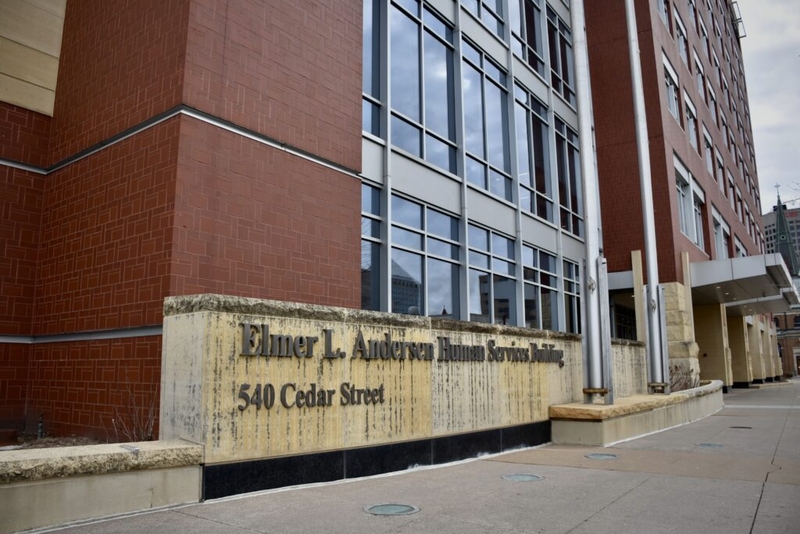
The Elmer L. Andersen Human Services Building in St. Paul, MN Thursday Jan. 15, 2026. (Photo by Alyssa Chen/Minnesota Reformer)
The Minnesota Department of Human Services is planning to replace Housing Stabilization Services, a Medicaid program that was so riddled with fraud it was shut down by the Walz administration last year.
The agency plans to develop a new program and a legislative proposal for 2028 as part of the Olmstead Plan, which is the state’s blueprint for helping people with disabilities live in the community instead of institutions.
Minnesota pioneered the Medicaid-funded housing stabilization program in 2020, geared toward elderly and disabled people, Minnesotans transitioning out of residential care, and people with substance use disorders seeking treatment. Under federal law, Medicaid dollars can’t be used to pay for the actual housing, so the money wasn’t used for rent, instead going to contractors who were supposed to help clients navigate the housing market and find something that would meet their needs, as well as moving costs.
HSS quickly drew people looking for fast cash, though, according to federal prosecutors who have charged over a dozen people in fraud cases involving at least $26 million. Prosecutors have said that the shuttered program was so easy to scam that it attracted “tourists.” In one striking example, two Philadelphia men heard HSS was “easy money,” traveled to Minnesota, enrolled their companies into the program, returned to Philly, submitted fraudulent claims from there, and received $3.5 million for doing so, prosecutors say.
On Wednesday, in the first HSS fraud case to go to trial, a federal jury convicted the owner of a St. Paul agency on three counts of healthcare fraud in what prosecutors said was a $4.3 million scheme.
Before the program began, the Department of Human Services predicted it would cost around $2.6 million a year. At its peak in 2024, the state paid more than $104 million to over 700 providers, many of whom were not actually providing services, according to federal prosecutors.
When announcing the first wave of HSS fraud charges last year, Joe Thompson, then the acting U.S. attorney for the federal District of Minnesota, warned that Minnesota was “drowning in fraud” in HSS and other Medicaid services intended to help disabled and elderly Medicaid recipients live outside of institutional settings.
The exponential growth in HSS mirrors similar growth in other Medicaid services deemed vulnerable to fraud, waste and abuse by the Walz administration. Spending on that basket of programs more than doubled in five years.
“I’ve been prosecuting these cases for years, and I’ve literally run out of ways to express what is happening in our state and on our state programs and to explain the coming iceberg I see as we reckon with fraud,” Thompson said at the time. “Now, we can and will prosecute many of these individuals as we have been, but we cannot prosecute our way out of this problem. We must do more at the front end to stop the outflow of money.”
Thompson was part of a group of prosecutors who left the U.S. Attorney’s Office in January, reportedly in response to the Justice Department’s handling of the U.S. Immigration and Customs Enforcement killing of Renee Good. Federal prosecutors have charged another wave of HSS fraud cases since then.
In the meantime, people who would benefit from housing stabilization services have been left without them. That’s why Mao Yang, a disability advocate, said she supports an HSS replacement.
Yang, who has cerebral palsy and uses a wheelchair full-time, said she signed up for HSS a few years ago because she needed help finding an accessible unit that was also integrated into the community. Yang never ended up receiving services for reasons unclear to her.
“We disabled people need HSS because we don’t know what’s out there and accessible in housing. There’s not a handbook on how to be disabled,” Yang said. “We need navigators to help us with that. It’s almost like a realtor but for accessibility purposes.”
Yang said she hopes the program’s replacement will be “intentional” and “person-centered,” and help people find housing that’s tailored to them.
William Heinen, who receives Medicaid waiver services for a range of mental and physical health conditions, said he was grateful that HSS helped him pay for his move. But Heinen said he would have appreciated guidance in finding new housing.
“I think they should do more to actually help find housing,” Heinen said. He said the housing options that were available were “never laid out to me, and there was no clear path to a better housing situation.”
The Department of Human Services’ commitment to replacing HSS was included with little detail in a draft update of the state’s Olmstead Plan.
Minnesota’s Olmstead Plan is meant to ensure that disabled Minnesotans are able to live in the most integrated, community-based settings possible — for example, in an apartment in a neighborhood with non-disabled people instead of a psychiatric unit. That right to integrated settings was affirmed in the 1999 landmark Supreme Court decision Olmstead v. L.C. In 2009, parents of disabled Minnesotans sued the state, alleging that their children were being restrained and treated inhumanely in a state-run facility, which resulted in a settlement that required the state to develop its Olmstead Plan.
The Olmstead Plan is no longer under court monitoring after a judge found in 2020 that the state had complied with the settlement’s terms, but it continues to lay out state agencies’ plans for helping disabled people live and work in community settings. The plan is currently getting overhauled in a process that has received ample criticism, in part for setting forth goals that disability advocates have said are not ambitious enough.
Yang participated in the process as a paid “inclusion consultant” with experience with disability, and advocated for replacing HSS, though she said the consultants’ input was “minimal” overall.
In an email, a Department of Human Services spokesperson said the state agency is planning to start working with a vendor later this year on the potential replacement, which will have “enhanced measures for program integrity, oversight and quality assurance.” The specific program integrity measures will be hashed out as the new program is developed over the course of 2027.
The Minnesota Legislature and the federal Centers for Medicare and Medicaid Services would have to approve any new Medicaid service. The department is planning to develop a legislative proposal for the 2028 legislative session, the spokesperson said.
The spokesperson also pointed to the department’s existing program integrity work on the other Medicaid services deemed vulnerable to fraud, including a claims review process and a re-screening of all providers of those services.

Saint Paul, MN