RI gubernatorial candidates talk housing, energy and education in first general election debate
Oct 08, 2026 | 9:41 am ET
Description
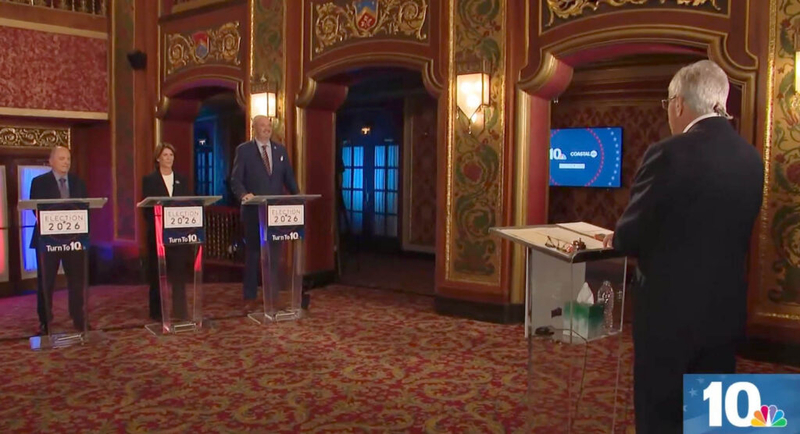
Left to right, Rhode Island gubernatorial candidates Ken Block, Helena Buonanno Foulkes and Aaron Guckian face moderator Gene Valicenti during the live debate hosted by NBC 10 WJAR in the lobby of the Providence Performing Arts Center on Wednesday, Oct. 7, 2026. (WJAR)
The first gubernatorial debate of the 2026 general election cycle began cordially enough.
Moderator Gene Valicenti asked the three candidates if their opponents had the temperament and experience to serve as governor. Republican Aaron Guckian readily acknowledged that each of them was “a smart individual,” while independent Ken Block conceded that Democratic opponent Helena Buonanno Foulkes at least had the temperament. Foulkes deferred to her opponents to speak for themselves.
But niceties were soon replaced with accusations and interruptions as the candidates bickered over policy and politics.
One of the most divisive topics of the hourlong debate, hosted by NBC 10 and Coastal ABC in the Providence Performing Arts Center lobby, was whether candidates could work with Providence’s Democratic mayoral nominee, David Morales. The 28-year-old democratic socialist ousted incumbent Mayor Brett Smiley in a high-turnout primary shaped by opinions over rent control and the Israeli-Palestine conflict.
Foulkes, 62, of Providence, who also defeated incumbent Gov. Dan McKee in the Democratic primary has already said she would endorse Morales in the general election, noting their shared focus on housing affordability, though she made clear she does not agree with the proposed rent stabilization policy Morales has pledged to enact.
“I am a capitalist, not a socialist, but we share a lot of things in common,” said Foulkes, who leads the race in public polling and fundraising. “The people of Providence have spoken. They picked him. The governor of this state has to have a good relationship with the mayor of the largest town.”
Guckian, in contrast, called Morales “one of the most dangerous politicians in the country,” denouncing Morales for previous statements to defund the police, which he has since walked back.
Foulkes fired back, indignant at Guckian’s proclamation minutes after the candidates were asked about their ability to work with the Trump administration. Guckian, 50, of East Greenwich, repeatedly emphasized his ability to foster relations and secure funding from federal officials, despite his campaign fundraising woes. Guckian had just $7,000 cash on hand as of Oct. 5, less than 4% of either of his opponents.
Foulkes denounced Trump, who she blamed for jeopardizing Rhode Island’s renewable energy projects, while creating fear around reproductive rights and immigrant safety in jeopardy.
“I can’t believe you’re calling David Morales one of the most dangerous people,” she said to Guckian. “I would say Trump is one of the most dangerous people.”
Another heated exchange over ideology emerged between the party nominees on the question of whether “biological males who identify as females” should be allowed to play women’s sports. Guckian replied “no,” while Foulkes deferred to local teams to decide while emphasizing the importance of protections for the transgender community.
“You are a wildly left Democrat,” Guckian said of Foulkes. “I am absolutely shocked. I thought you were a down the middle Democrat.”
Foulkes jumped in, “Thank you so much for calling me a proud Democrat, that’s what I am.”
You are a wildly left Democrat.
Block and Foulkes went toe-to-toe on energy, education and housing. Foulkes’ housing plan centers on using the newly enacted state millionaire’s tax to create a public revolving fund, with loans to developers to spur affordable housing development. The estimated $1 billion in revenue over the next eight years will create 20,000 new units, she said.
Block, 60, of Barrington, proclaimed the math behind Foulkes’ plan “fantastical,” countering that subsidies cannot be replenished to a revolving fund, and that her proposal would in fact create no more than 375 units.
Block instead suggested working with municipalities to tailor housing creation to their individual circumstances, and using state bonds to acquire vacant or underused land for redevelopment.
Foulkes responded that her plan was the “most ambitious,” noting the absence of details in Block’s alternative proposal.
“You have no plan, Ken,” she said. “You can criticize mine all day long.”
You have no plan, Ken. You can criticize mine all day long.
Plans — or no plans — again emerged as a critique during discussion of education proposals. All three candidates agreed on the importance of improving lackluster test scores among public school students while addressing longstanding teacher and resource shortages. But details differed.
Foulkes pitched a $100 million bond to expand career and technical education opportunities, while Guckian, who taught music in North Kingstown public schools for two years, proposed a reading and math-focused curriculum modeled after a turnaround plan in Mississippi.
Block again noted the differences among the state’s 36 local education districts, calling for individual solutions for each.
“They both missed the point,” Block said of his opponents. “There isn’t one magic bullet to fix our educational problems. We haven’t broken the cycle of poverty.”
He continued. “I will drive everybody to come to the table with solutions.”
Guckian characterized Block’s response as “word salad,” while Foulkes noted a lack of concrete details.
They both missed the point.
None of the three have held elected office before, with each casting themselves as the change-agent needed to bring transparency and efficiency to government.
None wanted to restart the truck toll program.
There was unanimous agreement to vote no on the Providence ballot question limiting city investments in foreign countries with human rights abuses — though only Foulkes lives in Providence and could actually vote on the referendum.
Guckian and Block both supported a temporary suspension of the state gas tax — mirroring proposals under consideration by states including Massachusetts as well as federal lawmakers — while Foulkes said she was “open to it.”
On reproductive health, both Block and Foulkes identified as pro-choice, though Foulkes insisted she was the only candidate to champion reproductive health. Block said existing state laws enshrine abortion rights, leaving little room for the federal government to threaten such protections. Guckian, who is pro-life, sidestepped questions about his commitment to abortion rights by answering that social issues have already been settled.
The debate ended with another tense back-and-forth, led by Valicenti.
In asking candidates for their proposals to address homelessness, Valicenti said the state has “shoveled tens of millions of dollars” to Crossroads Rhode Island, alleging the nonprofit service agency spent $700,000 on colored outdoor lighting.
Foulkes, who serves on the board of directors for Crossroads, said the lighting improvements outside the agency’s Broad Street shelter were a safety feature.
Block responded that the normally blue lights were pink when he drove by recently.
“That’s very condescending of both of you,” Foulkes said, rebuking Block and Valicenti.
Mike Raia, a spokesperson from Crossroads, said in an interview Thursday that the project was funded through grants and philanthropy, not public money, and that the lighting was a small part of a broader exterior renovation and repairs of the 100-year-old Providence building.
The three candidates will meet on Oct. 13 for pre-recorded radio debate on WPRO — airing at noon the same day — and again for a live, televised debate hosted by WPRI-TV 12 on Oct. 20.
Early voting begins Oct. 14 ahead of the Nov. 3 general election.
Providence, RI