Minneapolis City Council rejects Skydio drone contract, citing past ICE sales
Jul 16, 2026 | 4:28 pm ET
Description
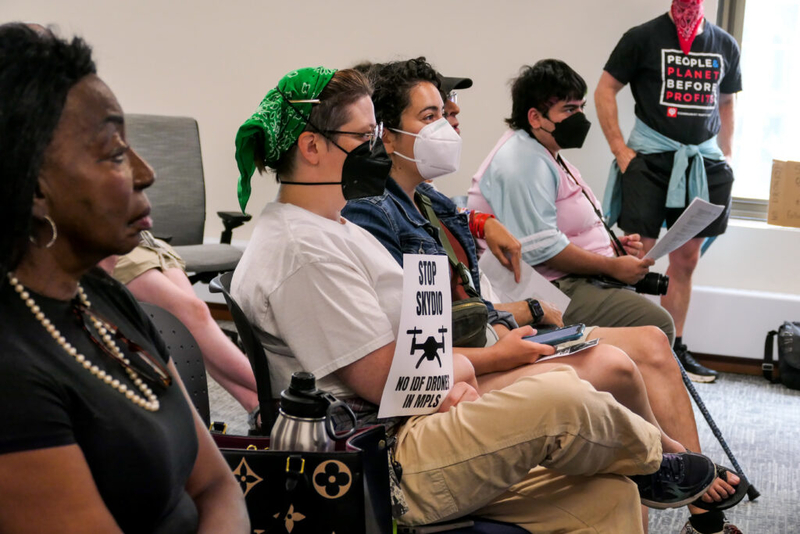
People gather to watch, many holding protest signs, a Minneapolis City Council hearing discussing a proposed pilot program that would put Skydio drones in the hands of Minneapolis police Thursday, July 16, 2026. (Photo by Ria Gupta/Minnesota Reformer)
The Minneapolis City Council declined to sign a contract Thursday with Skydio, a California-based drone company, over concerns it sold its products to U.S. Immigration and Customs Enforcement.
The contract would have allowed the Minneapolis Police Department a 75-day free trial to operate Skydio drones in north Minneapolis as part of an effort to reduce law enforcement response times as the department struggles with staffing shortages.
Before the motion failed 6-6, City Council Member Aurin Chowdhury called the proposal an “an abysmal mistake, and nothing is free. This costs the trust of our residents.”
Some members of City Council were unable to overlook a partnership with a company providing drone technology to ICE, months after Operation Metro Surge resulted in the deaths of two Minneapolis residents, Renee Good and Alex Pretti. Skydio sold an AI-powered drone to ICE for $25,000 in September, according to Forbes.
“They hijacked many of our public safety systems, though not all, and used that information to steal our neighbors and to murder other neighbors,” City Council Member Soren Stevenson said, referring to ICE. “I believe it’s naive to think that ICE won’t get access to the data from Skydio.
City Council Member LaTrisha Vetaw, who spearheaded the proposal, said the council has set a bad precedent: “If our standard is that we cannot work with any company that has contracts with a federal agency who has policies we oppose, we will quickly find that standard impossible to apply consistently.”
Vetaw, who represents the 4th Ward, argued that the focus should be on providing emergency aid to residents.
The motion failed 6-6 at the City Council’s Thursday meeting.
City Council members opposed to the proposal also cited Skydio’s past sales to Israel and concerns about surveillance.
Mayor Jacob Frey, who favored the deal, accused the council opponents of turning Minneapolis residents into “collateral damage because of geopolitics.” He added: “Refusing this pilot, I don’t believe sends a message to Israel.”
Skydio has rebutted claims of excessive surveillance at recent City Council meetings, saying that all footage not used for evidence would be deleted after seven days. Drones would also point strictly at the horizon until they arrived at the scene, where they then gather evidence.
But a Skydio data leak recently revealed that in response to a “prowler” call in San Francisco, a drone zoomed in on a young person sporting headphones on a rooftop before flying away, Wired reported. In another instance, in response to a “person with a gun” call, a drone fixated on an intoxicated person on a sidewalk.
Drones aren’t new technology to the MPD or Minnesota; they were used by MPD officers to locate a barricaded armed suspect during an eight-hour standoff last month.
Minnesota state law currently allows for 11 uses of unmanned aerial vehicles, including emergencies and disasters. Law enforcement may also operate drones to “document evidence that is at imminent risk of destruction” and to conduct anticipatory threat assessments.
The Skydio proposal sought to replace MPD’s current DJI drones after the federal government banned the China-based drone company from selling its products in the U.S.
Skydio drones also currently operate elsewhere in Minnesota, including St. Paul, Minnetonka, Rochester, Brooklyn Park and Duluth as part of the cities’ own drone first responder programs.
The average MPD response times for north Minneapolis — which Vetaw represents — currently sit at 7 minutes, 48 seconds. The Skydio proposal said that drones “could have responded to 4,643” of MPD’s highest priority calls within two minutes — around 17% of the area’s total calls.
The 75-day free trial would have added two rooftop docking units to Minneapolis Fire Station 14.

Saint Paul, MN