Mills’ U.S. Senate campaign ignites battle between establishment and grassroots Democrats
Oct 14, 2025 | 3:31 pm ET

Description
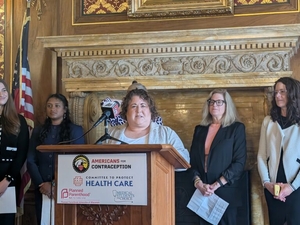
Maine Gov. Janet Mills spoke at rally in Portland on June 24, 2024, the two year anniversary of the U.S. Supreme Court’s Dobbs v. Jackson Women’s Health Organization decision, which ended the legal right to abortion. (Photo by Emma Davis/ Maine Morning Star)
Maine’s U.S. Senate primary is now teed up as a test for the future of the Democratic Party.
With Gov. Janet Mills’ official campaign launch Tuesday, the Democratic primary field for Republican U.S. Sen. Susan Collins’ seat not only got more crowded but is primed for a battle between growing grassroots momentum and the establishment.
Mills, who was scouted by and launched her campaign with the financial backing of national Democrats, will face a Democratic field of otherwise largely political newcomers. So far, most of the momentum has been building behind Graham Platner, an oysterman and military veteran from Sullivan who was scouted by unions and community groups.
Platner’s campaign is centered around breaking away from the Democratic establishment. He says he’s running not just to become a senator but to build out a lasting structure for grassroots politics in the Pine Tree State.
“I have held over twenty town halls in every corner of Maine, from Rumford to Madawaska to Portland. Everywhere I hear the same thing: people are ready for change,” Platner said in a statement Tuesday. “They know the system is broken and they know that politicians who have been working in the system for years, like Susan Collins, are not going to fix it.”
He and many of the other Democratic challengers welcomed Mills into the race Tuesday, calling primaries an essential part of the democratic process. One dropped out, while another called Mills’ bid a mistake for the party, echoing an earlier critique made by independent Vermont U.S. Sen. Bernie Sanders, who endorsed Platner.
“It’s disappointing that some Democratic leaders are urging Governor Mills to run,” Sanders wrote on social media earlier this month. “We need to focus on winning that seat & not waste millions on an unnecessary & divisive primary.”
The Senate GOP’s top super PAC made a similar point. In a statement Tuesday, executive director Alex Latcham called the Maine Democratic primary “increasingly toxic.”
“The only thing Mills has gotten right in her career is praising Senator Susan Collins’ effective and proven leadership,” Latcham wrote. “So while Democrats fight among themselves, Senator Collins will keep doing what she’s always done — delivering for Maine families.”
Collins did not respond to a request for comment about Mills entering the race nor Mills’ critique of Collins in her launch video as someone who has “forgotten their principles” and let bullies like President Donald Trump “have their way.”
In Collins’ hometown, Platner brings his grassroots pitch to The County
Collins hasn’t officially announced she’s seeking reelection, though she’s told Maine Morning Star she intends to run and has already raised millions to support her campaign. Maine Republicans have rejected the idea of forcing a primary on Collins, though there are two longshot Republican challengers.
A large Democratic primary field has some benefits for both voters and candidates, said Mark Brewer, chair of the political science department at the University of Maine. Voters have a bigger menu of options to choose from, while candidates get campaign experience before the general election, including debates.
“That can be beneficial, especially, for inexperienced candidates,” Brewer said.
After Mills’ announcement Tuesday, another Democratic candidate Jordan Wood, a former congressional aide, called for debates in all 16 counties.
“This campaign is about courage, accountability, and who has what it takes to defeat Susan Collins, defend our democracy, and deliver for working families,” Wood said in a statement. “I’m ready to make that case on the debate stage – and in every county across Maine.”
But there are also downsides. It can deplete resources — money, staff — for the general election. But Brewer sees a bigger downside in candidates from the same party beating each other up, exposing flaws that provide general election opponents hints on how to attack that candidate down the line. Research has shown that bitter primaries hurt high-profile candidates’ chances in general elections.
That’s top of mind for Keith Endy of Presque Isle, who attended a town hall Platner hosted in Caribou, Collins’ hometown, earlier this month.
“I am concerned about that one, just because if she enters the race, you are gonna have basically the entire establishment against Graham,” Endy said of Mills.
With Mills now officially in the race, Brewer sees the candidate pool essentially shrinking to two or three people. Even if other candidates don’t formally withdraw, he said, “she will take a lot of the oxygen out of the room.”
So far, only Dan Kleban, co-founder of Maine Beer Company, has officially suspended his campaign in light of Mills’ entrance. He also endorsed Mills.
“I entered this race because I believe Washington needs more leaders who put people before politics and who will fight every day to make life better for Maine families,” Kleban said in a video announcing his campaign suspension. “While our message was right, the timing isn’t. Governor Mills is the right leader for this moment and is in the best position to win.”
No one else has formally withdrawn so far, though little-known Natasha Alcala of Madawaska said she’s considering quitting.
Before Mills’ official announcement, another Democratic candidate, David Evans, an Army veteran and former Pentagon policy writer, entered the race on Oct. 1. He said he will stay in through the primary next June.
“Janet Mills and I both care deeply about Maine,” Evans said on Tuesday. “I look forward to a primary focused on solutions, not divisions and on delivering real solutions at the national level.”
Tucker Favreau, an Army veteran who works in cybersecurity, said Mills’ decision to enter the race has only energized him to grow his campaign more. While he said Mainers deserve a pool of candidates to choose from in the primary, he thinks Mills’ campaign is a mistake.
“She could have helped mentor multiple candidates throughout this race and helped Maine Democrats build a deep bench of candidates for multiple future races,” Favreau said. “Instead, she has chosen to run for a position which she would likely only be able to occupy for one term.”
Mills has already pledged to serve only one term in the U.S. Senate if elected, according to an interview with the Boston Globe. When Collins, who is approaching 30 years in Congress, was first elected in 1996, she had pledged to not serve more than two terms.

Augusta, ME