Millions already pouring into Missouri ballot fights over taxes and majority rule
Jun 25, 2026 | 12:04 pm ET
Description
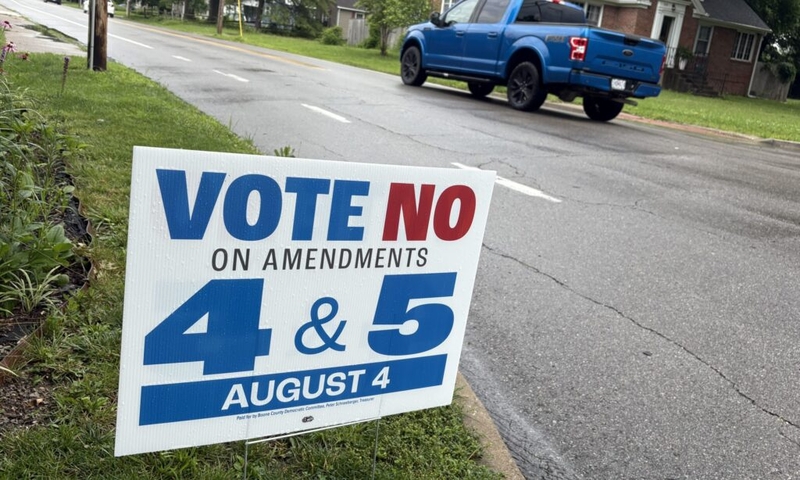
A yard sign opposing Amendments 4 and 5 in Columbia, paid for by the Boone County Democratic Party (Jason Hancock/Missouri Independent).
Missouri voters are being flooded with ads over two constitutional amendments that would reshape how the state taxes income and how citizens amend the constitution.
The campaigns for and against Amendments 4 and 5 have already raised $14.5 million. Through Tuesday, ballot measure radio and television spending had topped $3.3 million — roughly four times what primary candidates in all other contests have spent so far, according to Federal Communications Commission records.
The names in the disclaimers may tell voters what the committees buying the ads want to do. But finding out who is providing the money can require digging through campaign finance reports, corporate records and federal advertising files.
One early example is a Missouri Promise PAC ad attacking “big tech” and data centers as a reason to pass Amendment 5.
“That hum is the sound of big tech making money from online gambling, from porn,” the ad states over images of computer servers. “Data centers are money machines making millions every minute. And Missouri’s 1917 tax code means they make all that money and get away tax free.”
The ad says Amendment 5 would “fix the big-tech loophole,” phase out individual income taxes and cut property taxes.
Judge keeps Missouri plan to replace income tax with expanded sales taxes on Aug. 4 ballot
But the tax exemptions for tech company purchases of materials and equipment to construct and run data centers do not date to 1917. The Republican-controlled Legislature voted in 2015 to exempt from sales tax the computer equipment and construction materials used in data centers, plus the energy they consume.
And Amendment 5 would not repeal those exemptions. That would be up to the Legislature, which will decide what will be subject to sales tax — and what will not — if Amendment 5 passes.
Amendment 4 would alter how majorities are tallied for constitutional amendments proposed by initiative petition. Amendment 5 would direct lawmakers to phase out the personal income tax and grant the General Assembly authority to increase or expand the state sales tax to accomplish it.
Republican backers of Amendment 4 and Amendment 5 have organized one committee for each measure to raise money and operate a campaign. There are long-established conservative groups like Americans for Progress that are organizing events or pushing the message on social media, but only one main campaign committee on each proposal.
“We’re not trying to control every single group and what their mission is,” said Mike Hafner, the Republican political consultant coordinating the pro-Amendment 4 campaign. “But there is a common alignment of priorities that a lot of groups have identified as a priority for them in recent years, and this is our opportunity collectively to get it done.”
There are four committees opposing each measure, including one that opposes both. That isn’t a handicap because each committee is taking a slice of the job, said Mark Jones of the Missouri National Education Association.
“Everyone opposing these ballot initiatives is coordinating incredibly well together,” Jones said. “We have different communities that we have access to and are trusted messengers in, and so sometimes it’s just easier and faster to move with your own committee, and as much as the law allows, coordinate and cooperate where possible.”
Amendment 4 committee names and funding
Backers of Amendment 4 use the name Protect Election Integrity for their campaign, but they are far behind the four opposition committees in fundraising.
Republicans forced the measure through in a September special session. Protect Election Integrity was created in January.
Through Tuesday, it had only one reported donor, giving $20,000.
The single donor is MCR PAC, funded by St. Louis businessman Michael Rayner, who is part of the family that owns Cargill. Rayner is one of the state’s biggest donors, giving $6.3 million to Republican candidates and causes since the start of 2023.
Meanwhile, the three opposition committees have raised $5.5 million, and one, Missourians for Fair Governance, has spent $716,000 on broadcast ads that began May 16.
“I don’t even have a media buyer yet signed up where I can track those,” Hafner said. “I would imagine they’re going to outspend us.”
Amendment 4 would require constitutional amendments placed on the ballot via initiative petition to win majorities in all eight of Missouri’s congressional districts. The current standard, a majority of all votes cast statewide, would still apply to constitutional amendments proposed by the General Assembly.
If passed, as few as 5% of Missouri voters could defeat an amendment proposed by initiative. If it had been in place in recent elections, a sales tax cap that won 57% of the statewide vote in 2016 would have failed. And no amendment proposed by initiative since 2020, including marijuana legalization and expanded access to Medicaid for working-age adults, would have passed.
The television ad produced by Missourians for Fair Governance tracks the central mechanics of Amendment 4 and describes the result if passed as a “minority veto” over measures popular throughout the state.
The Missouri Association of Realtors, which backed the 2016 sales tax limitation, is the main funder of Missourians for Fair Governance, contributing $2.5 million. The other donor is another one of the opposition committees, Protect Majority Rule Missouri, which gave an in-kind donation of $714,820.
The two campaigns are sharing a website.
Missouri voters passed a sales tax cap. Under Amendment 4, it would have failed
Money from the Realtors is accumulated from payments made by association members, said Scott Charton, spokesman for Missourians for Fair Governance and the Amendment 5 opposition committee Missourians for Fair Taxation.
“Missouri Realtors have 26,000 grassroots members,” Charton said. “All of them have connections in every community because they’re trusted community members. They worship and play and attend school and live on the same street as their neighbors who are voters.”
Protect Majority Rule is a committee organized by liberal-leaning advocacy organizations. The committee has raised $2.6 million.
Of that amount, a little more than half is from Missouri-based groups. The Health Forward Foundation of Kansas City contributed $700,000; MOVE Action St. Louis gave $400,000; Missouri Jobs With Justice donated $300,500; and Missouri Workers Power contributed $300,000.
Another $1.1 million has come from The Fairness Project, a Washington, D.C., nonprofit that has backed ballot measures in 19 states.
None of the organizations contributing to Protect Majority Rule are required to disclose their donors.
The new majority requirements have been a top priority for Republicans for more than a decade, Hafner said. The Realtors’ opposition will be remembered by the GOP-led Legislature, he said.
“I would say that it’s disgraceful that an organization, a Missouri organization, filled with good, hardworking folks, has been hijacked by the far left to advance a political agenda that is aiming to minimize the voices of rural Missourians,” Hafner said.
The attack on the Realtors shows that backers of Amendment 4 don’t want to talk about the proposal, Charton said.
“Amendment 4 is a politicians’ power grab from the people of Missouri, and it is deeply unpopular with citizens across the political spectrum,” Charton said. “Missourians are learning that the politicians’ Amendment 4 will let one urban congressional district veto the will of rural Missourians from across the state, and value your vote based on where you live.”
The wide spectrum of people opposing Amendment 4 share a common goal on this issue even if they don’t agree on much of anything else, said M’Evie Mead, campaign director for Protect Majority Rule.
“Opposition to Amendment 4 is uniting voters from every corner of the state around one simple belief: Missourians — not politicians and their special interest donors — should decide what becomes law,” she said.
The final group opposing Amendment 4 is called Protect Freedom and Democracy. It has reported a single donation of $150,000 from MOVE Action.
Amendment 5 committee names and funding
In a television ad that began running Tuesday opposing Amendment 5, Missourians for Fair Taxation uses a version of the children’s game musical chairs to illustrate what the amendment would do to taxes.
With the tune “All Around the Mulberry Bush” playing in the background, and graphics that say “Politicians’ Amendment 5 Tax Shift Plan Bad Odds For You,” the ad shows 10 people circling a set of chairs, with only two slots available when the music stops.
“Amendment 5 opens your family to being hurt by new taxes on services, doctor visits, childcare, even apartment rent, and higher sales taxes that could rise to over 20%,” the announcer states.
The ad points to authority included in Amendment 5, which says lawmakers could create a sales tax “on transactions involving any goods and services.”
If nothing is added to the tax base, raising enough revenue to replace the income tax would add up to 8.5% to the current state rate of 4.225%. Stacked local levies would bring the rate to 20% in some locations.
So far, all the money raised by Missourians for Fair Taxation has come from the Realtors.
Missouri Realtors pour $1.9 million into campaign to defeat Amendment 5 tax plan
“The Missouri Realtors have set up campaign committees focused on each issue, but the common connection is that we want to protect the power of Missourians from both Amendment 4 and Amendment 5,” Charton said.
The first week of broadcast ads for Missourians for Fair Taxation cost about $350,000, FCC records show.
Missouri Promise started its broadcast campaign for the Aug. 4 election at the start of June and has spent $1.9 million. Before the PAC was created May 5, a not-for-profit corporation organized in October 2025 in Delaware called Missouri Promise spent $210,000 on ads that ran in November, December and April advocating for lawmakers to pass the measure that became Amendment 5.
Of the $3.4 million raised so far by Missouri Promise PAC, almost $2 million was donated by the Missouri Promise nonprofit. The rest came from a not-for-profit corporation named Secure Missouri, organized in March 2025 by Jefferson City attorney Marc Ellinger, to “support Governor Mike Kehoe’s vision of a stronger, more competitive Missouri where businesses thrive, families prosper, and communities grow.”
Neither corporation is required to disclose the source of their funds to the Missouri Ethics Commission. Their corporate structure means that if they are recognized as a political corporation by the IRS, any disclosure of funders will be made after the election is over.
Joe Lamie, spokesman for Missouri Promise, declined a request for an interview.
In a statement sent to The Independent, he did not address the identity of the donors who have backed the two nonprofits.
“We are receiving an enthusiastic response from every corner of the state,” Lamie said. “Voters are excited and energized at the prospect of reducing their tax burden and creating an environment for growth. We believe that positive message is resonating with voters who want Missouri to modernize its tax code to compete in the global market.”
Like Amendment 4, there are four committees working to defeat Amendment 5.
Along with Missourians for Fair Taxation, they are: No Everything Tax, a coalition of left-leaning organizations with Amy Blouin, executive director of the liberal Missouri Budget Project, as treasurer; Parents for Missouri Public Schools, which spokeswoman Molly Fleming described as a volunteer organization that grew out of efforts to support schools on local issues in Kansas City and St. Charles; and a group called Protect Freedom and Democracy.
The only reported donation to No Everything Tax is $250,000 from the Missouri National Education Association. The goal, Blouin said, is to engage voters face-to-face rather than raise millions for broadcast ads.
“This group really is about talking with real Missourians one on one, with a diverse array of coalition partners,” she said. “We aren’t just focused on media. Obviously media is going to be very important for folks to do, but it’s not the only thing.”
Parents for Missouri Public Schools has only reported one donation as well, $10,000 from MOWIN, a St. Louis-based organization, but will report nearly two dozen small donations when the next full reports are due July 15, Fleming said.
“Those mainline campaigns should strategically be really focused on all the things you need to do to try to run a major communications campaign,” Fleming said. “This is trying to engage and develop people in their place to engage in their communities, and it’s just, it’s just a different lane of work.”
Jefferson City, MO