DeSantis hails ‘Alligator Alcatraz’ as victory while confirming its shutdown
Jun 25, 2026 | 1:42 pm ET

Description
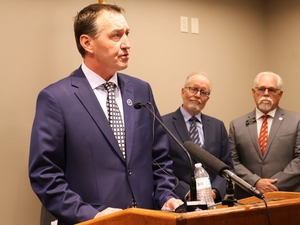
Ron DeSantis announces Alligator Alcatraz is closed, June 25, 2026. (Via DeSantis' X livestream)
‘Alligator Alcatraz,’ the state-run Everglades immigration lockup, is closed, Gov. Ron DeSantis announced Thursday, hailing the facility as a success for state and federal partnerships and the Trump administration’s crackdown on undocumented immigration.
It lasted just under a year.
Joined by Border Czar Tom Homan and Florida Immigration Enforcement Director Anthony Coker, DeSantis claimed the facility kept dangerous criminals away from Floridians (he rattled off names of migrants accused of rape and murder), exemplified how levels of government can work together, and saved taxpayers the costs of undocumented immigrants living in the state.
“Alligator Alcatraz fulfilled the role it was designed to serve,” DeSantis said, speaking outside the facility Thursday afternoon. “Today, it now has zero detainees.”
No one escaped from the center, he said, adding that it saw just under 21,000 migrants either staged, detained or deported. Another 10,000 have been processed through the so-called “Deportation Depot” center in Baker County, which the governor said remains open.
DeSantis expects that the Everglades facility will return to use as a training airport for pilots, and that the closedown will be fully completed in two weeks. This comes as Miami-Dade Mayor Daniela Levine-Cava pursues permanent environmental protection for the area, and Attorney General James Uthmeier advocates for the plot to return to the Everglades.
DeSantis’ comments came days after CBS News Miami first reported the closure, and a month after whisperings of a June shuttering. State and federal officials had maintained that while there were no “official” talks about a shutdown, the facility was always designed to be temporary. Soon after, ICE claimed detainees were simply being moved for hurricane season.
But financial, humanitarian and legal questions have plagued the center since its inception, painting a vastly different picture from the governor’s description of an ironclad facility. Instead, critics portrayed a remote, at-minimum $1 billion facility run amid disorganization and confusion, vexing environmental and human rights activists alike.
The Florida Tributary reported Thursday that leaders had no cohesive plan for the facility until recently. For weeks, the Florida Division of Emergency Management — the operating agency — had told vendors ‘Alligator Alcatraz’ would morph into a short-term transfer site facility. Then the staff was “urgently” told to shut it all down in a matter of days.
FDEM, meanwhile, revised its predictions of how much the center would cost at least three times during its first six months of operation — predicting anywhere between $1.065 billion to $1.4 billion, most recently estimating that both detention facilities would rack up a $1.7 billion tab.
That figure appears to be closest to the truth: FDEM signed at least $1.01 billion in contracts with vendors, of which more than $600 million is still owed. That doesn’t account for the tens of millions of dollars spent on travel, food, and supplies.
Environmental review
Aside from costs, advocacy groups have repeatedly sued to shut down the center largely over environmental qualms. From allegations of generators sputtering out toxic gases to failures in obtaining a federal environmental review (a court has disputed this one), the lockup has been tied up in courts across the Southeast since Uthmeier went public about ‘Alligator Alcatraz,’ his brainchild.
The tab for these activities has come out of the emergency response and preparedness fund, a 2022 creation designed to allow DeSantis to quickly spend money on disasters without needing legislative approval. But when he expanded emergencies to include immigration in 2023 — and has renewed that declaration at least 20 times since — it opened the fund to pay for immigration enforcement.
According to the state’s government accountability website, the fund had roughly $187 million in its coffers at the start of July 2025, when ‘Alligator Alcatraz’ first opened. And while another $807 million was pumped in since then, more than $814 million has been disbursed from the fund on immigration, hurricanes, evacuation flights and other declared disasters.
Roughly $108 million remains in the trust.
Federally, Florida has been promised $608 million in reimbursements. They’ve so far received $58 million.
Tallahassee, FL