Miller-Meeks, Bohannan face off on abortion, immigration at 1st District debate
Oct 21, 2024 | 11:11 pm ET

Description
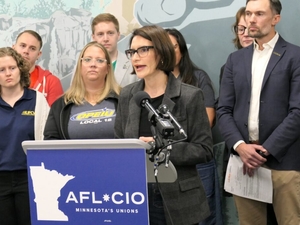
1st Congressional District candidate Christina Bohannan, left, speaks during a debate with Republican incumbent Mariannette Miller-Meeks hosted by Iowa PBS on Oct. 21, 2024, in Johnston. (Pool photo by Lily Smith/The Des Moines Register)
Republican incumbent Mariannette Miller-Meeks and Democrat Christina Bohannan, running in Iowa’s 1st Congressional District, exchanged heated arguments Monday about their positions on abortion and immigration policy during a televised debate.
The “Iowa Press” debate started off with Bohannan and Miller-Meeks sparring about their positions on abortion. Bohannan said Miller-Meeks supported the six-week abortion ban currently in effect in Iowa, a measure she characterized as “one of the strictest in the country.” The law restricts abortions after fetal cardiac activity can be detected, as early as six weeks of pregnancy, with exceptions for rape, incest and to save the life of the mother.
Though Miller-Meeks was not in the Iowa Legislature in 2018 or 2023, when the two versions of the so-called “fetal heartbeat” law passed, Bohannan said her opponent “touted” the measure on the campaign trail, in addition to supporting a more restrictive abortion ban at the federal level.
However, Miller-Meeks said the legislation she co-sponsored — the “Life at Conception” Act — is not an abortion ban. The measure would guarantee a “right to life” for every human and state that human life begins at conception. It does not specify exceptions to this legislation, but does not authorize the prosecution of women who have an abortion. The measure did not come up for a vote.
Though the measure does not explicitly mention abortion, Bohannan said defining life as beginning at conception would effectively ban all abortions in the country.
“Everybody knows this, it is a personhood bill,” Bohannan said. “It creates the full rights of personhood at the moment of conception. Everybody knows that the legal consequences of that is a complete … abortion ban with no exceptions across the country, that is exactly what people knew they were signing on to when they signed on to it.”
Miller-Meeks said she supports exceptions for abortion bans, and said Bohannan was “lying” about the Republican’s record on abortion. She also pushed back against criticism of her support for exceptions for the “life” of the mother instead of the “health” of the mother.
Miller-Meeks said she believed the two words in legislation had “very similar” definitions, and said she did not agree with arguments from some doctors and reproductive health care advocates that “life” language prevents doctors from performing abortion procedures until the pregnant person is near death.
Speaking with reporters after the event, Miller-Meeks said she believed most doctors are “well aware” of which abortions would fall within these legal requirements. She said families who have shared stories about physicians not performing the procedure in life-threatening situations due to concerns about legal ramifications should pursue legal actions.
“I think most physicians have clear guidance,” Miller-Meeks said. “And you would have to ask that physician, is that physician for abortion or against abortion? For restrictions or against restrictions? But I think it’s very clear physicians know. I’m not an obstetrician, but even I would know when to step in. So I think that there is guidance.”
Miller-Meeks also said Bohannan’s position on abortion was extreme, allowing for abortions up until the time of birth. Bohannan said she would support a federal return to the Roe v. Wade standard that was overturned by the U.S. Supreme Court.
“What my opponent just said was to refuse to answer whether or not there were any restrictions or limits on abortion,” Miller-Meeks said. “Roe v. Wade does not have limits or restrictions on abortion.”
The two candidates are facing off for Iowa’s 1st Congressional District seat, representing much of southeast Iowa including the cities of Iowa City, Davenport and Fairfield. The race is one of the most competitive in the country, one of 26 marked as a “toss-up” by election forecasters like Cook Political Report. These races have the potential to decide control of the U.S. House in 2025. Alongside the 1st District race, Iowa’s 3rd Congressional District is also considered a competitive race.
With increased national attention, there has been high fundraising and spending in the 1st District: Bohannan raised more than $1.8 million and spent $3 million in campaign funds in the Federal Elections Commission quarterly report ending Sept. 30, and Miller-Meeks’ raised $1 million and spent $1.2 million.
In addition to sparring over abortion, the two candidates also challenged one another’s records on the issue of immigration and border security. Both candidates said they supported securing the U.S. southern border and making changes to the legal immigration system, but disagreed on the best ways to implement these goals.
Bohannan said she would have supported the bipartisan immigration package that failed to be taken up in the U.S. House, pointing to Republican support for the measure in both chambers.
“This is what we have, we have people who talk about solving these problems, but … when it comes down to it, they don’t want to do anything about it, because they want to keep playing politics with this issue,” Bohannan said. “And this is an example where, you know, Rep. Miller Meeks voted against a bill — or refused to even vote for it in a bill — that actually could make a big difference.”
But Miller-Meeks said she took action on immigration — voting for the Secure the Border Act of 2023 backed by House GOP that was not taken up by the U.S. Senate — whereas the bipartisan package was never brought forward. She also claimed Bohannan supported sanctuary cities and organizations that sought to abolish ICE.
“My opponent didn’t mention the border, didn’t say anything about the border, didn’t say the border should be secure, until it became a political liability for her and her party,” Miller-Meeks said.
Another important topic discussed at the Monday night debate was economic goals for Congress in the upcoming year — plans that could be subverted based on who wins the White House and each chamber of Congress. Miller-Meeks called for renewing the Trump tax laws passed in 2017 that are set to expire at the end of 2025. The end of these tax laws would mean the expiration of higher child care tax credits provided under the law, and Republicans say could hurt the budgets of many low- and middle-class families.
Bohannan said she believed Congress should pursue a different tax policy.
“Look, that was in 2017, that was seven years ago — a lot has happened,” Bohannan said. “COVID has, you know, largely changed our economy, and a lot about our economy. So we need to look holistically (at) our tax system, and what we need to make sure … it is working for the middle class. You know, my opponent has supported tax cuts for the ultra wealthy or billionaire donors for corporations, and I think that we need to have a tax system that has everybody pay their fair share, and would never support raising taxes on middle class.”
Concerns about the expiring tax bill have become even more prominent in this year’s election discussions, as many families across the country struggle with inflation and high costs of living. Bohannan said that the federal government should “claw” back some of the unused COVID-era relief funds that remain undispensed, stating that returning the money to other funding needs could help bring down debt and help create a stable economic environment.
But Bohannan also argued that some of the inflation in costs that Iowans are seeing at the grocery store is not because of high government spending, but because of corporations keeping prices high in the wake of the pandemic even after the supply chain issues causing the initial jump were resolved.
Miller-Meeks said that Bohannan’s argument was to her favor, as the price gouging and high inflation after the pandemic came during President Joe Biden’s time in office.
“You’re making my point on why people should reelect Donald Trump and why they should reelect me,” Miller-Meeks said. “And that is, if companies were afraid to price gouge under President Trump, maybe he should be back in the White House. Companies only price gouge under President Biden.”
This story has been updated to clarify that the Life at Conception Act did not come up for a vote in the U.S House.

Des Moines, IA