Migrants detained at ICE facilities launch hunger strikes to protest conditions
May 29, 2026 | 4:54 pm ET
Description
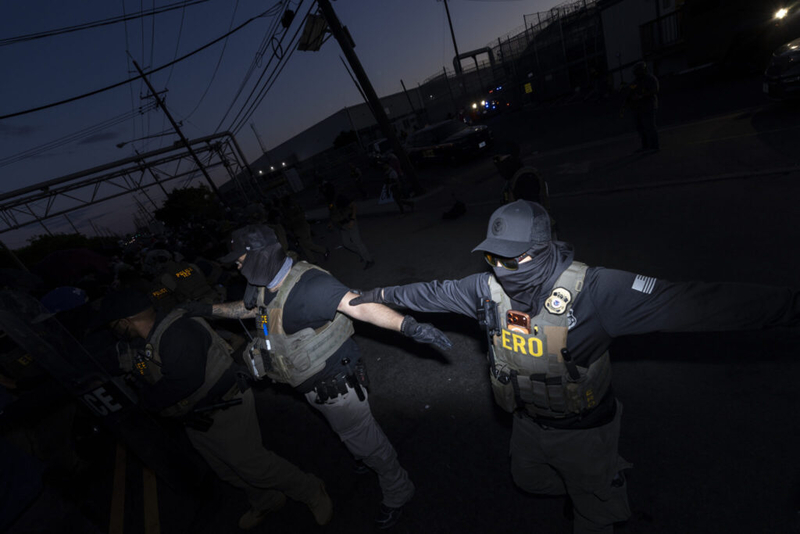
ICE agents link arms outside Delaney Hall in Newark, N.J., on May 28, 2026. An ongoing hunger and labor strike at the 1,000-bed migrant detention facility reportedly involves roughly 300 people and has sparked daily protests outside. (Photo by Anne-Marie Caruso/New Jersey Monitor)
In at least four states, migrants detained in ICE facilities have launched hunger strikes in recent weeks to protest the conditions in which they are being held.
An ongoing hunger and labor strike at the 1,000-bed Delaney Hall facility in Newark, New Jersey, reportedly involves roughly 300 people and has sparked daily protests outside the jail, which is owned and operated by the GEO Group, a private security company that provides security, maintenance, food and medical care under a 15-year contract with U.S. Immigration and Customs Enforcement (ICE).
Earlier this month, it was reported that at least 20 detainees at the 750-bed Desert View Annex in Adelanto, California, had launched a hunger strike to call attention to what they allege are substandard conditions at that facility, including a lack of medical care, unsafe drinking water, and mold.
And last month, hunger strikes reportedly erupted at the 1,800-bed North Lake Processing Center in Baldwin, Michigan, and at the Moshannon Valley Processing Center in Clearfield County, Pennsylvania, which has a capacity of nearly 1,900. North Lake is the largest facility in the Midwest, and Moshannon Valley is the largest in the Northeast.
The GEO Group operates all of the facilities where the hunger strikes have taken place.
Families of migrants detained at Delaney Hall say their relatives are being tear gassed and beaten by guards. Outside the facility, ICE agents have countered protesters with pepper spray, the New Jersey Monitor reported.
In a statement on Thursday, New Jersey Democratic Gov. Mikie Sherill said the New Jersey Department of Health tried to conduct a health inspection of Delaney Hall, but was denied access to all but a limited portion of the facility. Sherill said Delaney Hall should be shut down.
“Refusing to provide full access raises serious questions about what ICE is trying to hide from public view,” she said in the statement. “I am calling for ICE to immediately de-escalate the situation as I continue working to keep New Jersey residents safe.”
ICE issued a statement dismissing the accusations of substandard conditions at the facilities as a “hoax.”
“All detainees are provided with 3 meals a day, clean water, clothing, bedding, showers, soap, and toiletries. Illegal aliens also have access to phones to communicate with their family members and lawyers,” the statement says. “Certified dietitians evaluate meals. In fact, ICE has higher detention standards than most U.S. prisons that hold actual U.S. citizens.”
In a statement, the GEO Group asserted that its support services “are monitored by ICE, including by on-site agency personnel, and other organizations within the Department of Homeland Security to ensure compliance with ICE’s detention standards and contract requirements regarding the treatment and services ICE detainees receive.”
For the last few days, Gabriela Fuentes, 35, has protested outside Delaney Hall. She said her husband, who came to the U.S. from Guatemala on a work visa, told her recently that the guards had beaten and tear gassed him and other detainees.
“We’re all human, we’re all people, just because we’re Hispanic does not mean that we need to be treated like this,” Fuentes said.
Haddy Gassama, senior counsel at the American Civil Liberties Union, described the hunger strikes as “the natural consequence of a detention system that’s really falling apart at its seams.”
“Hunger strikes are a tool that people use when they are most desperate, where they feel that they have no other options,” Gassama said. “It’s really the natural consequence of what happens when you supersize a detention system that’s already rife with abuse so fast, with so much money, with so little accountability.”
Voluntary departures spike as immigrants face squalid detention, pressure to leave
Jasmine Rivera, executive director of the immigrant rights group Pennsylvania Immigration Coalition, said it’s hard to get a handle on the scope of the hunger strikes in Pennsylvania and elsewhere.
“Upon the hunger strike, the detention center stopped communication lines to that particular unit, so it’s hard for us and for family members to stay up-to-date on what was happening,” Rivera said.
In Michigan, Ruby Robinson, an attorney at the Michigan Immigrant Rights Center, called for more state oversight of ICE detention facilities.
“It’s our understanding that they do not really have the means to adequately provide the oversight that’s needed, and outside of that, we don’t really see any other oversight, besides visits from members of Congress,” Robinson said.
“Because many immigrants are being detained in county jails, not just private detention facilities, there’s an opportunity to ensure that state law is followed. And if state law is insufficient, then it needs to be updated to basically reflect reality.”
This story was updated to include a statement from the GEO Group.
Stateline reporter Shalina Chatlani can be reached at [email protected].