Michigan’s U.S. Senate primary highlights divisions within Democratic Party
Jun 09, 2026 | 4:00 am ET
Description
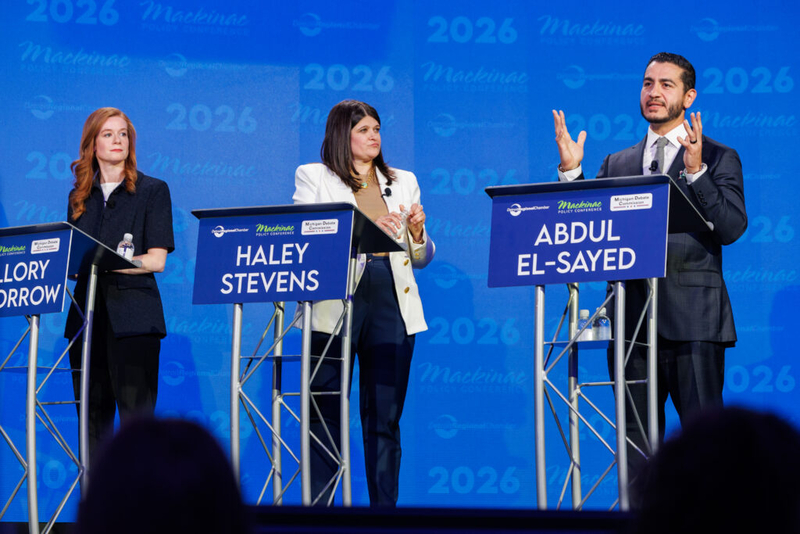
State Sen. Mallory McMorrow, left, U.S. Rep. Haley Stevens, center, and former Wayne County Health Director Abdul El-Sayed, right, participate in a U.S. Senate candidate debate during the Mackinac Policy Conference on Mackinac Island, Mich., on May 28, 2026. (Photo by Andrew Roth/Michigan Advance)
The path to a Democratic Senate majority runs directly through Michigan, where U.S. Rep. Haley Stevens, state Sen. Mallory McMorrow, and former Wayne County Health Director Abdul El-Sayed are disagreeing on how to handle key issues, with the Aug. 4 primary less than two months away.
Mike Rogers, the Republican nominee, has secured $45 million in outside spending and ensures the winner of the Democratic primary will face one of the best-funded Republican campaigns in the country.
“If we lose this seat to Mike Rogers, there is no path for Democrats to flip control of the United States Senate,” McMorrow said. “All control rests on Michigan…all eyes are on us.”
Democrats are widely expected to gain control of the House of Representatives in November. The Senate, however, is forecasted to be a tossup. Democrats need to gain four seats while not losing any of the four up for election, including Michigan.
U.S. Sen. Gary Peters (D-Bloomfield Township), the two-term incumbent who is not seeking reelection, has declined to endorse a successor, but said he hopes whoever wins is willing to work with both sides of the aisle.
“A good Democrat—but someone who’s willing to work in a bipartisan way to get things done,” Peters said at the U.S. Capitol June 2 when asked about the values his successor should embody.
David Dulio, a political science professor at Oakland University who attended the debate between the three candidates at the Mackinac Policy Conference last month, said the race reflects the broader struggle over what direction the Democratic Party will take in the future.
“This race is shaping up to be a battle for where the Democratic Party is headed,” Dulio said. “There are two separate factions at this point.”
Immigration and ICE
The candidates’ positions on U.S. Immigration and Customs Enforcement and the question of its abolishment have drawn some of the sharpest contrasts in the race.
“I’m the only candidate who’s clear-eyed about ICE—to recognize it can’t be reformed or retrained,” El-Sayed, whose parents immigrated from Egypt, said. “They need to be abolished.”
McMorrow has not called for the abolition of ICE, but criticized the agency’s conduct during the Trump administration and has called for reforming the agency.
During a phone interview, Stevens touted a bill she introduced in the U.S. House of Representatives titled the “Hold ICE Accountable Act of 2026.” Specifically, it would appoint a special prosecutor to investigate actions conducted by ICE and U.S. Customs and Border Protection during President Donald Trump’s second term.
Stevens was criticized by McMorrow and El-Sayed for voting in favor of a resolution condemning a flamethrower attack on a pro-hostage-release group in Colorado last year—a resolution that also sought to thank law enforcement officers, including ICE personnel, for “protecting the homeland.”
“The title of the resolution was called Condemning an Anti-Semitic Terrorist Attack in Boulder, Colorado,” Stevens said. “Republicans did put in a cynical line about thanking ICE … I am always going to call out political violence and extremist violence.”
Corporate money and outside spending
A major point of contention among Democratic candidates across the country concerns whether they have previously accepted money from corporations.
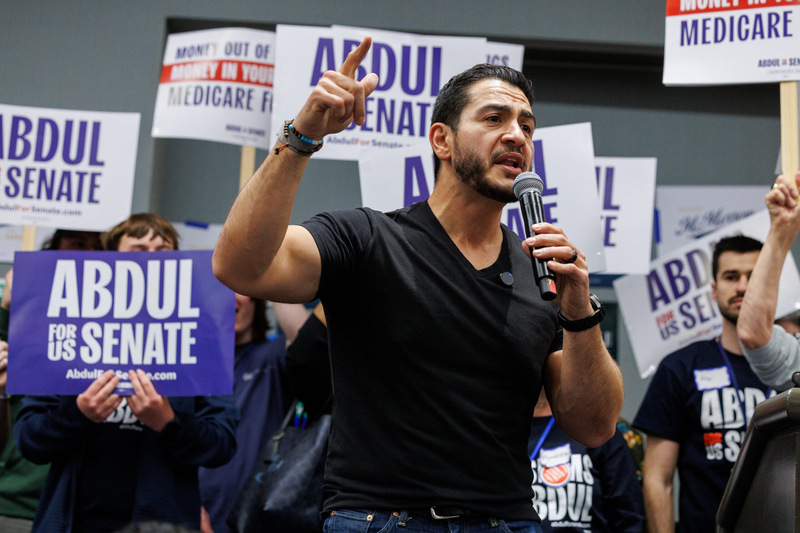
El-Sayed and McMorrow have both pledged not to accept corporate PAC money.
“I’m the only candidate in my race who’s never taken a dime from a corporation, Democrat or Republican,” El-Sayed said, referring to McMorrow previously accepting corporate PAC money in her state legislative campaigns despite pledging to not do so for her U.S. Senate campaign.
Stevens has accepted money from corporate political action committees and significant outside spending from the American Israel Public Affairs Committee, or AIPAC, the pro-Israel lobbying organization.
Dulio said support from AIPAC has become a particularly divisive issue in Democratic politics more broadly.
Most Republicans are just pulling out the popcorn and encouraging them to keep at it.
“The AIPAC issue is a wedge in current Democratic politics, and it’s not going away,” Dulio said, referencing Stevens’ longtime support by the organization. “They are aligned on substance when it comes to Israel and the Middle East, there’s no denying that.”
Jason Roe, a Michigan-based Republican political strategist who has worked on Mitt Romney and Marco Rubio’s presidential campaigns, said the AIPAC spending was an asset for Stevens even though El-Sayed has attacked her for it.
“I don’t think there’s a long‑term risk to her to be supported by those AIPAC dollars, and really the only opportunity for anybody to take advantage of that is in the primary,” Roe said.
However, Marina Martinez-Kratz, a retired nursing professor from Chelsea who attended an El-Sayed campaign event, said the AIPAC spending in the race played a critical role in her assessment of the candidates.
“I’m really disgusted with all the AIPAC money that’s coming in to support her candidacy,” Martinez-Kratz said of Stevens. “Why would we in Michigan need a senator that is supported by AIPAC, and what would that say about us?”
Gaza and foreign policy
The Democratic National Committee released its autopsy of the outcome of the 2024 election last month, and it was widely criticized for not mentioning the war in Gaza as a contributing factor to Kamala Harris’ loss. Polling after the election suggested the Biden administration’s support for Israel during the war in Gaza led many voters in 2024 to reject Harris.
“It’s delusional to think it didn’t play a role,” said El-Sayed. “It shaped so much of how you understand someone’s moral character.”
An example of the fallout of the Gaza war on the 2024 election was how Dearborn, the first Arab-majority city in the U.S, voted. Trump won Dearborn with 42% of the vote, according to a Detroit Public Radio report. Third-party candidate Jill Stein received 18% of the vote, more than anywhere else in Michigan.
On foreign military aid, El-Sayed said he opposes unconditional aid packages to any country and would support aid depending on compliance with international law.
“Unconditional foreign military aid, to me, should be abolished,” El-Sayed said. “In the case of Ukraine, there is a clear international law reason why we’re supporting the Ukrainian military at this time, because they’re standing up against an autocrat who violated their territorial sovereignty.”
Stevens and McMorrow have not called for halting aid in the same terms. However, McMorrow has said she would have supported a resolution by Sen. Bernie Sanders (I-Vermont) to block arms sales to Israel.
Senate leadership
Although Democrats hope to seize power in Congress during the midterms, the Democratic Party this spring polled at 39% approval among Americans, up from a low of 36% last August.
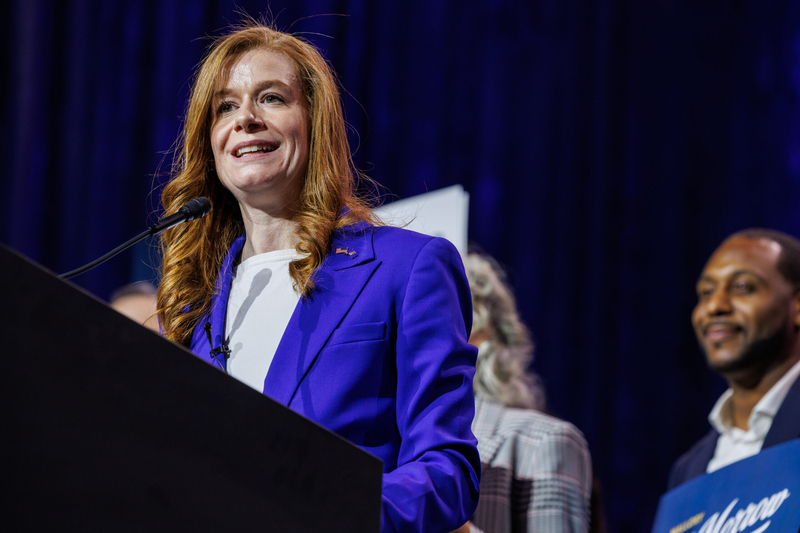
McMorrow has been the only candidate to say that she definitively would not support Senate Minority Leader Chuck Schumer (D-New York) if she were to be elected. She criticized Schumer for being too passive.
“We need new leadership in this party,” McMorrow said. “[Schumer] said, ‘don’t worry, [Republicans’] polling numbers will come down, and we’ll just get them in the midterms.’ That to me is not meeting this moment.”
McMorrow stopped short of announcing support for an alternative candidate, but praised Sen. Chris Murphy (D-Connecticut) as an example of effective opposition.
“I’ve watched Senator Murphy use social media to call out the grift and corruption in a way that I’ve been really impressed by,” McMorrow said. Murphy endorsed McMorrow in January.
El-Sayed did not commit to opposing Schumer and said it depends on the alternative options available.
“The better question is not about where you stand on Schumer, it’s about where Schumer stands on you,” El-Sayed said. “I’m the only person that Chuck Schumer has said he cannot abide in the U.S. Senate, which is exactly why people who cannot stand that kind of politics should support me.”
El-Sayed added that he would support Sen. Chris Van Hollen (D-Maryland) as an alternative to Schumer.
Stevens has avoided saying whether or not she supports Schumer, telling Semafor Michiganders “don’t need me talking about inside baseball,” when asked.
Electability and the general election
All three candidates have made the argument that they are the best choice to beat Mike Rogers in November.
“As every poll will show you, I’m in the best position to go and beat Mike Rogers in the fall,” Stevens said, who emphasized her congressional experience and endorsements from labor unions.
McMorrow pointed to her 2018 victory in a competitive state Senate district over an incumbent Republican as evidence of her ability to win close races.
“We swung a district 20 points in a single cycle,” McMorrow said. “I then helped flip control of our entire state senate to Democrats for the first time since 1984… I can beat [Rogers].”
El-Sayed argued his platform, despite being progressive, should speak to voters who feel underrepresented by both parties.
“Michigan went for Bernie before it went for Trump in 2016, then it went for Biden, then it went for Trump again,” El-Sayed said. “Do you think that the voters in Michigan are schizophrenic, or do you think that they haven’t had an opportunity to vote for what they really want?”
El-Sayed said voters he has spoken to are more interested in a candidate that represents their struggles than a candidate that matches their political ideology.
“I offer that in my campaign,” El-Sayed said.
Roe said he hopes El-Sayed wins because he thinks Republican candidate Rogers would easily beat him.
“I think Republicans are rooting for Abdul El-Sayed,” Roe said. “Our sense is that a lot of his views are far out of the mainstream, and that he just has less crossover appeal in a general election.”
However, Dulio said the question of who is most electable is genuinely unsettled.
“I don’t think there’s any arguing with the fact that Haley Stevens as the nominee provides an easier path for Democrats,” said Dulio. “But as he has shown it, El-Sayed is charismatic and built for the spotlight.”
“I think that El-Sayed has just as good a chance as anybody else to beat [Mike Rogers] out of the three candidates that are running,” said Martinez-Kratz.
Republicans, meanwhile, are watching closely.
“Most Republicans are just pulling out the popcorn and encouraging them to keep at it,” said Roe.
Lansing, MI