Michigan’s Thanedar may have violated STOCK Act again with unreported crypto stock purchase
Aug 14, 2025 | 3:03 pm ET
Description
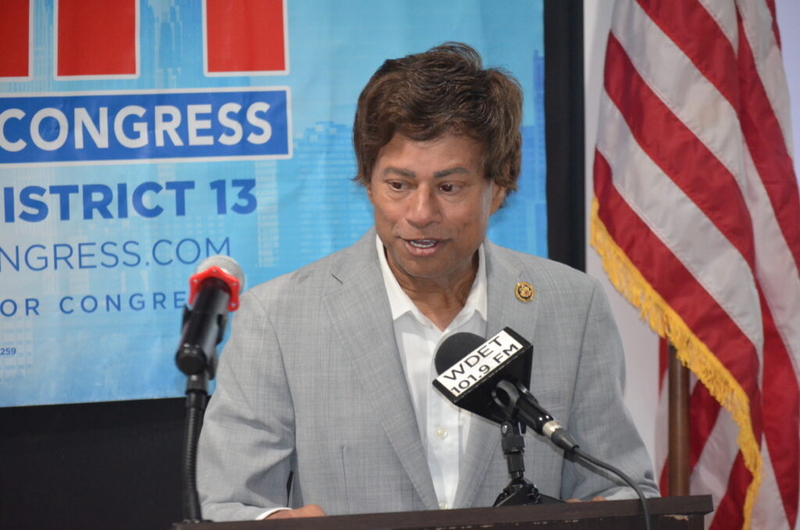
U.S. Rep. Shri Thanedar speaks at his election night party in Detroit on Aug. 6, 2024 | Ken Coleman
U.S. Rep. Shri Thanedar (D-Detroit) failed to publicly report the purchase of up to $50,000 in stock shares purchased from a well-known proxy for cryptocurrency holdings, a violation of a law created to prevent conflicts of interest and increase transparency around lawmakers’ stock trades.
A periodic transaction report filed this week with the clerk of the U.S. House of Representatives shows Thanedar purchased common stock in MicroStrategy Incorporated in an amount ranging from $15,000 to $50,000. The report date and its notification date listed the purchase as occurring more than a year ago on July 1, 2024.
The transaction type was listed as a stock purchase, but MicroStrategy is well-known as a Bitcoin treasury and the largest corporate holder of the cryptocurrency, owning 423,650 bitcoins worth $42.43 billion, according to a CNBC report published in 2024.
The Stop Trading on Congressional Knowledge (STOCK) Act of 2012 does not ban trading for sitting federal lawmakers, but it does require them to disclose stock purchases of more than $1,000 within 45 days.
Violations of the act are rectified through fines against lawmakers starting at $200 per violation.
In an interview with Michigan Advance on Thursday, Thanedar said the MicroStrategy stock buy was something that his wife purchased and was something that he just became aware of recently.
“As soon as I became aware, I reported it,” Thanedar said. “[People are] trying to make it like this was intentional, but it was not. … I have also been reporting my crypto holdings for years, so there’s no particular reason to not report this one transaction under $50,000, when I had reported other transactions within minutes [of those purchases].”
As far as penalties for any potential violation of the law, Thanedar said he has not had any communication with the U.S. House Ethics Committee. Thanedar indicated that he was willing to pay the fine if he had to.
The congressman also reiterated that he reports all his stock holdings in a timely manner, and although this one fell through the cracks, it did not represent a pattern.
“If my delay of reporting one stock caused a problem, then, if there is a consequence, I would pay for it,” Thanedar said. “It’s less than 1% of what was not reported, this one stock is one out of maybe 500 or 1,000. I don’t know how many individual stocks I have.”
Although Thanedar is nowhere near the Top 10 wealthiest members of Congress, he is ranked No. 30 with a net worth of $40.97 million out of the 457 members, according to a list compiled by Quiver Quantitative, a website that tracks alternative data for trading trends and analysis.
News of the purchase and the potential violation related to the MicroStrategy stock was first reported by NOTUS, a nonprofit news organization based in Washington, D.C. Other reports show that this was the second time since 2023 that Thanedar potentially violated the STOCK Act.
Thaendar told NOTUS that he plans to direct his financial advisors to no longer invest in individual stocks and to sell off the ones that remain. The congressman, however, was less committed to that plan when speaking to the Advance on Thursday.
“I’m just like any other investor, and I have been investing in stocks for 30 or 40 years now, way before I became a public servant,” Thanedar said. “When I talked to the agent, I was wondering aloud about was it worth even doing this, and is it better for me to just get out of stock so there are no misunderstandings of my intent.”
When asked about his advisors’ response to that question, Thanedar said he was advised that it was not financially wise to just dump stocks like that.
“If I direct them to, they will, but this is not financially smart,” Thaendar said.
Asked whether he planned to do that or if it was something he was just taking under consideration, Thanedar told the Advance that he was talking with advisors about whether it was worth the perception questions that surround holding individual stock.
The late report also raises questions about Thaendar’s cryptocurrency holdings and a potential conflict of interest given that the congressman is a member of a cryptocurrency subcommittee that has been exploring the expansion of digital coins as a major new asset. He recently voted for three pro-cryptocurrency bills that provide a regulatory framework for digital markets and stablecoins, complete with consumer and financial privacy protections.
Thanedar told the Advance that he didn’t see his holdings in cryptocurrency as a conflict of interest because he’s been investing in the area since 2017, and that his recent purchases were not related to any of his work on cryptocurrency in Congress.
“I believe in a digital future,” Thanedar said. “Digital currency is the future. I believed that in 2017 and I believe it today. … I have invested in this before I was a member of Congress and even if I invested now as a member of Congress, I really don’t see an issue.”
Lansing, MI