Michigan Republicans are pretending to run for governor
Dec 02, 2025 | 7:00 am ET
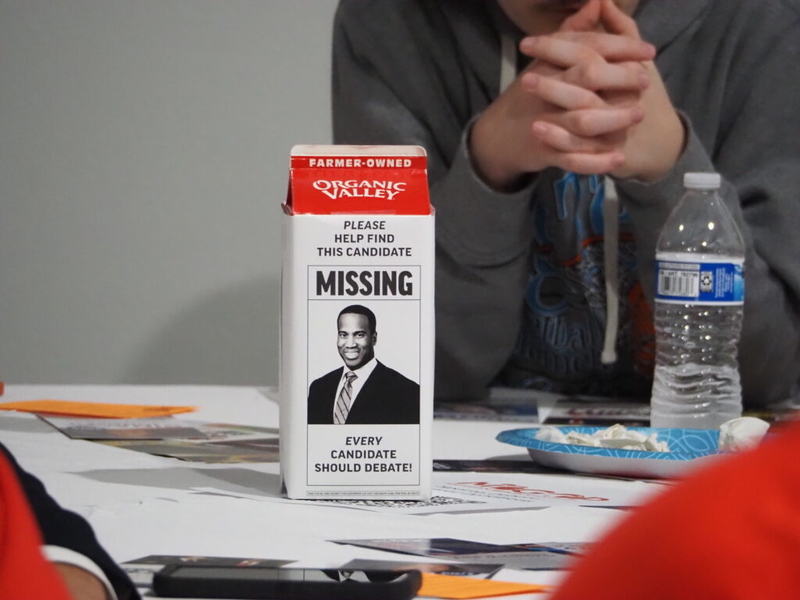
Description
A milk carton with a 'missing' poster of U.S. Rep. John James (R-Shelby Township) that supporters of Michigan Senate Minority Leader Aric Nesbitt brought to Michigan Republican Party gubernatorial debate in Sparta, Mich. James was invited but did not attend. Oct. 29, 2025 | Photo by Ben Solis/Michigan Advance
Nine months out from the 2026 Michigan gubernatorial primary, contenders for the Republican nomination are running like they have all the time in the world.
You would be forgiven for thinking Michigan isn’t even holding an election for governor in 2026. While the race exists on paper, in press releases and in campaign finance filings, few of the candidates have full-time staff, have spent meaningful money or have done anything more than make the rounds at rubber-chicken dinners hosted by county Republican parties.
Republicans have a reasonably long front bench. Congressman John James, state Senate Minority Leader Aric Nesbitt, former Attorney General Mike Cox and former Speaker of the House Tom Leonard all bring experience, fundraising capability and established networks of support. The others — who I won’t even name — are unlikely to make the ballot.
And yet, for all the theoretical strength, almost none of these campaigns resemble a serious statewide operation.
Republicans, if they want to take back the governor’s office, must start running a real race.
The political dynamics of 2026 — an open seat after eight years of Democratic Gov. Gretchen Whitmer and an electorate that remains deeply divided — theoretically favor a strong Republican nominee. Add in the wildcard of Detroit Mayor Mike Duggan’s faux independent bid and the race is even more ripe for a win.
But that nominee must first run a campaign worthy of the office.
That means hiring real staff and putting them out front. It means building out an organization in all 83 counties. It means spending money instead of hoarding it. And it means making a public case for why each candidate should be governor, instead of waiting for a Truth Social notification that may never come.
Ask party insiders who is actually managing these campaigns and the answer is often a shrug, followed by a comment about consultants “helping informally.” Aside from an occasional press release touting how much cash they’ve raised, the kind of structure expected at this stage simply isn’t there.
Endorsements are similarly scarce.
Normally by now, you would see state legislators, party officials and grassroots activists pick sides. You would expect candidates to have a chair in every county. As of this writing, only Leonard and Nesbitt have released endorsements — and even then, we’re talking about a handful of names, maybe a dozen at most. Do any of these campaigns even have a statewide steering committee, let alone a campaign chairman? The silence is telling.
Contrast that with Lieutenant Gov. Garlin Gilchrist II and Secretary of State Jocelyn Benson. Not only do the two Democrats do a stronger job touting endorsements, but their campaigns also appear to exist beyond the confines of social media feeds.
Among Republicans, it feels as if nobody wants to do anything substantive because President Donald Trump might post a late-night endorsement on Truth Social, thereby ending the race before it truly starts.
If that’s the strategy, it rests on shaky ground.
Trump’s 2026 endorsements have mostly focused on races for Congress. Whatever he ultimately decides, there’s little evidence he’s preparing to wade into the Michigan GOP’s gubernatorial primary. And even if he does, candidates cannot run a statewide campaign in a battleground state by holding their breath until absentee ballots drop in June.
Elections are won by the candidates who show up. Right now, the would-be standard-bearers for Michigan Republicans aren’t showing up nearly enough.
Lansing, MI